

So, what tires are we running next year?


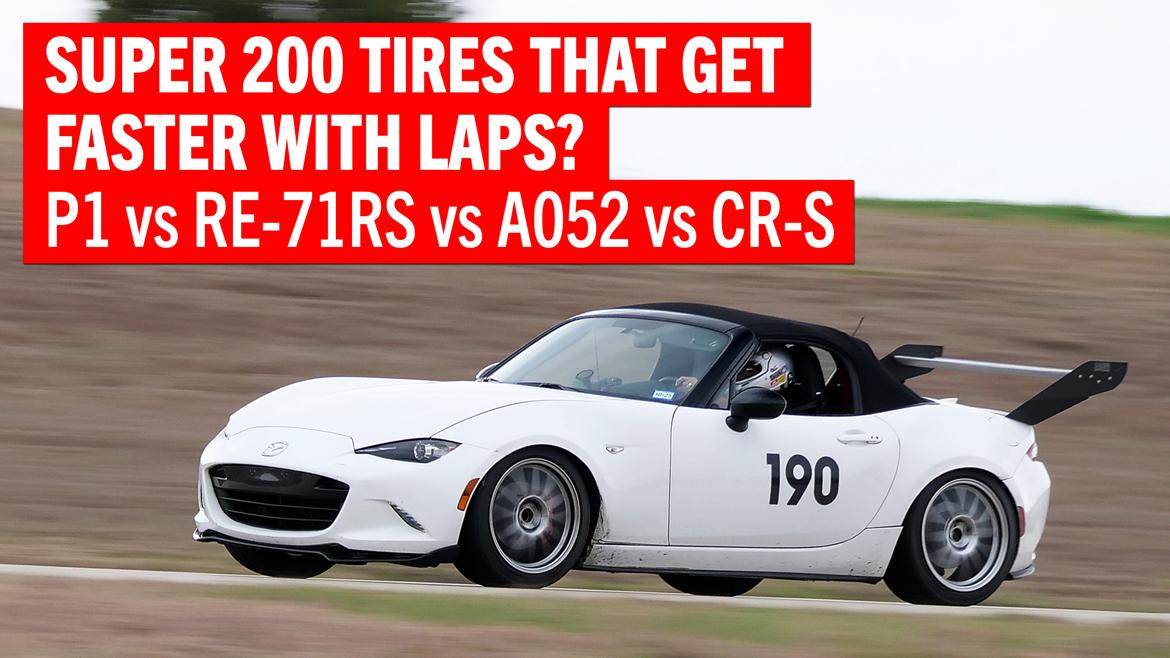
Photograph by Timothy Harper
Is today’s hot tire tomorrow’s also-ran?
While our regular tire tests usually feature new rubber, we also cycle through the faster ones for our own track days and competition–just like we all do.
Over the past year, however, we added something special, periodically checking in on those tires with measured testing so we could monitor their life cycles: What happens to our favorite Super 200 track tires as they age?
[Tested: How tires perform on track as they wear]
Welcome to the very first GRM Long-term Super 200 Tire Test. In addition to pace and durability trends, we’ll also share other subjective insights as a user’s guide for each model–some learning gleaned from our testing, some from other trusted sources.
This story begins with last fall’s comparison of today’s top contenders in the Super 200 class: Vitour Tempesta P1 P-01R, Yokohama Advan A052 and Nankang Sportnex CR-S. All of the tires–size 245/40R17–were tested at their full 7/32-inch tread depths, and in that test, the Vitour P1 was clearly a step ahead of the others on single-lap pace. We also ran the Bridgestone Potenza RE-71RS that same day, just after the bracketed testing that we published.
What would that picture look like as the four tires saw track time? To find out, we’d then regularly rotate through the tires on our Mazda MX-5 track mule during our own outings. Given that daily track conditions can vary due to weather and recent use, directly comparing that objective lap time data is not useful. The subjective impressions, though, were logged, and we started to see some trends.
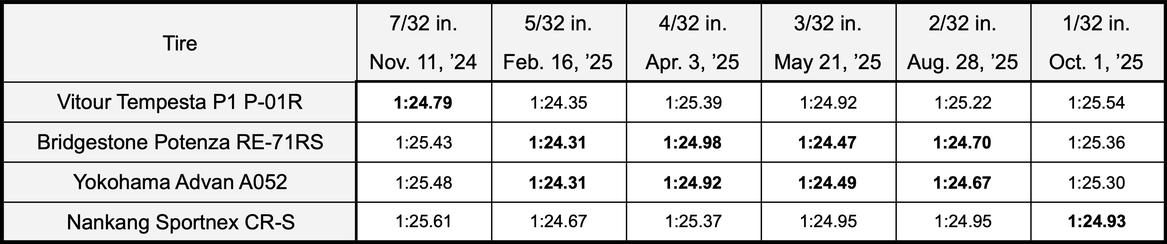
At key wear points, we’d then get the same four tires back together for full-on, head-to-head retests. How did our four Super 200 tires now compare at reduced tread depths?
The first of these retests occurred in mid February: at 5/32-inch tread depth for all four tires, the Yokohama A052 and Bridgestone RE-71RS had caught up to the Vitour P1. The Nankang CR-S also went quicker than before but still lagged a few tenths behind.
By April, all of the tires showed 4/32 inch of tread, so we again ran the entire group on one day. The Nankang CR-S now ran with the Vitour P1, but the Yokohama A052 and Bridgestone RE-71RS outpaced them both by nearly half a second.
Throughout the summer, we repeated this pattern with checkpoints at 3/32 and 2/32 inch. The pace deltas between the Vitour P1, Yokohama A052 and Bridgestone RE-71RS remained the same, but the Nankang CR-S began to find a bit more speed.
One final test was performed at 1/32 inch. By then, all of our tires had seen a lot of heat cycles but were still delivering quick pace. However, the signs said that the end was near with further full comparisons futile.
While still quick, the Bridgestone RE-71RS and Vitour P1 were both getting edgy and required more prep laps to come in. By contrast, while the Nankang CR-S’s shoulders looked nearly slick, the tire ran better than ever–the fastest of the group.
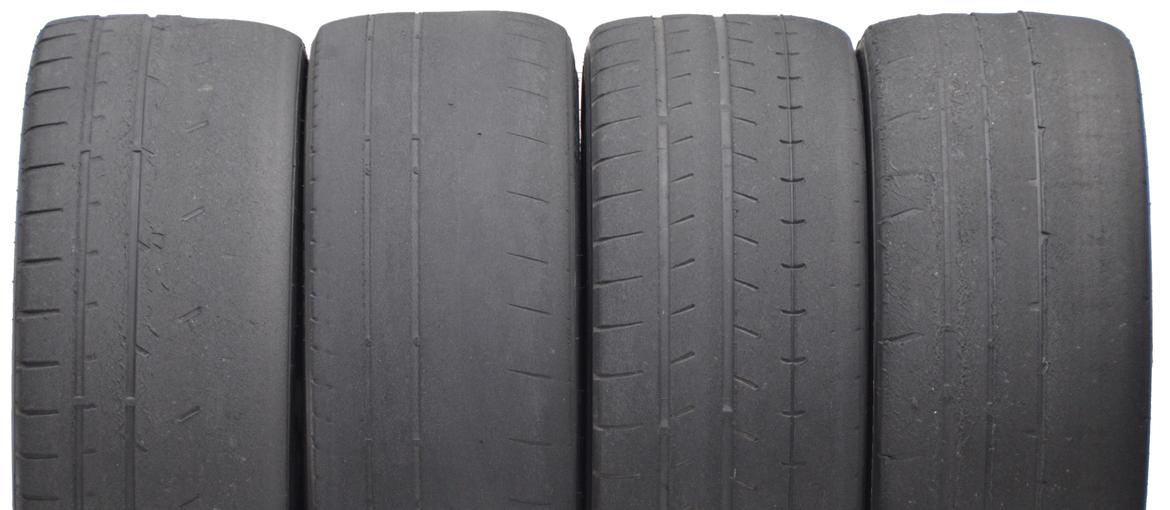
From left to right: Nankang CR-S, Vitour P1, Yokohama A052, Bridgestone RE-71RS. Photograph by Andy Hollis.
When we first noticed the relative performance trends at 4/32 inch, however, we wondered whether the Vitour P1 was simply getting slower or the others were all getting faster.
Time to test worn tires against new tires. On that same day–and it was a loooong one–we inserted sets of the full-tread Nankang CR-S and Vitour P1 into the pattern to confirm our hunch.
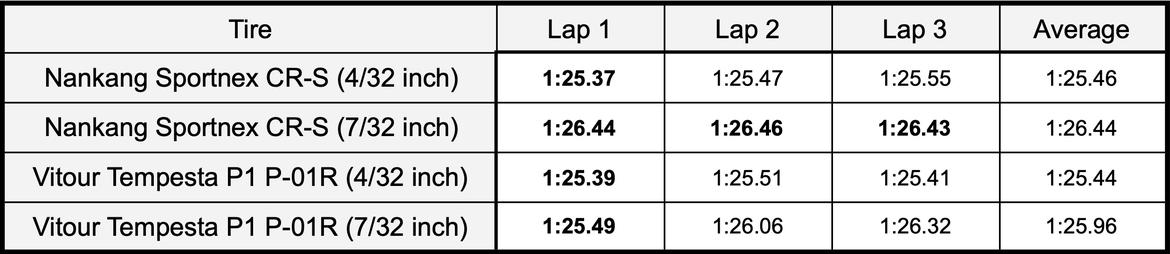
The Vitour P1 delivered the same lap times both when new at 7/32 inch and when worn to 4/32, yet the Nankang CR-S clearly ran much quicker with less tread. We also found that the full-tread Vitour P1 could only deliver a single flyer before falling off, while the 4/32 version could consistently do at least three. Nankang’s consistency was tread depth-agnostic.
To confirm this result, we did one more new-versus-worn comparison of the Vitour P1 in early August. We saw the same results: similar single-lap flyer pace for each, but less consistency thereafter with full tread. That same day, the Yokohama A052 delivered super-consistent laps at 2/32 inch–pretty amazing given the warm summer ambient temps.

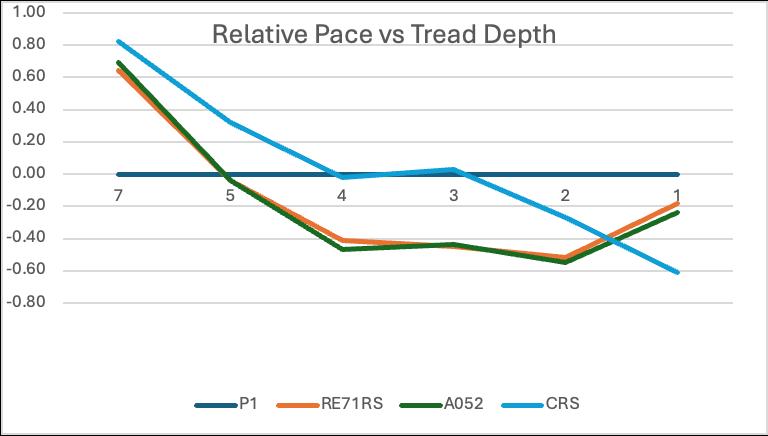
To see all of this in a graphic, we normalized each test data set using the Vitour P1 as the standard. This made sense given its long-term consistency, validated by those two new-versus-worn comparisons.
This graphic shows how each of the other tires performed relative to the Vitour P1 over time. The Vitour P1 starts off fastest, while the others get quicker as they wear. By 5/32 inch, the Yokohama A052 and Bridgestone RE-71RS are quickest, with the Nankang CR-S finally matching the Vitour P1 at 4/32. Eventually, the Nankang CR-S becomes the quickest.
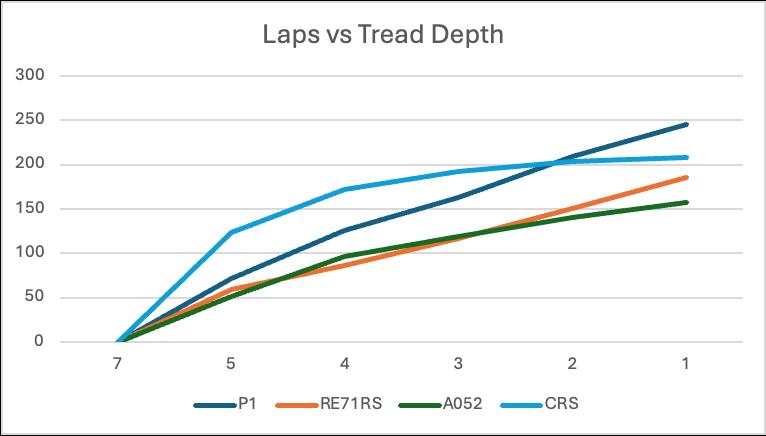
Pace isn’t everything, though, should a tire wear too quickly. How many quick laps can it deliver over time?
This next chart shows laps versus tread depth. The Vitour P1 is the durability king, followed at equal intervals by the Nankang CR-S, Bridgestone RE-71RS and Yokohama A052. Overall, the Vitour P1 delivers 50% more tread life than the Yokohama A052, but much of that is at a slower single-lap pace.
Consistency within a session is also important, since you might not be able to connect the dots on the one flyer opportunity the tire presents. The Nankang CR-S is the most consistent right out of the box, with the Bridgestone RE-71RS and Yokohama A052 catching up by the time they’ve worn to 4/32 inch.
The Vitour P1 is always quickest on the first lap where the compound has turned on, but lower tread depth or cooler track temps sometimes give it another shot or two. It doesn’t fall off that much, but delivering absolute max pace is a tricky exercise in heat management for that tire.
Let’s take our Ultimate Track Tire Guide for motorsports tires a few steps further by summarizing our findings from the past year’s testing. Plus, we’ll include some additional info, like wet-weather performance, from our trusted partners at Tire Rack.
All of these tires can get the job done when put into their optimal temperature window and kept there. Tread depth has a lot to do with that, with full-depth tread squirm generating more heat than shaved or worn rubber.
That can be a good thing for applications like autocross, where the tire needs to turn on quickly in between copious cool-down times between runs. But with the relentless pounding of track laps, that excess heat is usually bad for consistency and ultimate pace.

The Vitour P1 is ideally suited for track days and time trials. Its compound needs some energy to activate, but it hangs in there for subsequent laps even in endurance racing situations.
It’s also quite consistent on single-lap pace over the life of the tire, with reduced tread offering less drop-off due to heat soak. Cooler ambient temps also help its session consistency.
While a great track weapon, the Vitour P1 is not a smart choice for autocross except in certain circumstances where heat can be built quickly: on the front end of front-drive cars, in hot ambient conditions, on two-driver cars or at events with quick turnarounds.
The Vitour P1 had the quickest single-lap pace of the group when new, but the others caught up and passed it as tread wore off. Even with a mild initial heat cycle to condition the rubber, some cosmetic graining was evident during the first couple of uses.
The Vitour P1 comes in a variety of extra-wide, motorsports-friendly sizes. Given that it’s fairly tolerant of pinching, that may result in more rubber on the ground for many applications. It also needs less camber than some others, working well on camber-challenged vehicles.
The Vitour P1’s durable compound lasted the longest, tying it for best per-lap cost. All of this dry performance comes at a price, though, as its highway ride is harsh and its wet performance is below par.
Thanks to its super-stiff sidewalls, the Bridgestone RE-71RS delivers crisp response and quick pace even with narrow wheels or lack of camber. This makes it ideal for SCCA Street category autocross and Sport category time trials.
Its compound is more heat-tolerant than the Yokohama A052, so it can deliver more quality runs or laps without as much need for cool-down–especially at reduced tread depth. Initial full-tread use can also result in center rib graining that robs performance until it is worn off.
In addition to its dry prowess, the Bridgestone RE-71RS has strong wet performance–the best of this bunch. Its high-silica compound grips wet pavement even when cold. Only deep water and high speeds can defeat it.
While a benefit on the track, the Bridgestone’s stiff carcass results in a harsh highway ride, especially as the tread wears. It’s more durable than the Yokohama A052, but it does get edgy before the tread is all gone. Unless you’re a drifter, you’ll typically pull them out of service before any cord appears.
Sizing is somewhat limited with few extra-wide, motorsports-oriented fitments. But some of those have a reputation for being hard to mount due, again, to the very stiff sidewalls.
The Yokohama A052 has been at the pointy end of the field for almost a decade now. Its grippy compound turns on quickly–especially at full tread–which makes it ideal for autocross. But on a road course, squirm will heat-soak the tire quickly. Lower tread depths improve both pace and consistency and are recommended for optimal time trial use.
The Yokohama A052 is also very sensitive to wheel width and camber–the more, the better. It will underperform relative to the others when pinched on a narrow wheel or with insufficient camber.
The compound is also quite good in the wet, with only the shallow 7/32-inch tread depth limiting its rain performance–higher speeds and deep water can result in hydroplaning.
While mushy and numb at full tread, the Yokohama A052 gets more responsive as the tread wears. This compliance does give it a smooth and quiet ride on the highway, though.
While very quick, the Yokohama A052 is the least durable and least cost-effective tire of the bunch, especially when shaved to optimal tread depth for competition. On the bright side, it can typically be run to the cords without heat-cycling out if stored properly between uses.
The Nankang CR-S is similar to the Vitour P1 in many regards: needs heat to turn on, tolerates it well, lasts a long time and comes in a wide range of motorsports-oriented sizes. This makes it good for road course use, but less so for autocross.
As with most of the tires in our group, single-lap pace and consistency improve as tread depth decreases, though the Nankang CR-S was never the fastest for most of its life. Of note, previous test sets of this tire have performed right at the top.
[Has the Vitour Tempesta P1 earned its place among 200tw benchmarks?]
Priced below the others, the Nankang CR-S tied with the Vitour P1 as the most economical per lap, so it’s a great track day choice.
Road ride quality is soft and smooth, much like the Yokohama A052 it resembles visually. This makes it a great dual-duty street/track choice as long as significant precipitation is not in the forecast. When cooled by water, its compound will not develop full grip.

So, what tires are we running next year?
And anyone have any of those spicy 195/50R15 Toyos laying around? :)

Potential typo in the article, in the section "Top 200 Treadwear Tires: A User’s Guide" the table shows the RE-71RS twice. Presumably the second instance of it (last entry in the table) should be the CRS?
Also a question about the photo: I noticed that the CR-S shows heavy wear on the side that's to the right, while the P1 shows heavy wear on the left. Is that an actual difference in how they wore in real life, or are the tires just flipped relative to each other in the picture?

In reply to codrus (Forum Supporter) :
Actual wear. P1 was a bit more inside and CRS outside. P1 prefers less camber than CRS.

In reply to codrus (Forum Supporter) :
You would be correct, that should be the CR-S.
All fixed now, and thank you for catching that. 

Were heat cycles recorded for this test? Would be interesting to see how heat cycles correlate with pace on these tires.

“Ideally suited for track days and time trials.”
The Vitour P1 delivers the fastest laps when new, the longest life of the group, at the best cost-per-lap -- making it the most consistent and economical Super-200 track tire.
If that’s not a win for Vitour -- and for grassroots racers -- I don’t know what is.
Vitour is coming in 2026 with new product lines, aiming to bring that same “ideal” performance to even more segments of grassroots racing.
JaredFloyd said:Were heat cycles recorded for this test? Would be interesting to see how heat cycles correlate with pace on these tires.
While I did not count them up, the cycle count is pretty linear with the laps accumulated.
My typical non-test day is 3-4 10-15 minute sessions, bookended with a 45 mile drive to/from the track.

This is the stuff the manufacturer’s don’t want us to know 😉. Thank you for the hard work Andy and team!
In the chart of the user's guide, why is the A052 given a C and the Vitour an A for tread depth sensitivity when the Yok is quickest at 5/32 -2/32s and second quickest at 1/32 while the Vitour is the fastest at 7/32 and the slowest at 1/32? I would think that an A means that the tire relatively is not sensitive to tread depth.
Displaying 1-10 of 44 commentsView all comments on the GRM forums
You'll need to log in to post.