
Hey, I spy a 195/50R15 on the list.


Photograph by Timothy Harper
It isn’t often that a new tiremaker comes into our space as a viable competitor, especially one that moves straight to the front of the field. For 2025, Vitour was that company, and its Tempesta P1 was that product: pointy-end grip, long-term consistency, category-leading durability and a wide range of motorsports-friendly sizes.
Now, Vitour is expanding its offerings for the North American market to include an autocross-specific version of the P1 with a new compound dubbed X01R–the original P1 carries the P01R label.
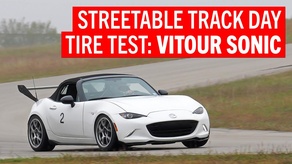
The brand also has an entry coming to the sub-200 Streetable Track Day tire category called the Sonic, which has shown tremendous pace over existing stalwarts like the Michelin Pilot Sport Cup 2 R and Goodyear Eagle F1 SuperCar 3R. Watch for upcoming GRM tests of both.
And while the original P1 has seen strong success in some applications for endurance racing, various sanctioning bodies have moved away from allowing the Super 200s due to consumable costs. Durability, consistency and price are the focus now.
The Enzo was Vitour’s original attempt at building a competitive Super 200, but it fell just short of the day’s category benchmarks, like the Bridgestone Potenza RE-71R and BFGoodrich g-Force Rival.
To make matters worse, the Yokohama Advan A052 arrived on the scene shortly thereafter, pushing the bar even higher. Vitour went back to the drawing board, eventually creating the P1.
Meanwhile, the Enzo found a home in drifting, with several compounds supplied around the world. In that venue, durability, consistency and price are valued as much as ultimate grip–same as today’s North American endurance road racing scene.
But which compound would be best for the U.S. market? This past spring, we were asked to help answer that question and can now release those results publicly.
Photograph courtesy Vitour
As a testing benchmark, we chose the Continental ExtremeContact Force, the spec tire for the World Racing League. It’s also one of the strongest entries on ChampCar’s 2026 “white list” of allowed tires. (Read more here.) We’ve tested the ExtremeContact Force a number of times, so we have comparative data to effectively rank its performance against the full landscape of 200tw offerings.
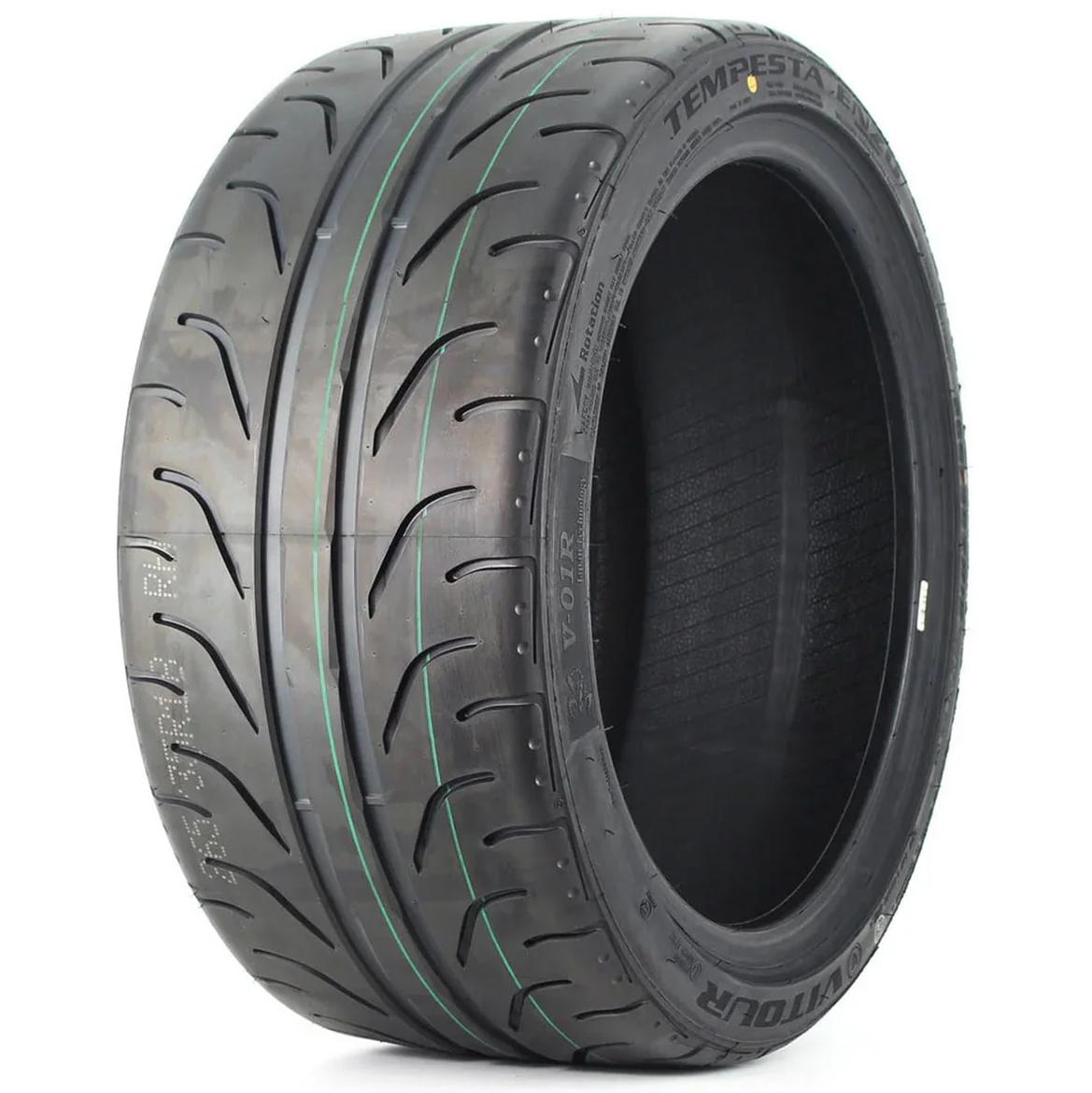
Two versions of the Enzo were supplied: one in the V01R compound and the other in V02R. The former was ultimately selected for U.S. production, so we’ll focus on that here.
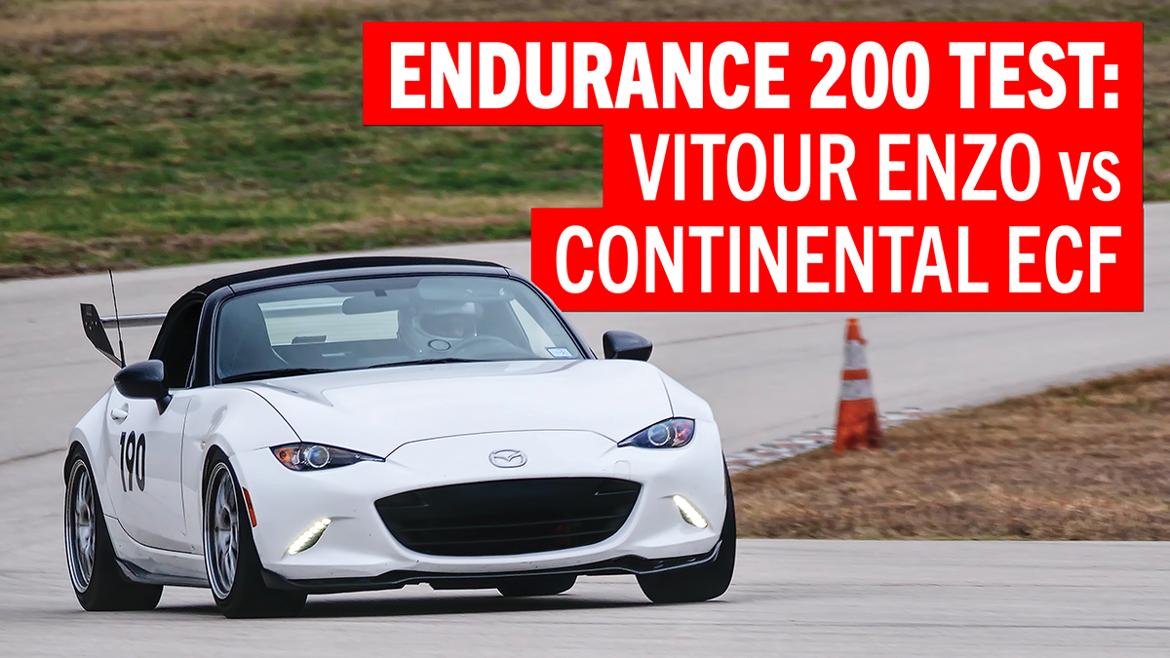
Once again, we tapped our Triple Threat ND Miata as test mule. We now have thousands of laps behind its wheel at our home track, Harris Hill Raceway. The car’s setup has been tweaked to be both quick and consistent around that somewhat bumpy circuit. Tire size was 245/40R17 mounted on 17x9-inch wheels.
Each set of tires was heat-cycled with a 45-minute highway drive, six laps of gradually increasing pace laps and another 45-minute highway drive, then removed and cooled for at least 24 hours. Notes were taken regarding the highway ride quality and street driving dynamics.
Test day weather was perfect. Cloudy skies and 67° to 77° ambients kept track temps super consistent over the course of the morning.
One 20-minute warmup session was driven on scrubs, both for practice and to clean up the track from overnight dust and dirt accumulation. When times stabilized at the known best pace for those tires, track evolution was complete and testing began.
On the road: The Continental ExtremeContact Force exhibited a linear and direct response to steering inputs to deliver an athletic handling characteristic. It was harsh over road irregularities and noisy on anything other than smooth pavement.
On the track: When pushed to the limit, the Continental ExtremeContact Force was highly responsive, easily driving down to an apex. Audible feedback announced impending slip. Breakaway was a bit edgy but recovery was easy.
Full grip was not available until after a hard out lap and partial push lap. At that point, the performance was quite consistent for the duration of the session.
On the road: The new Vitour Enzo V01-R was quiet with no appreciable drone. Ride comfort was quite smooth for a UHP tire, with road irregularities absorbed quite well.
Steering response was average for this category, with a largely progressive feel. Small inputs generated small reactions for a calm driving experience on the highway, but larger inputs elicited sportier handling on twisty roads. On-center feeling was moderate.
On the track: The V-01R came alive on track, turning more the harder it was pushed. It was eager to dive to apexes and deliver the grip to stay on line. Very little warmup was needed on the out lap for full pace, and the tire heat-soaked a bit after one and a half hard push laps. Pace was consistent thereafter.
To bracket the test and check for any potential track evolution or driver improvements, we ran the Continental ExtremeContact Force again at the end. It was consistently one- to two-tenths quicker than in the first session, which data analysis showed to be due to slightly improved grip in the Turn 3-2 complex. Since the tire had residual heat from running earlier, it also did not need as much warmup this time.

Testing shows that the Vitour Tempesta Enzo V-01R is superior to the Continental ExtremeContact Force in single-lap pace, but it falls off to a consistent deficit of at least a half second compared to the Continental.
At full tread, the Enzo V-01R exhibited pace-versus-heat traits typical of many in the Extreme Performance Summer category of tires: a couple of quick laps, then a drop-off of a full second for the remainder of the session.
The Continental ExtremeContact Force, by contrast, remains extremely consistent across long sessions. It has no initial flyer laps, instead settling right into a very specific pace range. This is ideal for endurance racing, its intended design purpose.

Hey, I spy a 195/50R15 on the list.

If nothing else, Vitour really feels like it's one of the more engaged tire makers in our scene.

The higher cold grip on the V-01R could make it a good choice for people who use the same tires for track days and autocross but put more importance on autocross performance.

TWO tire related tests within ONE WEEK?! I have no prospects of buying either of these tires, but this makes me happy.

bladebrakers101 said:TWO tire related tests within ONE WEEK?! I have no prospects of buying either of these tires, but this makes me happy.
My plate is finally clean.
But more coming, so back to the tread-mill. ;)

Love these tests!
bladebrakers101 said:TWO tire related tests within ONE WEEK?! I have no prospects of buying either of these tires, but this makes me happy.
I guess you could say we're really on a roll with these tire tests.
(I'm sorry)
In reply to Andy Hollis :
Thank you Andy!
How are the tire pressures chosen and managed?

David S. Wallens said:Hey, I spy a 195/50R15 on the list.
Quite a few 15" options listed on Tire Rack. Unfortunately, not many options in a 24" OD sizes.
Wheelman_99 said:In reply to Andy Hollis :
How are the tire pressures chosen and managed?
We used to use a very scientific process with a skid pad and timer. What we found was that for pretty much all of the 200tw class of tires that performance followed a bell curve, with a fairly wide sweet spot in the middle. Typically +/- 3psi didn't make any difference other than feel (and likely long-term wear).
Note that this is with a car that has plenty of camber and wheel width for the tire size. So pressure doesn't have to compensate for some other suspension deficiency or a pinched fitment.
So these days we simply set them to 24 cold, which takes them to 28-30 hot. That said, we will adhere to manufacturer input, if given.
Displaying 1-10 of 39 commentsView all comments on the GRM forums
You'll need to log in to post.