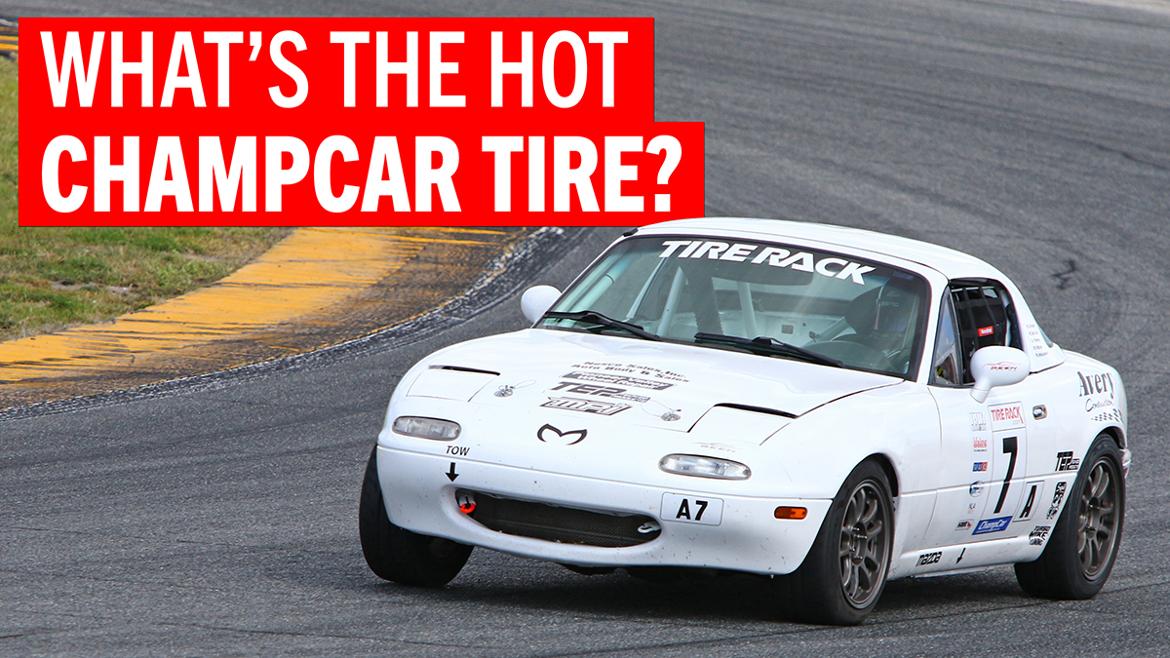
Photograph by David S. Wallens
ChampCar is one of the longest-running budget-oriented racing series in the U.S. To keep costs in check, competitors must run street tires with a UTQG treadwear of 200 or better.
But the recent progression of performance at the pointy end of the Super 200 field has resulted in tires that are quicker at the expense of durability. As a result, teams have had to decide between cost and pace, with the front runners changing tires as often as needed during a race.
For the 2026 season, ChampCar will move to an inclusion list rule for allowed tires, with a focus on durability and consistency. Only the tires on that list will be allowed, plus any others than are over 250tw.
ChampCar’s list pretty much matches the Endurance 200 grouping in our Ultimate Track Tire Guide but with one addition: the Kumho Ecsta V730.
Given our extensive experience with all of these tires, a number of teams have asked for our advice for 2026. So we pulled together results from previous tests and summarized them here–with a couple of new twists.
For the most part, this chart is a concise version of our Tire Guide, with the most notable addition being the “Enduro pace” column. This is primarily determined by averaging laps 3 through 6 of our typical six-lap test session, omitting the single cool-tire flyer pace that 200tw street tires often exhibit. The former is more representative of endurance racing, while the latter is a useful indicator only for circuit qualifying or time trials. We also looked at full-hour endurance tests we had done in the past for further insight.
We added a column for molded tread depth, which complements the “Wear rate” column to yield a better understanding of tire life.
And finally, pricing is shown for our typical 245/40R17 test size. Note that prices across a full line are not linear, as manufacturers often price according to how much competition they have in a particular size within that market segment. For example, a 235/40R17 Falken Azenis RT660+ costs $250, while the larger 245/40R17 runs $228–strictly due to competition and sales volume.
So, what’s the best choice for your ChampCar team? It depends. Yeah, you knew we’d say that. Here are our best recommendations for various circumstances.

If cost of consumables is your primary consideration, the Hankook R-S4 is your droid–assuming it comes in a size that works for you. And assuming it’s in stock. Hankook makes the Ventus R-S4 in batches once a year, arriving in early spring. If you run a popular size, stock up.
Molded to 9/32 inch, the R-S4 is the durability king, easily lasting a full race weekend and sometimes two. It’s a little slower than the rest in the dry and delivers only average grip in the wet, but it’s the least expensive both at purchase and per lap.
The Continental ExtremeContact Force has by far the most diverse set of sizes, which could be a pace advantage if there’s one that better fits your application than the other brands. It’s a very consistent and durable tire, lasting full race weekends in most applications. It’s also the most expensive.
While the ExtremeContact Force is one of the quicker and most consistent dry choices, it’s not the best in wet conditions. Adding its stablemate–the Continental ExtremeContact Sport 02–to your arsenal is the move here. The ExtremeContact Sport 02 will be quicker than the ExtremeContact Force in anything from damp to deep water.
The BFGoodrich g-Force Rival + performance is pretty much a carbon copy of the ExtremeContact Force except for one key point: The Rival + is a category leader in the wet, so you don’t need dedicated rains except in the deepest of standing water conditions. This helps avoid time-consuming pit stops in changing weather.
On the downside, BFGoodrich is still building out its inventory of sizes, so your favorite may not yet be available.
While one of the quickest at qually flyer pace, the Vitour Tempesta Enzo V-01R slots just behind the ExtremeContact Force and Rival + in continuous endurance lap times. And it’s just not very good at all in the wet. But its pricing is attractive, and there are many motorsports-friendly sizes on offer. This could be a perfect compromise situation for many.
Which brings us to the Kumho Ecsta V730–the only tire on ChampCar’s list that we rate as a Super 200. In reality, it’s kind of a tweener: It has many of the hallmarks of an Endurance 200–durability and consistency–but is just a bit quicker over a shorter lifespan. Expect this one to only last a single race, if that. And while it’s on the low end of the pricing scale, you’ll need more of them.
View all comments on the GRM forums
You'll need to log in to post.