


Maybe I missed it, but why did you replace the track pads when you still had >1/2 the pad left? Was it just the knockback?



Photography by J.G. Pasterjak
Have we found it? Have we finally discovered the one brake pad that can do it all? The one pad that works great whether you’re getting groceries or grabbing apexes? That isn’t noisy or dusty, doesn’t fade, doesn’t eat rotors and lasts for years on end?
Haha, no. Come on, man.
Look, we get it, it’s a common ask. It’s one of our most common questions, actually. Everyone wants the one pad that does everything because they think that would be the most affordable and efficient way to go about their track activities in a dual-purpose car. We were once like you. We believed in that, too.
But after a year of doing dual-duty work with our BMW 435i project car–we swapped on appropriate pads before each track event–we have some data to share. We believe the pad swap method may be the best approach from not just a performance standpoint but economically as well. Follow along. Racer math ensues.
The car in question here is our 2015 BMW 435i. The pads used: Hawk Performance HPS 5.0 for the street and Hawk DTC-60 for the track.

One pad for track and street? Not really a thing. Our solution? One set for each venue. The result? Longer pad and rotor life.
Each pad is designed for a particular situation. The HPS 5.0 compound is tuned for heavier and more powerful cars on the road–think Mustang and Camaro as well as chunky BMWs like our own 3600-pound 4 Series. These pads have about 20% more friction across their temperature range than Hawk’s regular HPS compound, but that friction begins to fall off a bit after about 600° F.
That falloff is a compromise to minimize factors like noise, dust and rotor wear and to optimize those requirements in the temperature range where the pads will most frequently operate. That 600° limit means they could probably survive a lap or two on track, but once they exceed it, wear will accelerate dramatically, as will the potential for reduced pad effectiveness.
Our Hawk DTC-60 track pads have a remarkably flat friction coefficient across their temperature range. From ambient temps to above 1500°, friction varies by barely 6%. From 300° to 1300°, friction varies by barely 2°.
So, if it works great at any temperature, why not just run this magical pad all the time? The answer there is the trade-off.
According to Hawk, below its ideal operating range–which starts around 400°–the DTC-60 can produce accelerated rotor wear. It’s also a bit more of a compromise in the livability department, producing some squeal and a lot more dust than the HPS5.0. This is why we only run the DTC-60 pad on the track and then switch back to the HPS 5.0 for civilian duty. (Cheat code: track pads for track use, street pads for street use.)
What does an extra set of brake pads cost us? Well, for our application, the HPS 5.0 pad retails for around $180 for the front axle and $146 for the rears. The DTC-60 pad sells for $284 in the front brakes and $240 for the rears. That’s a total of $850 for both sets, and when they arrived, both compounds showed about 12 mm of pad material all around.
Between March and October of 2024, we ran the race pads at Virginia International Raceway, Daytona International Speedway and NCM Motorsports Park plus numerous test days and time trials at the Florida International Rally & Motorsport Park. We also put about 2500 street miles on the street pads.
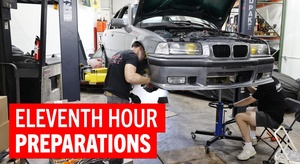
Now, we understand that our particular situation is favorable because swapping pads on our BMW is extremely easy. The process takes under 20 minutes, which we realize is not a luxury every car shares. But even the most complicated pad swaps get easier with practice (he said, knowing he only needed three simple tools to swap pads in a BMW).
When we went to fit a second set of DTC-60 pads late that summer, our original set had worn to 7-8mm of thickness, with the leading edges showing a bit more wear than the trailing edges. During this time, the street pads had not shown any appreciable material loss.

Proper pad management has maximized rotor life, with the front track pads exhibiting expected taper at their first replacement.
We didn’t toss those old race pads, though. We ran them a few times as a “warmup” set before switching to the new, full-depth pads for competition runs. The worn pads performed as well as new, although the reduction in thickness resulted in a little more pad knockback if we were aggressive on the rumble strips.
But do you know what we didn’t buy all year–and still haven’t, as of this writing? Rotors. Our rotors have shown practically zero degradation over the year of action.
Would we have needed rotors after our somewhat easy 2500 street miles? Maybe, maybe not. But start examining a car that sees at least 400 or 500 miles a month, and those race pads that are harder on rotors below 400° will certainly extract more of a toll.
And rotors cost money. BimmerWorld shows $298 each for the fronts and $154 each for our rears, meaning a set of $326 street pads can save us $900 in rotors.
We can hear the voices: “It can’t be as simple as just swapping pads, can it?” Valid question, and there are some considerations to be made if you join the two-pad club.
We’re going to speak in terms of best practices here, not mandatory ones. Look, your car will still probably stop perfectly safely and securely if you don’t follow this advice, but just imagine the Terminator or, if you’re OG, John Connor, extending a generous hand: “Come with me if you want to live.”
There are a few steps you can take as a member of the pad posse to ensure things go smoothly. First, the experts recommend that you also dedicate a set of rotors to each set of pads. This is mostly to preserve the benefits of the bedding process–which transfers a layer of pad material into the grain of the rotor–and increase the life of both components. We agree that having that transfer layer in place is beneficial in the long term, and a second set of rotors is the ideal situation.

To keep track of which pad goes where, we simply mark them with a paint pen. We scuff the rotors, too, and then rebed the pads.
But we don’t all live in ideal worlds. The next best route is hitting those rotors with some 200-grit paper during your pad changes to scuff off a bit of that transfer layer before rebedding the next set of pads. The third best choice is the ol’ swap-it-and-send-it.
Each level of laziness represents the increased potential for reduced effectiveness and accelerated wear. Determining exactly how much requires extensive testing beyond most of our resources, but for the record, we hit our rotors with a quick zizz from a sanding disc during swaps. Then we always rebed the track pads. Maybe we skipped rebedding the street pads once or twice. Sorry.
We’ve also had multiple representatives of multiple brake companies make different recommendations when it comes to reusing legacy pads. Some say they always want the pads to meet the rotors in the same direction. This preserves the structural granular alignment in the pads that develops as they heat and cool and could extend life.
Others recommend flipping the pads during each reinstallation to reduce any tapering at the leading edge. Also valid advice.
We’ve opted for the directional retention method, as we experience fairly minor tapering, but your situation may vary. Any accelerated wear due to flipping could be offset due to reduced tapering. Let your testing and experience in your situation be your guide here. The takeaway message is to mark each of your pads as to their position and alignment when they come off the car so you can accurately recognize long-term patterns.
Sorry to burst your brake bubble about the do-it-all pad. While plenty of pads can be pretty good at doing a lot of things, the reality is that the demands of track use and the requirements of street use are still far too disparate for one pad to do everything well.
There are always going to be compromises. Hopefully our experiences with our BMW show you that overcoming those compromises is not as complicated, and potentially not as expensive, as it may seem.

Maybe I missed it, but why did you replace the track pads when you still had >1/2 the pad left? Was it just the knockback?

well, as expected :)
While I'm owning Miata ND and 2 front original rotors cost me $80, I don't care about rotors that much. I use track pads during "track seasons" and switch back to organic pads in winters
It would be nice to see a review of different manufacturers like you do tires. Porterfield and Gloc have decent pads that are very capable for several environments.

I have had good luck using Hawk HT-10s as a dual duty pad on my 03 Cooper TT car. I found Brembo front rotors on sale at Rock Auto for $20 each. Snatched up a couple sets. Still on my first set with zero issues. The Brembos wear better than the OEM rotors. Lastly, the HT-10s work decently in the cold.
Thanks JG. Echo the other reader on desire to see multiple manufacturers. I've switched to Cobalt pads and am pretty impressed. Most track pads are borderline dangerous on the street when not warmed up but these things bite nicely when cold. I've been burned by skipping bed in on hawk pads, they do not work well unless carefully bed in. I had made a bunch of other changes and showed up to the track thinking of everything besides bed in it seems. Cobalt advertises no bed in required and lived up to the promise. The only complaint is they are so grabby that its making heel and toe trickier as they require a more delicate foot on the pedal. One more, they did not provide the anti-rotation pin for my Mazda rear brake pad backing plate to keep the piston from spinning which was an issue. I put a screw in there to take care of that. I almost feel like I am revealing a secret here. They seem to change the game. Still a bit early, but rotor wear looks minimal. Eddie at Cobalt is a really nice guy and helpful with applications questions.

BA5 said:Maybe I missed it, but why did you replace the track pads when you still had >1/2 the pad left? Was it just the knockback?
Yeah the knockback was annoying, so we run the important stuff with freshies and hang on to the half-used pads for spares/warmup sessions.
I run a Lotus Elise very hard on track and it is my daily driver. I have had the car 18 years and have tried MANY brake pads. The only pad I found that is great on both the street and track is Cobalt! Also, they were fantastic to work with to get the pad I really needed. They say they are for off road use only but as the post above said, they bite great on the street when cold.
On my BMW I run Carbotech 10s on the front and 8s in the rear 24/7. DD/track/autox. Stone cold light application will squeak. Just step a little bit harder. Good bite cold. Rotors are cheap. Dusty but does not turn to concrete when wet. Please test more brands of pads.
Did you swap the pads at the track? I've been wondering if the 1-2 hour drive to Daytona and Sebring is what's causing my accelerated rotor wear despite using dedicated track and street pads. (I also used the swap-it-and-send-it method.)

I use Carbotech AX6 pads to daily and autocross. They're a compound specifically designed for autocross. They are nearly silent (at least on my car), work well from cold, and dust like an Oklahoma windstorm.
They will eat rotors in daily use, about two sets per set of pads, so I bought cryo treated fronts the last time I did brakes. Sure, rotors are cheap, but I would prefer to avoid having to take the time to replace them as often.
I put a set of the Porsche air deflectors on my lower control arms, increased my wheels to 17 inches to allow for more airflow, and they worked fine at the last GRM track day. 2800 pounds and a front rotor that's barely ten inches is asking a lot, but they held up fine with the increased air cooling. I had to bleed the fronts during the lunch break at last year's event.
I'm doing a track day at the Speedway next month. I'm installing all new calipers, brake hoses, wheel studs, and will switch the fronts to a true track pad.
Displaying 1-10 of 18 commentsView all comments on the GRM forums
You'll need to log in to post.