Photography by J.G. Pasterjak, lead photo by Chris Tropea
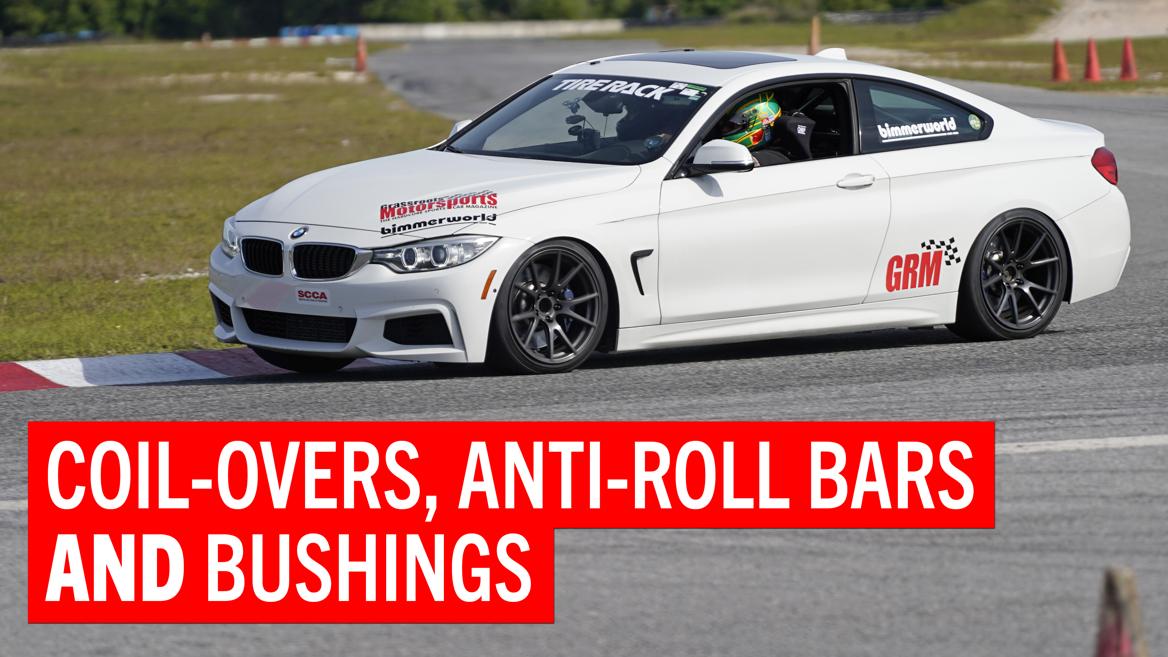
Okay, let’s talk about project creep. Sure, all “dual-duty” projects may start out with the best of intentions, but eventually you hit that point where the allowable modifications for your chosen venue could possibly exceed what is reasonable and prudent for a “street” car. It’s one of the dilemmas of our world, and one we certainly faced with our BMW 435i.
See, as soon as we slapped that wonderful, helpful intercooler on our BMW, we bumped ourselves up into the SCCA’s Tuner division for Time Trials competition. This opens up the rule book a bit for us, although the stated intent is still for the cars competing in this division to be fully street-capable.
In addition to those bolt-on engine goodies and a tune, we’re now also allowed to fiddle with the chassis a bit. Anti-roll bars are still on the table, but now we can swap out bushings for non-metallic ones while fitting adjustable coil-overs. So naturally, we had to do this.
The big question: Why?
Why are height-adjustable coil-overs necessarily better than just a regular shock or strut-and-spring combo? Why are larger and/or adjustable anti-roll bars an upgrade? What do those stiffer polyurethane bushings really do? So, let’s talk about that first.
The key thing we’re doing with all of these parts is adding adjustability and reducing compliance to create a more stable contact patch at each corner. Handling begins and ends at your tire’s interface with the road, and everything else you do to the car is simply in service of that relationship.
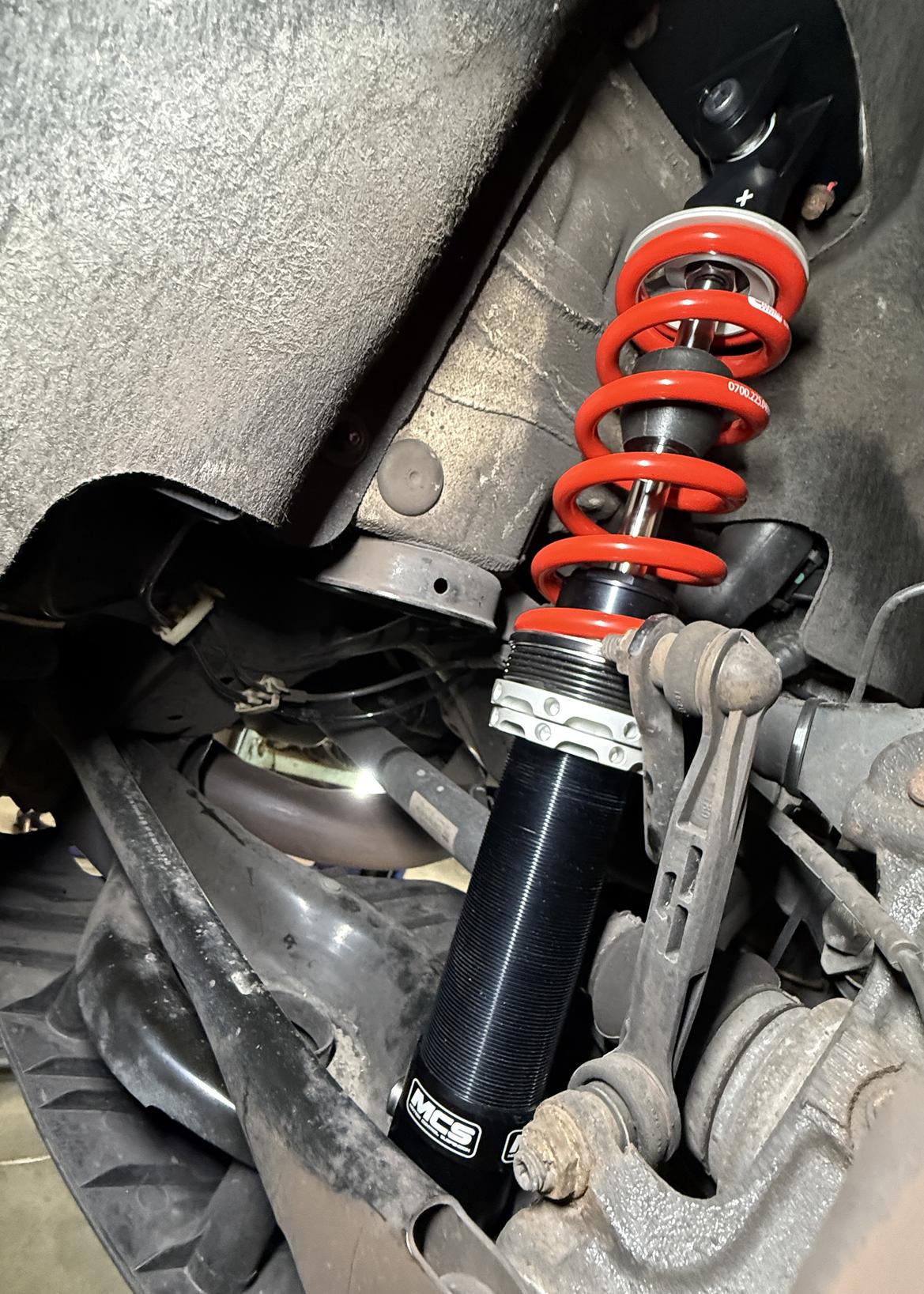
Height-adjustable coil-overs approach this problem with three different systems:
The damper controls the motion of the spring, which would otherwise enter into a cyclic compress/release motion that would clearly not offer a stable contact patch. Our Motion Control Systems are single-adjustable for rebound as this, perhaps counterintuitively, is the most important function of that damper: Get that contact patch back in contact with the road after it bounces or is lifted off.
The springs are the primary connection between the chassis and the hub and wheel. Spring stiffness will affect body roll as well as the speed of load transfer during dynamic cornering. A softer spring will initially absorb more of that energy of load transfer, while a stiffer spring will transfer more of that load because it is deflecting less itself.
The ability to adjust ride height allows you to tune the static weight distribution on each of the four tires. Notice we didn’t say static “mass” distribution, and that’s simply because the mass is going to stay wherever it is within the car. But the adjusters allow us to alter the ride height and spring preload at each corner, putting more or less weight on each corner of the car, much like sliding a folded-up piece of paper under a table leg. The goal is not necessarily to create a perfectly balanced car under static conditions, although that is a nice index point to start from, but to tune dynamic weight transfer and its impact on handling feel and performance.
The anti-roll bars–and it’s fine if you call them sway bars, which may not be entirely technically correct, but everyone is still going to know what you’re talking about just fine–do exactly what their name implies. By inserting what is essentially a torsion spring between the left and right suspension at each end of the car, a lever is created that works to move both sides of the car together. So, for example, as the outside suspension compresses through a corner, the anti-roll bar attempts to compress the inner suspension as well–but the inner suspension is extending, and, through the bar, that load is being transferred back to the outer suspension as well. How much of this load is shared by each side is a matter of how much the bar twists and deflects, which is a function of the stiffness of the center part of the bar to resist twist and the leverage afforded by the arms that connect the bar to the individual suspensions.
The ultimate result is that load sharing created by the bar works to resist roll during cornering. If both sides of the suspension move together, the bar really does nothing except swivel in its bushings. It’s only when the suspensions side to side are doing something different that the bar comes into play. For this reason, anti-roll bars are a great choice for a mod on a street car, as they have minimal impact on ride quality.
Finally, the bushings complete the puzzle by reducing compliance at the joins between individual suspension components as well as those suspension components and the chassis. On our BMW, for example, the front control arm bushings, particularly the front thrust arm bushings, are soft.
This softness is designed in to reduce the transmission of noise and vibration from the suspension to the occupants inside the car, but this compliance can also create a lot of dynamic alignment changes under load. If your toe settings are changing under load–say, under heavy braking or acceleration–that softness is going to create a lot of instability or unpredictability. And that instability is going to happen right when you really need it.
Whenever making any modifications, there’s a big fear of second-order effects. We know what these mods will do for the most part, but what other problems will they create? This is hardly truer than with coil-overs, as they’re nearly infinitely adjustable, giving you countless ways to screw up your car.
Luckily, we had a couple head starts: baseline figures from our previous setup plus some setup help from Phil Wurz at BimmerWorld. After we installed our MCS coil-overs, we first set the same ride height that we ran with our old, fixed-height Koni setup.
Phil added that the cars like a small bit of rake–maybe a quarter inch of additional ride height in the rear when measured from the rocker seams–so when we started tweaking each corner weight on our Intercomp scales, we kept this tip in mind.
When adjusting corner weights–and remember that “perfect” cross-weights are not always the end goal, but they are a great place to start–adding ride height at one corner tends to increase the corner weight at that corner AND the opposite corner on the other end of the car.
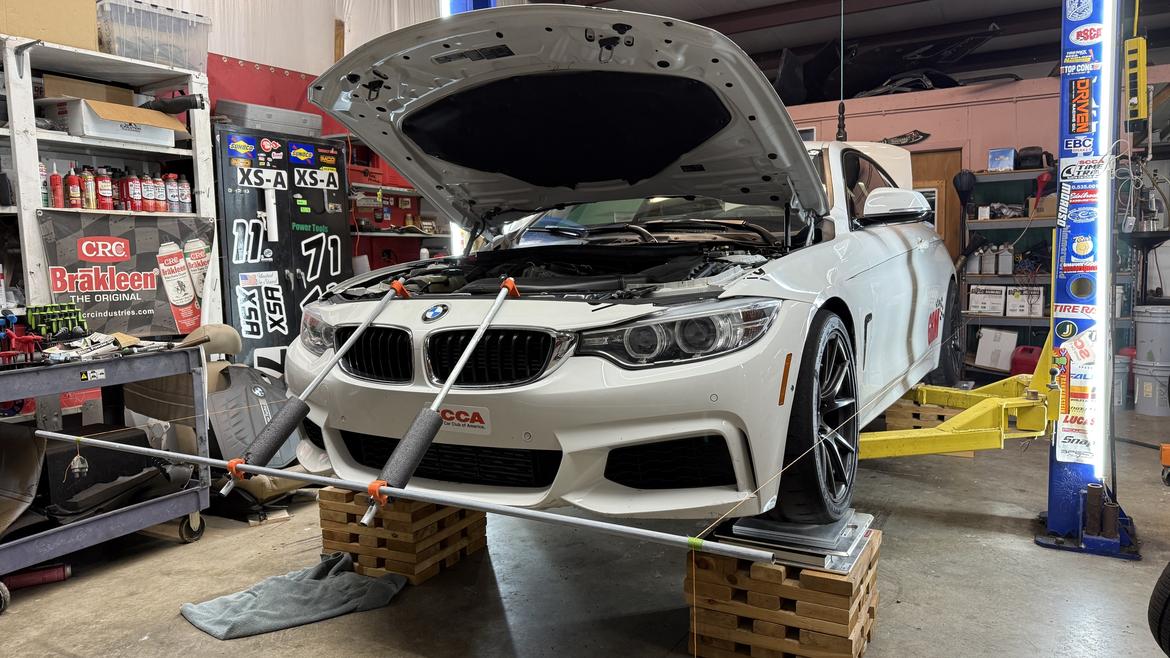
Again, think of the four-legged table analogy: If we needed more weight on the left-front, for example, we’d keep Phil’s rake advice in mind and get it by raising the right rear of the car or lowering the right front.
Fairly quickly, with a half tank of fuel and driver aboard, we got our cross-corner weights nearly even. We even had our side-to-side balance looking pretty good for a car where we couldn’t move around a lot of stuff.
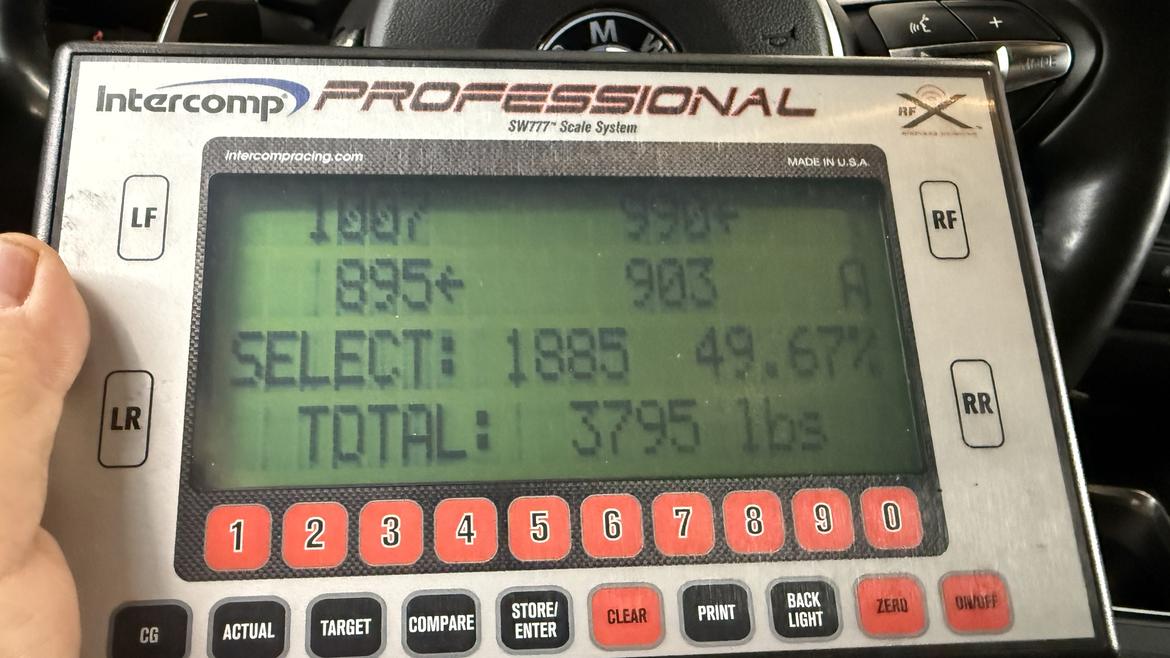
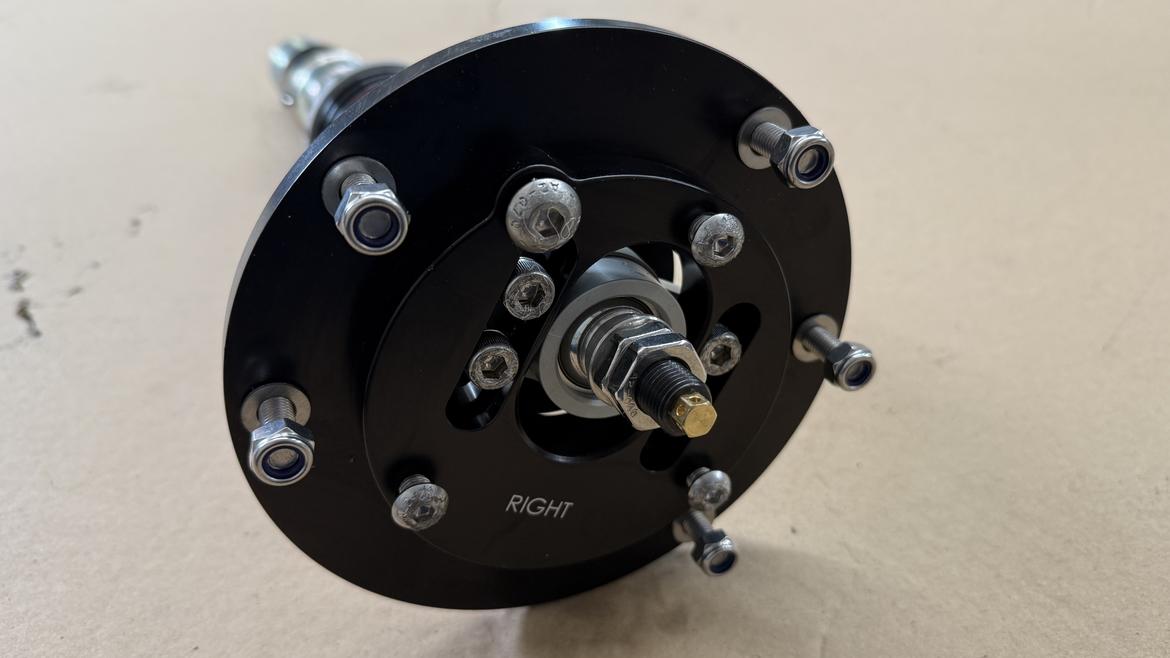
Our single-adjustable MCS coil-overs list for $3740 in the BimmerWorld catalog, but that’s before you add springs and the MCS camber plates. Prices on those will vary based on exact spring brand, rate and application, but you’ll be out the door for less than $4500 in most cases with a complete setup like ours.
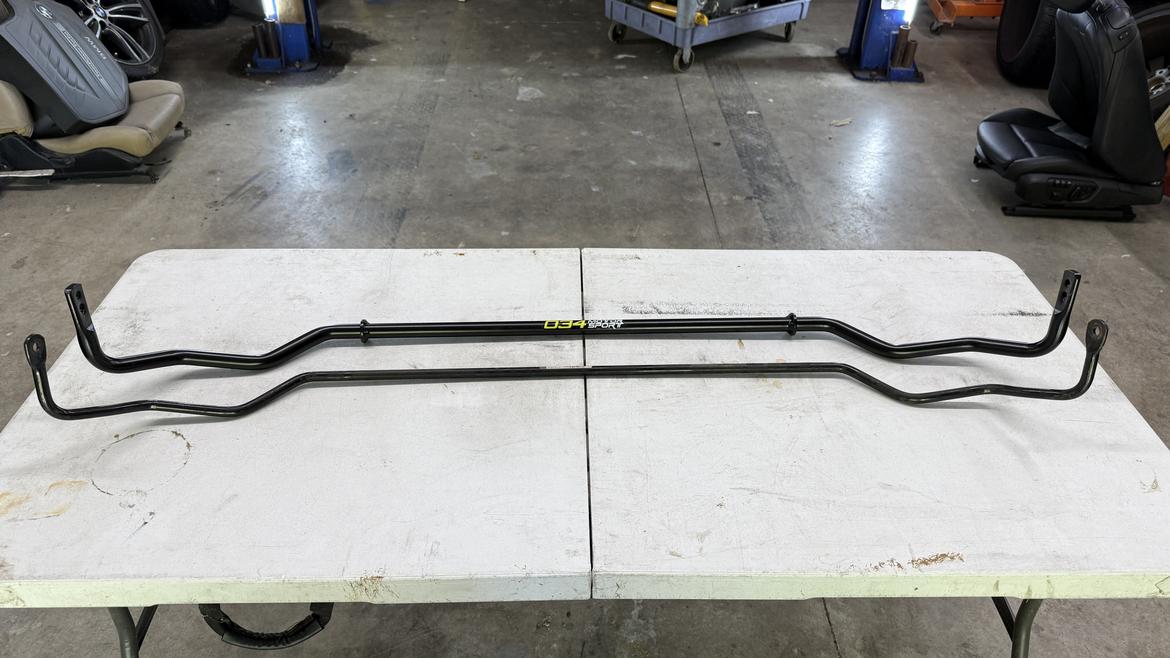
Anti-roll bar installation was a bit more complicated–both front and rear subframes have to be dropped to install the bars–but our adjustable bars from 034 Motorsport fit perfectly and came equipped with top-notch hardware, including billet brackets with zerk fittings.
The Dynamic+ bar kit from 034 Motorsport features a 30mm hollow front bar that’s from 62 to 85% stiffer than the stock bar and a 22mm solid rear bar that ranges from 315 to 390% stiffer than the stock unit. The kit retails for a little over $700.
Our big worry with the bars was a lack of dynamic compliance in the rear under cornering load, as our car doesn’t have a mechanical limited-slip diff. We’re trading contact patch stability for compliance, and that compliance was precisely what was driving that outside-rear tire into the ground and keeping the inside rear on the ground so the open diff could do its thing.
Thankfully, in initial testing, we haven’t noticed too many bad habits or excess e-diff intervention due to the increased roll resistance afforded by the bars. We still have some room to soften the front bar, which will allow for a little harder plant by that outside-rear tire. We also have the rear bar set in the softest of its two adjustment positions to allow for as much compliance as possible. So far, so good.
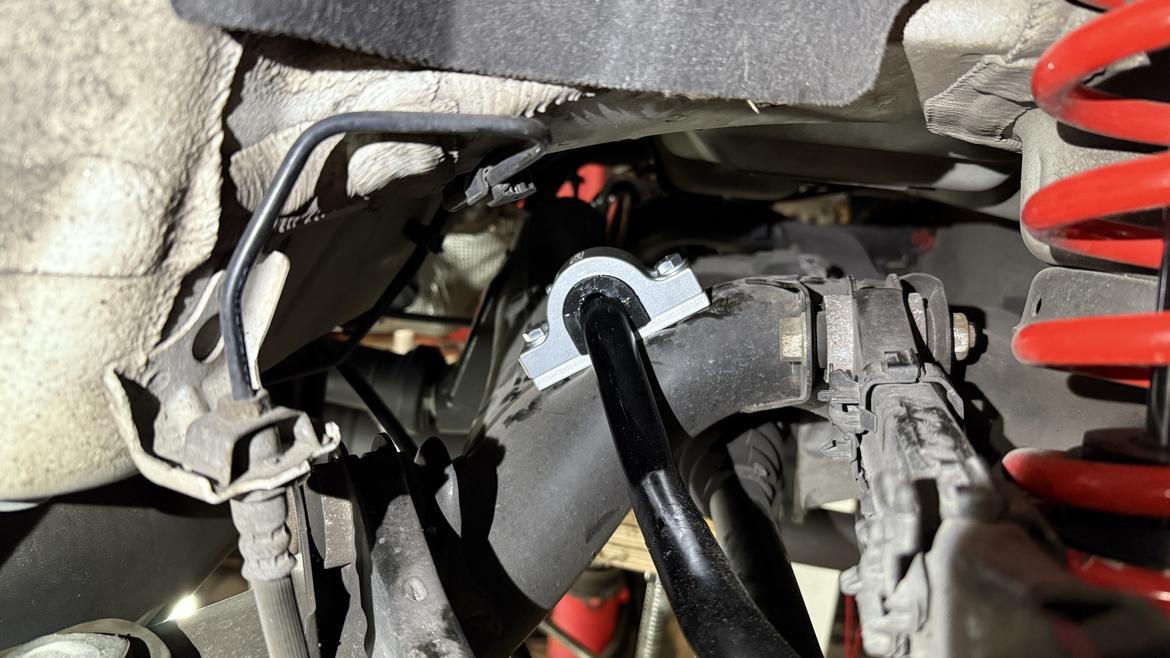
In the bushing department, we had a set of front thrust arm bushings that were basically shot, so those were an easy decision to upgrade with Powerflex Black Series bushings. We also replaced the front control arm bushings with Powerflex’s Black Series camber adjustable offset bushings.
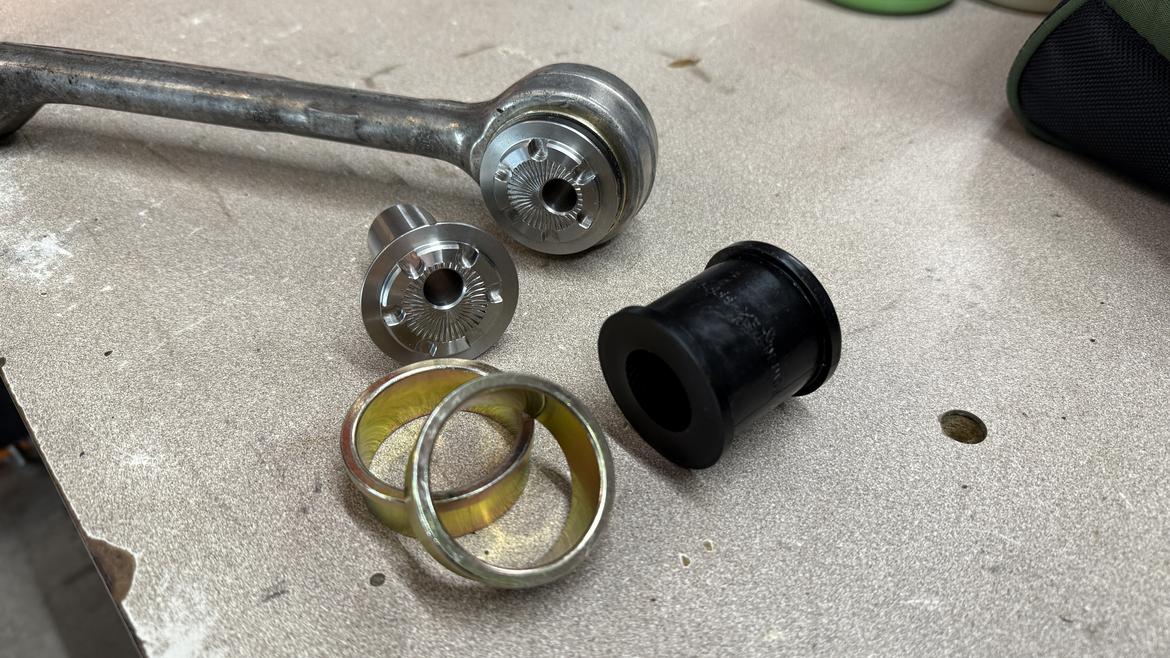
Those bushings helped add some much-needed camber. Phil had suggested up to or beyond 3° of negative front camber, and the MCS camber plates alone didn’t allow quite that much.
The offset bushings, which must be pressed into the arms after the stock units are pressed out, offset the mounting hole by around 8mm, giving up to an additional half degree of camber. So we now have our full 3° negative and a far more stable contact patch.
The answer here is complicated, because installing a highly adjustable suspension is the beginning of a process, not the end.
The new suspension setup didn’t magically make the car go faster. If a new suspension instantly lowers lap times, perhaps your old setup wasn’t that good. (And our old setup was actually quite capable.)
However, our first session after the install reveals a lot of good things. The biggie: Our VBox data shows that we can now get on the power sooner and add more of that power while still in the turn–40 to 50 feet sooner, in some cases.
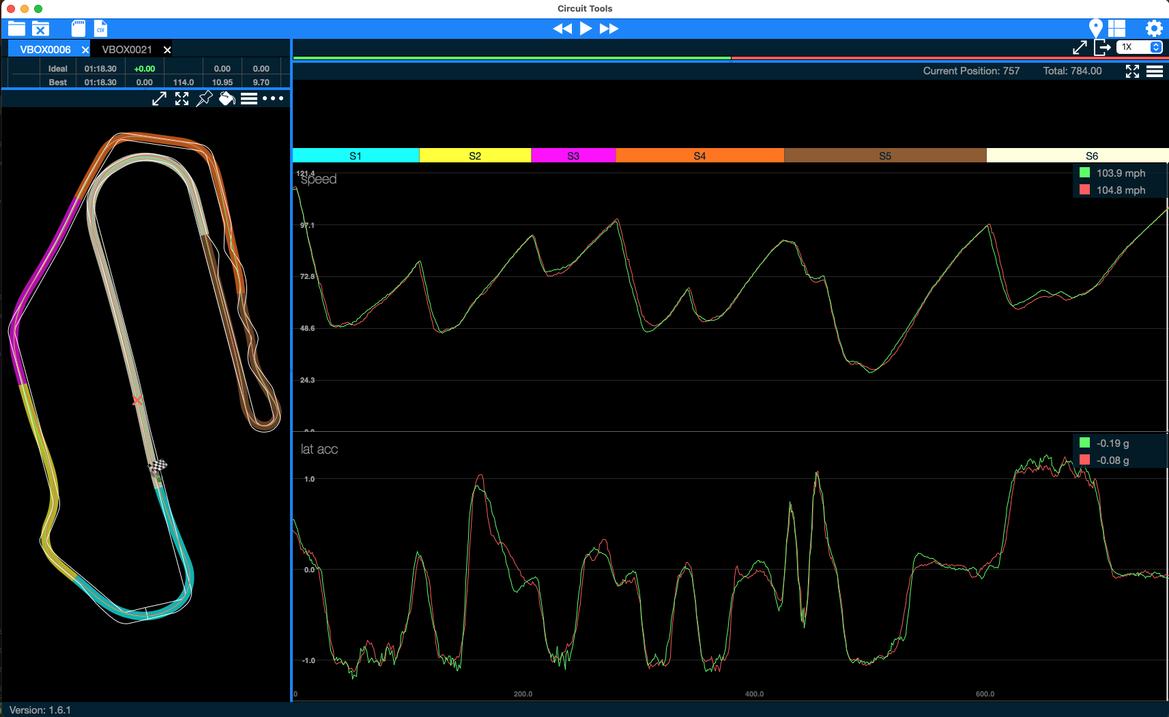
We’re also absolutely seeing faster mid- and late-corner speeds in long sweepers. It’s easy to say that’s the result of less body roll and a more stable and better aligned contact patch.
We’re also seeing some higher early corner speeds, which is a good indicator of the overall level of driver confidence afforded by a responsive and communicative chassis.
In the FIRM’s Turn 8, the banked left-hander, we also see more lateral grip.
Overall, we’re not seeing any downsides in the data. Each corner is as good or better than it was previously, and now it’s mostly a matter of fine-tuning our own feel behind the wheel to the new setup and then making adjustments to further optimize. Luckily, between the ride height adjustment afforded by the MCS coil-overs and the stiffness adjustment afforded by the 034 bars, we have those variables at our disposal now. All that’s left is testing.
Lots and lots of testing.
View all comments on the GRM forums
You'll need to log in to post.