
Awesome data and comparison — great to see the Vitour P1 delivering results!



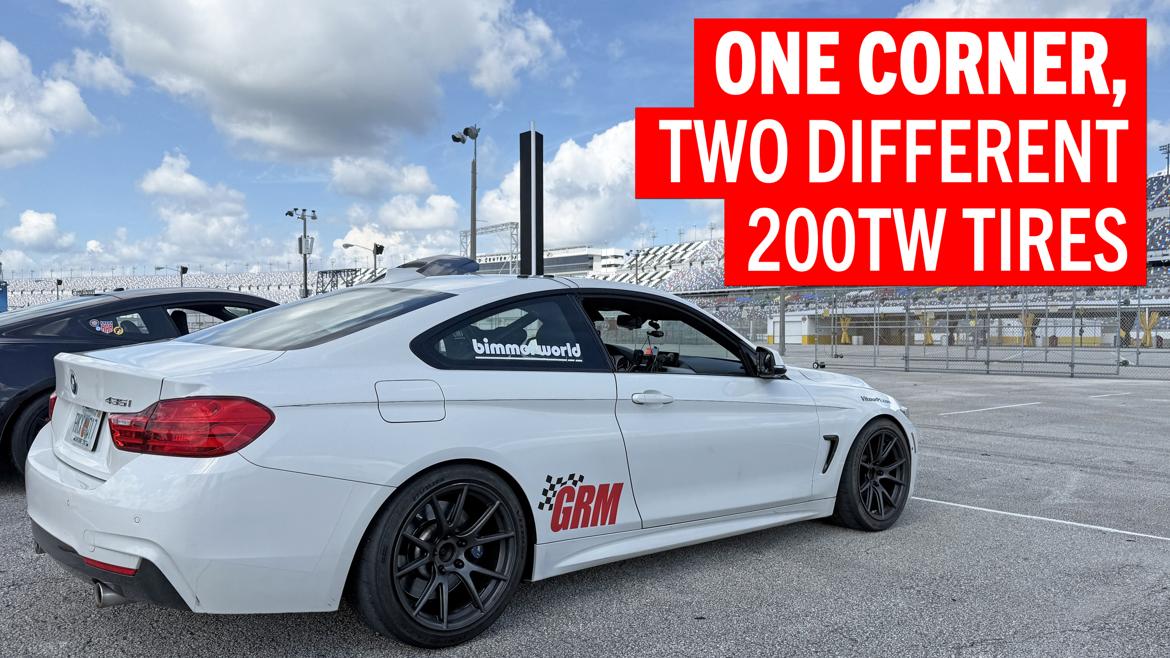
Photography by J.G. Pasterjak
An opportunity we enjoy by being in the same town as one of the world’s most famous race tracks is the ability to compare data in specific corners with different configurations of parts on the car. Sometimes the differences in this data show technique discrepancies, track condition changes, the effect of the parts we’ve installed or adjusted, and sometimes it’s a combination of all of those factors.
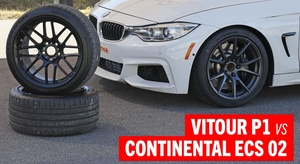
At a recent SCCA Track Night in America event at Daytona, we ran our BMW 435i project car with the Vitour P1 rubber that we’ve been running since spring.
Our previous data from the track was on Bridgestone RE-71RS tires in the same 275/35R18 size. Prevailing conditions were similar for both days: scorching Florida summer heat with ambient temps in the mid 90s and heat indexes around 115 degrees. The big difference in conditions was a heavy rain on the day before we ran with the Vitours, which usually doesn’t do any favors to traction at Daytona until the track has the chance to rubber back in.
[Has the Vitour Tempesta P1 earned its place among 200tw benchmarks?]
First, a note about the Vitours and their durability. As Andy Hollis has noted in previous tests, Vitours seem to suffer minimal falloff during track sessions as tire heat increases, and we definitely see that in our testing at the FIRM and here at Daytona. We’re also seeing minimal performance loss as the tires go through multiple heat cycles and aging. They appear to be on their way to being sharp and drivable, if not fully competitive, all the way to when the air starts showing.
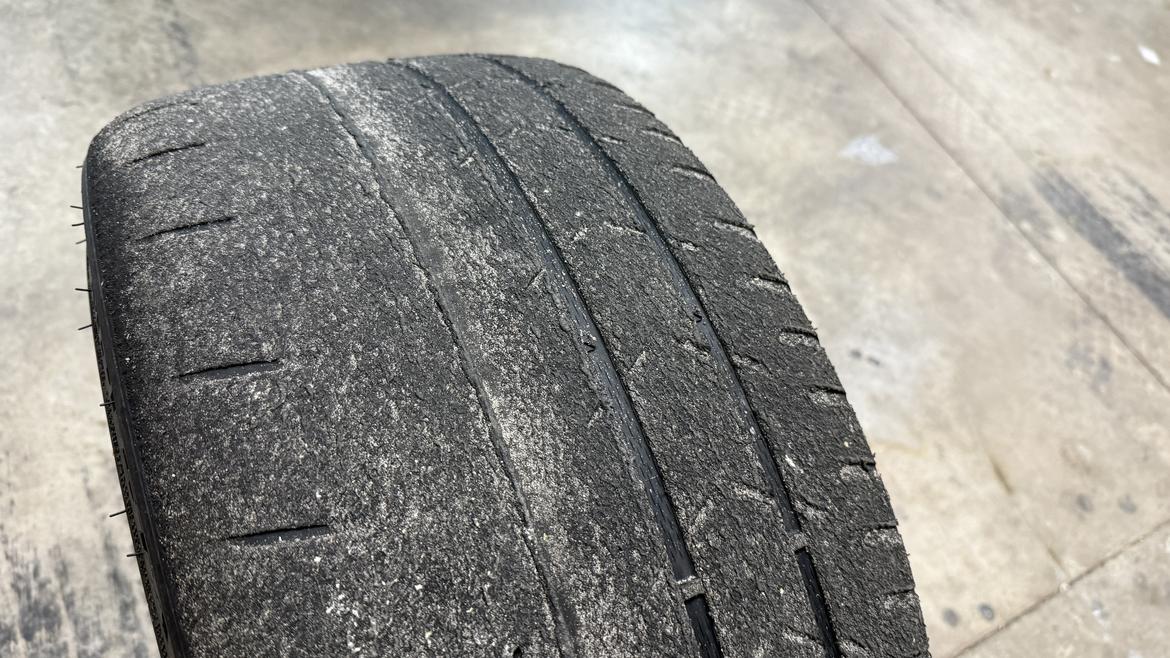
Our Vitour P1s after six months and 80-plus FIRM laps (and a couple thousand street miles). The inner grooves haven’t quite hit the wear bars. Outer grooves are still present, and the shoulders are still fairly square. Center rib shows even wear with no beveled wear that 200tw tires can sometimes display.
Our Vitours have about 10 heat cycles and more than 80 FIRM laps on them and still feel as good as they did when we first mounted them up. The data seems to back this up as our FIRM times have remained largely consistent, with any anomalies being more due to track conditions and temperature than tire performance.
Particularly impressive is their ability to multitask. This can be seen in the VBox data from Daytona’s legendary Le Mans Chicane, formerly called the Bus Stop, but now there’s a tram and “Tram Stop” didn’t have the same ring to it.
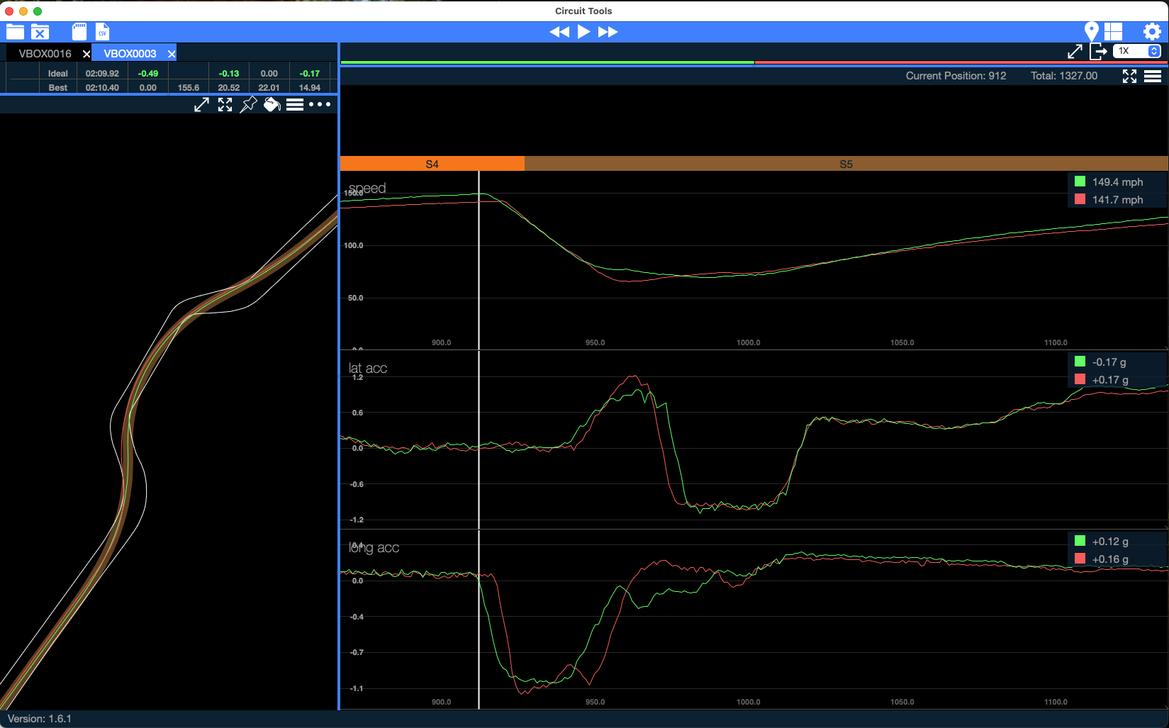
Our story begins at brake initiation with the Vitours (green trace) having a big speed advantage heading down the back straight over the Bridgestones 10 months prior. We hit the brakes later with the Bridgestones, partially due to the lower terminal velocity, and actually saw fractionally harder initial deceleration with the RE-71RS tires, but the big difference here was how clean the area of max deceleration was with the Vitours compared to the Bridgestones. Look at longitudinal acceleration at the bottom chart. The Vitours hit peak decel cleanly and level off for the entire braking area until we start to release a bit on the initial entry. The Bridgestones needed some adjustment to try and maintain peak decel, and the initial release wasn’t nearly as clean.
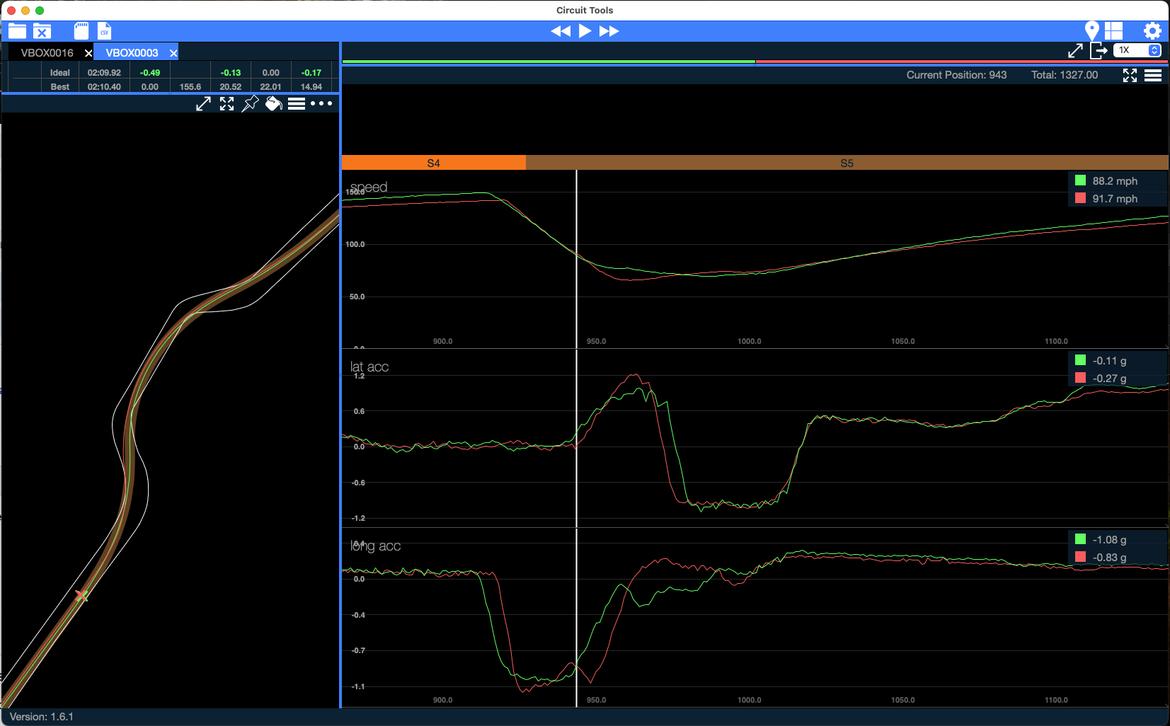
Next, we’ll jump to that release point, and the Vitours are really showing their multitasking ability here, even after many heat cycles. Look how cornering forces (middle chart) start to build nicely in sync with the decel forces reducing.
The Bridgestone traces show that we tried to initiate turn-in in a similarly smooth fashion, but needed a bit more slowing to get the job done, which caused a late downward spike in the longitudinal g reading.
Our speed trace (top chart) reflects this instability as well. Our turn-in speed was much higher with the Vitours than the Bridgestones because we were able to carry that trail-braking all the way through the left-hand chicane’s entry to the point where we initiated turn in for the right-hand center part of the chicane.
With the Bridgestones, we had to turn those two initial direction changes into two very separate corners. Look at the lateral G reading here and you’ll see how much more spread out the Vitour trace is, showing we were taking a far more gradual approach to the corner and doing multiple things at once–braking and cornering–with a high degree of stability.
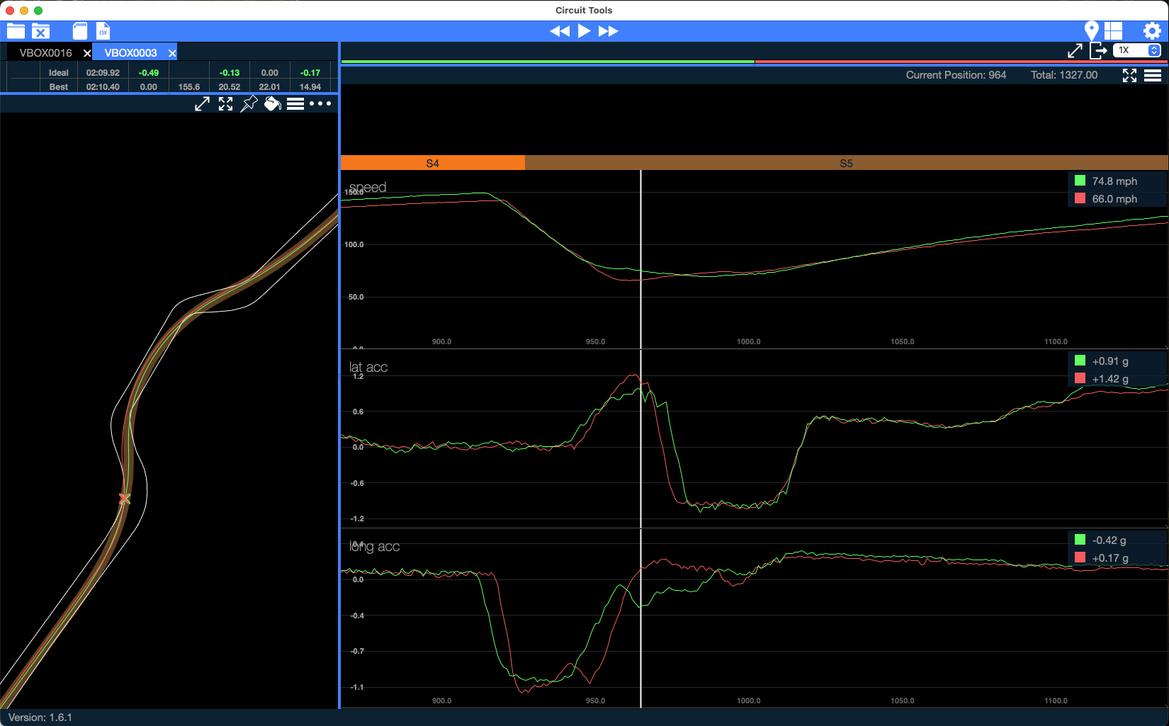
Interesting tidbit here: The momentary increase in deceleration force on the Vitour chart here is the point where we hit the inside curbing while still braking into the corner. Curbs can take a lot of energy out of the car, so if you’re a habitual curb-hitter, look at your data to see how that habit is affecting your car’s attitude. You may spot something on the data you hadn’t picked up on from the driver’s seat.
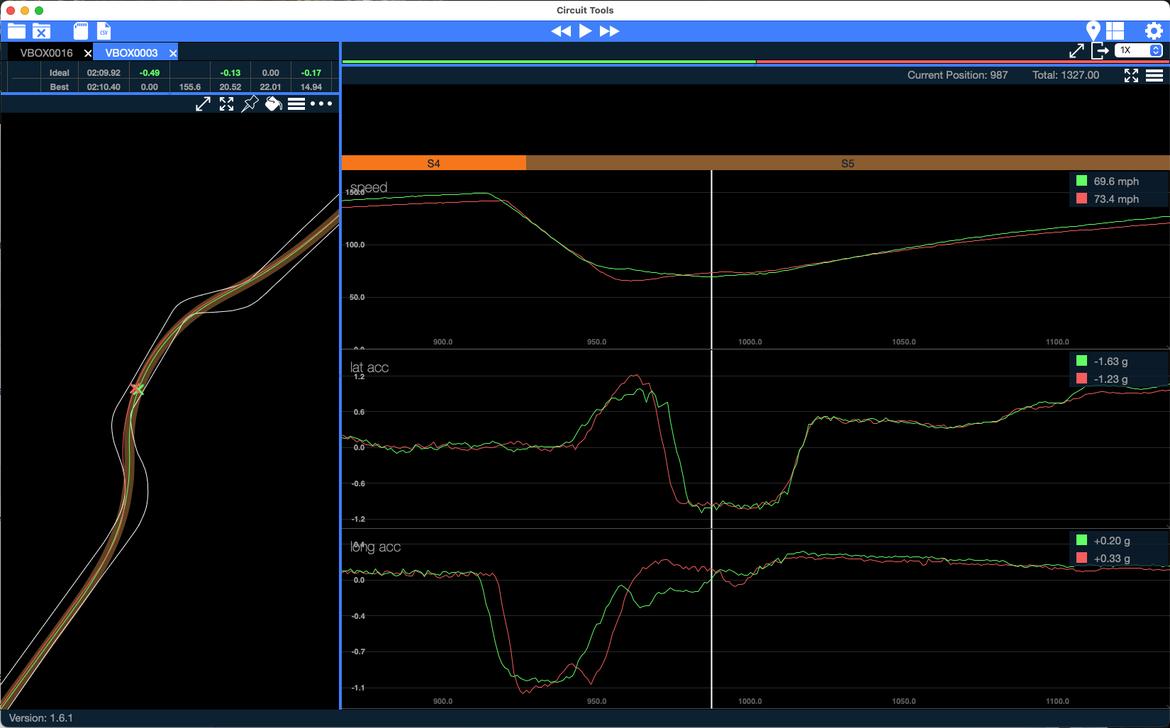
Now let’s fast forward to the point where we make our final acceleration commitment and throttle out onto the fastest section of Daytona.
Because we turned the entry section of the chicane into multiple corners with the Bridgestones, we got a good run through the middle of the sequence, but the most important thing here is when you finally hit the throttle for real, because it will define your speed for the next 20 seconds or more.
Look at the point where the longitudinal acceleration crosses from negative to positive. With the Vitours, it’s just past the right-hand kink at the entrance to the chicane. With the Bridgestones, we accelerated through the middle but had to give up some speed to make the exit and couldn’t commit to throttle until we were making the second right to head for the exit of the sequence.
You can see how this pays off on the speed trace with acceleration beginning earlier with the Vitours and speed quickly outpacing the Bridgestones because of the earlier throttle. Even though we were going a few miles an hour faster with the Bridgestones at that point, we tried to gain time over a section of a couple hundred feet and it cost us speed over a section of a couple thousand feet.
And, again, some of this is attributable to differences in cleanliness of driver execution, or track grip, but solid execution relies on drivable tires, and these Vitours are showing they have what it takes to keep up with absolute bangers like the RE-71RS, and retain that performance over multiple heat cycles and through treadwear.

Awesome data and comparison — great to see the Vitour P1 delivering results!

how does 80 firm laps translate to sessions, i.e., how many 25 min sessions? The re71rs do not work for me on my bmws, high wear rate and odd beveling that's more than just the center, the whole tire does it almost like the tire is deforming under high load, I should throw a camera under the car again. The re71rs are fast but I would rather have more sessions of usable grip as the re71rs fall off hard. toyo RR have worked well and I may go back to those if I can find any old stock

In reply to dallasreed :
FWIW I've been happy with the P1s that you sold me for my Z06. I'll be buying another set for my Emira when it's time.

I'll go to my grave calling it the bus stop.
All this renaming of corners and tracks for promotional purposes is for the birds.

Andy Hollis said:I'll go to my grave calling it the bus stop.
All this renaming of corners and tracks for promotional purposes is for the birds.
Hey as long as Canada keeps paying their invoice I'll call Turn 12 at Road America whatever they want.
mrblah said:how does 80 firm laps translate to sessions, i.e., how many 25 min sessions? The re71rs do not work for me on my bmws, high wear rate and odd beveling that's more than just the center, the whole tire does it almost like the tire is deforming under high load, I should throw a camera under the car again. The re71rs are fast but I would rather have more sessions of usable grip as the re71rs fall off hard. toyo RR have worked well and I may go back to those if I can find any old stock
If you look at it in terms of heat cycles, figure about 12-14 laps per heat cycle since the sessions we run there tend to be close enough to one another that the tires never really cool. Although they aren't wearing while they're sitting in the paddock, so it's still not a direct comparison.
I will say that at Daytona I was running longer sessions than normal, since the main thing I was testing there was IAT and cooling. Although Daytona isn't as hard on all four tires for an entire lap, and the left side tires have lots of time to cool on each lap, I wasn't getting much falloff even after 5-6 laps. Like most 200s, I may still say lap 2 was the money lap, but they were just as predictable (maybe even moreso) on lap 6, maybe just with marginally reduced grip.
I saw a lot of center rib wear with the Bridgestones as well, and so far Im not getting that on the Vitours, which is interesting.

JG Pasterjak said:Andy Hollis said:I'll go to my grave calling it the bus stop.
All this renaming of corners and tracks for promotional purposes is for the birds.
Hey as long as Canada keeps paying their invoice I'll call Turn 12 at Road America whatever they want.
Canada Corner for life, maing!

In reply to Andy Hollis :
I will never call Road Atlanta by "Michelin Whatever Anything"...
I worked at Oak Mountain Amphitheater near Birmingham. Verizon bought the naming rights for about 10 years, but nobody called it anything but "Oak Mountain" :-)

In reply to DaleCarter :
I feel the same way about F1 races and even some of the teams.
For example, this was the official name of this year's Emilia-Romagna Grand Prix: Formula 1 AWS Gran Premio Del Made In Italy E Dell'Emilia-Romagna
JG Pasterjak said:I saw a lot of center rib wear with the Bridgestones as well, and so far Im not getting that on the Vitours, which is interesting.
Super common with the Stones if started at full tread.
Can be avoided by shaving, but you'll get less usable life.
Displaying 1-10 of 19 commentsView all comments on the GRM forums
You'll need to log in to post.