



It really is like a different car–crisp and responsive.



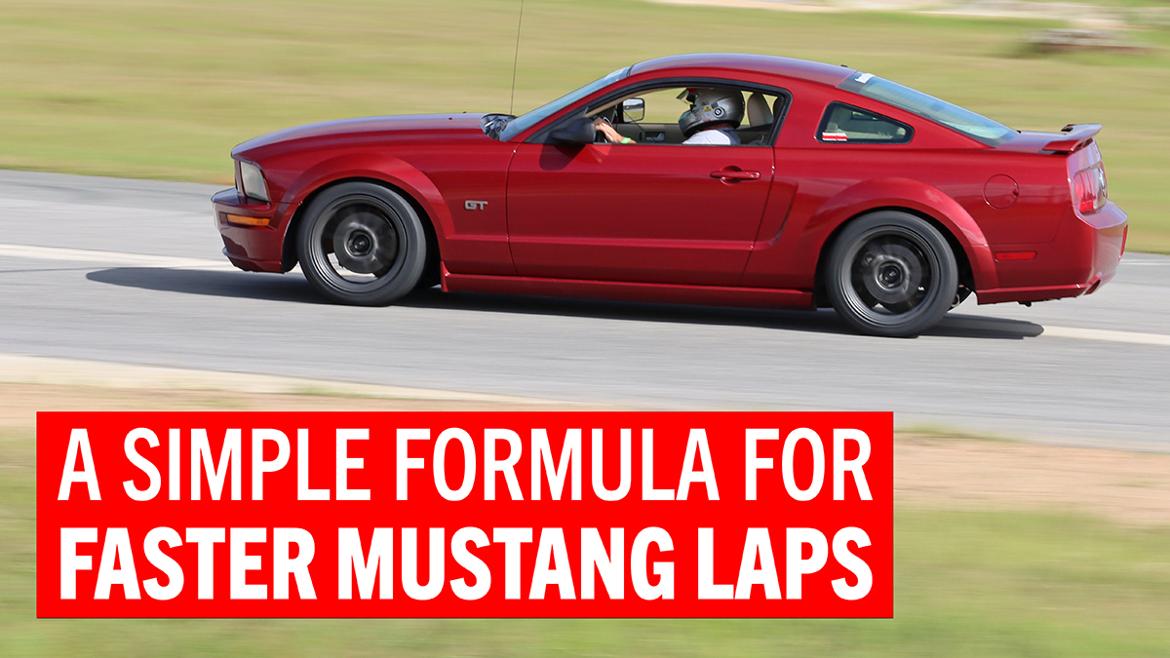
One of the great fears of upgrading a car that already has good habits: You’ll either hurt those good tendencies or, at the very least, highlight the remaining weaknesses and turn them into real boat anchors.
The second condition is usually easier to deal with and more preferable of the two, and luckily that’s where we found ourselves with our Club Spec Mustang project after its recent suspension upgrade.
This phase of upgrades to our 2006 Ford Mustang GT consisted of Koni shocks, Eibach springs and anti-roll bars, and a set of Maximum Motorsports camber plates. We also fit a set of Goodyear Eagle F1 tires on König wheels, with that wheel-and-tire setup coming from Tire Rack. (Under Tire Rack’s makes and models tab, you’ll find SCCA Club Spec Mustang listed as a separate item.)
[How we built our Club Spec Mustang in less than 6 hours]
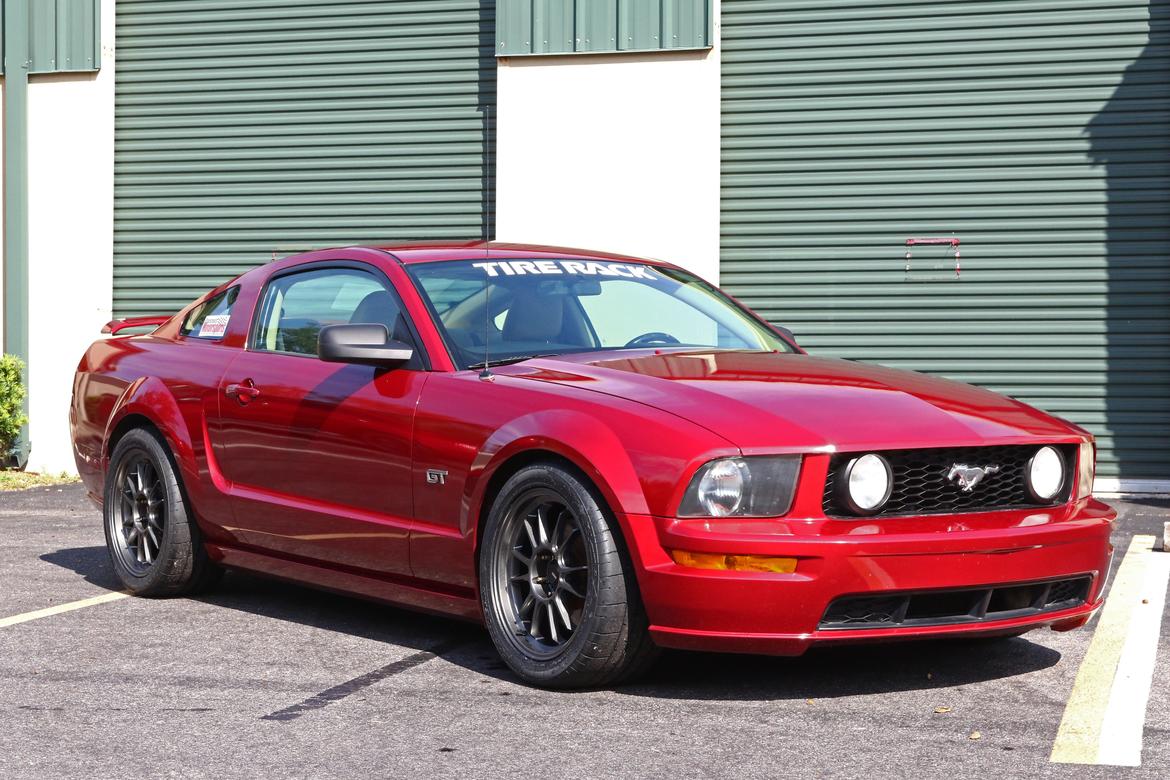
Photograph by David S. Wallens
Still on the table are a few under-car upgrades, like an aftermarket Panhard bar and third link, as well as a limited-slip upgrade for the differential, which is currently of the “one-wheel peel” variety.
Before we walk through the VBox data, note that we moved our traditional start and finish from between Turn 1 and Turn 2, the old-school start/finish line at the Florida International Rally & Motorsport Park, to the new start/finish line on the front straight.
We did this so we could get a better look at the speed traces through Turns 1 and 2, and luckily VBox’s Circuit Tools software makes it easy to place the timing segments anywhere you want with the click of a mouse.
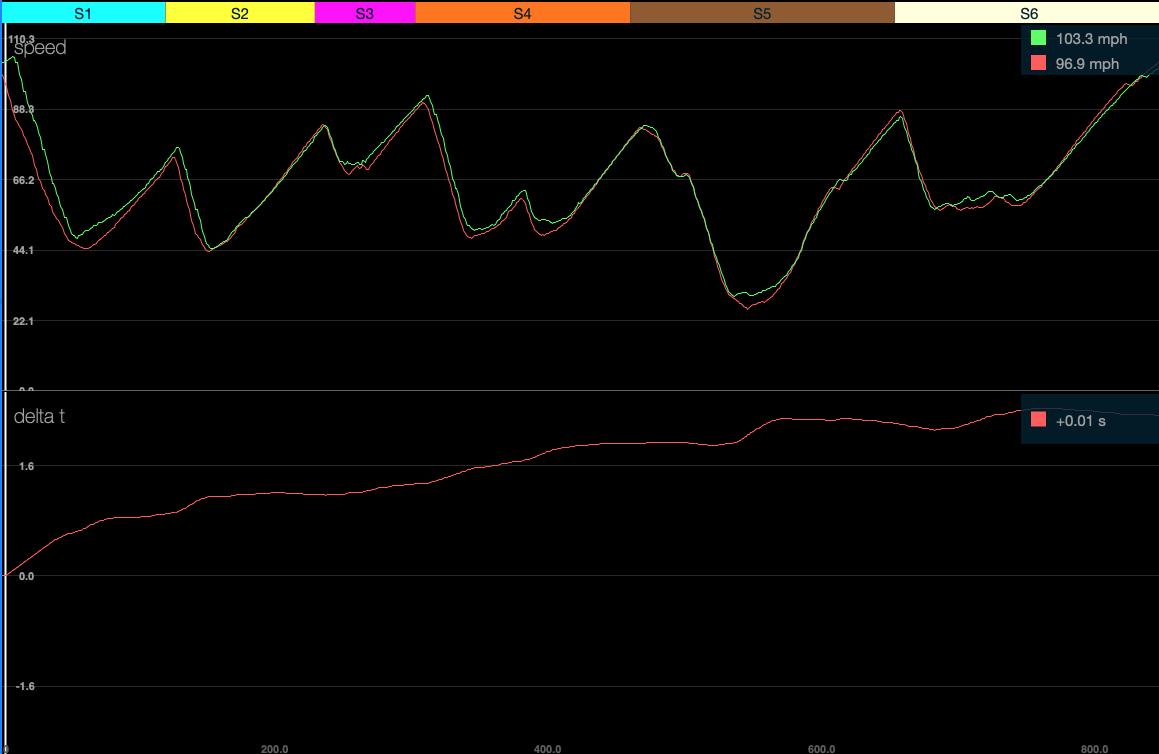
Click on the graph to open it in a new tab
And what did those times say? The upgrades to our 2006 Mustang GT shaved some 2.4 seconds, dropping us from a 1:25.04 down to a 1:22.63, putting it firmly in league with lots of modern sporty cars.
Notable was not how much faster the Mustang went, however, but how much faster we think it can go once we get a few more issues solved–particularly the differential, which is really holding back acceleration out of slow corners, and the brakes, which are inconsistent at best and downright dicey at worst. Cornering performance, still, has been dramatically improved, and the excellent steering feel hasn’t suffered a bit.
Starting in Turn 1 before we even get to the 500-foot mark, we can see a higher entry speed, less distance covered at minimum speed, earlier throttle out and higher average speed in the corner. The new (green) speed trace looks much more like a real track car instead of a street car tripping over itself.
Speed through the Turn 4 kink is also higher and smoother as you can see around the 2200-foot mark, but an upgraded differential will help here as well because any use of the inside curb just sends the inside-rear wheel into full burnout mode.
The real pain of our Mustang’s worn-out differential strikes in the hairpin, though, which comes just before the 6000-foot point. The exit is downright lazy, with our upgraded Mustang performing no better than the stock car, even though the upgrades help it to a 4-plus mph advantage in the tightest part of the corner.
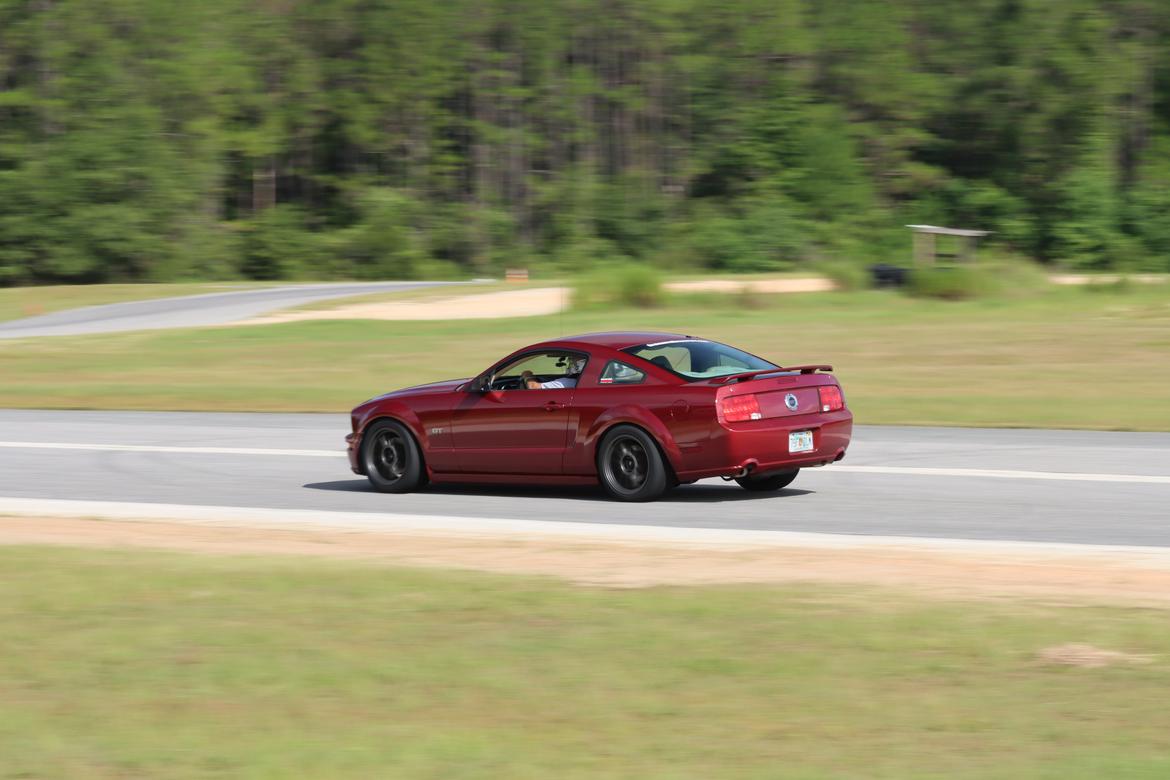
Once the power is turned on, though, wheelspin limits acceleration. If you look at the delta T graph through this area, you can see that we’re even giving back some time to the stock car since turning on the power just turns the rear Goodyears into dust.
Once we rebuild the differential and get power to both wheels–the SCCA rules provide a few options here–we should pick up several mph down the next straight, netting us a nice speed advantage into Turn 8 around the 6800-foot mark.
The brakes also need some attention, and you can see this most dramatically entering Turn 1, right at the start of the lap. The braking trace is jagged, showing inconsistent deceleration, and dear reader, that doesn’t begin to tell you how sketchy it felt from behind the wheel. Getting more consistent and smoother deceleration will pay off on corner entry, and being able to have additional feel to trail-brake and properly point the nose into corners should net significant gains.
Our newfound speed and grip, however, have uncovered another liability: the stock driver’s seat. We were expending too much energy simply trying to hold ourselves upright–especially in tight autocross maneuvers–when when should have been focused on the next corner.
Leaving the FIRM, we now see a clear path to picking up another 1.5 seconds or so, putting our Mustang on par with serious track machines like the FL5 Honda Civic Type R and, perhaps, the BMW Z4.

It really is like a different car–crisp and responsive.

In reply to David S. Wallens :
It has a "this is how the car should have left the factory" feel to it.
Way more fun to drive now.

Thanks to your earlier series recommendations, the TrueTrac diff I installed make a huge difference. So did Whiteline rear lower control arm relocation brackets. So too did Steeda front lower controls arms with longer ball joints (no more high speed judder) and their bump steer kit (very light go kart steering now). I just replaced the stock Brembo 14"/quad piston calipers with 2013 Shelby Girodisc 15"/Motorcraft rebuilt 6 piston calipers and the brakes are powerful enough to lock the 275 Goodyear F1s on dry pavement, so wider wheels/tires are a must. I'm hoping those will make some Porshes/ new Corvettes think twice about dive bombing me under braking again  . Many of these upgrades may not qualify for "spec", but the point is there's a lot that can be done with Stangs if when keeping the changes balanced.

"It's more communicative at the limit, faster around a circuit, more consistent and easier to drive."
I guess that doesn't really make for compelling magazine copy. 
Nice improvement! This has probably been covered in an article but I'll ask. Not including the purchase price of the cars how do the Club Spec Mustang and Miata compare once prices all parts to be class competitive are added up? Is one considerably less costly than the other? Is there a comparison chart of the prices of allowed mods and parts?
Thanks

My Google fooo is about zero,but where can one find the Spec Miata rules.
Thanks
Completely agree with the comments about the Updates on the Mustang.
Our 2005 has very similar suspension updates plus the Torsten Rear Differential.
The diff makes a heck of a difference getting the power on the ground.
Thanks to Fasted and Fusion 66 https://grassrootsmotorsports.com/forum/build-projects-and-project-cars/2005-gt-mustang-build-4/259783/page1/ plus the deceased Matt at Xpress the Silver Bullet is a completely different ride than the stock S197.
Proof will the the Southland Targa in the Summer of 2026
Just my $.13 worth
RacingComputers said:My Google fooo is about zero,but where can one find the Spec Miata rules.
Thanks
literally just type spec miata rules into google. Perhaps the particular organization you wish to compete in (if they have different rule sets, I don't know).
Guess I was over thinking it
Thanks

RacingComputers said:My Google fooo is about zero,but where can one find the Spec Miata rules.
Do you mean the "Club Spec Miata" (I.e NC) rules; or the "Spec Miata" (NA/NB w2w) rules?
Displaying 1-10 of 11 commentsView all comments on the GRM forums
You'll need to log in to post.