


Guess I'm going to have to try driving in automatic next time I'm on track... great article!



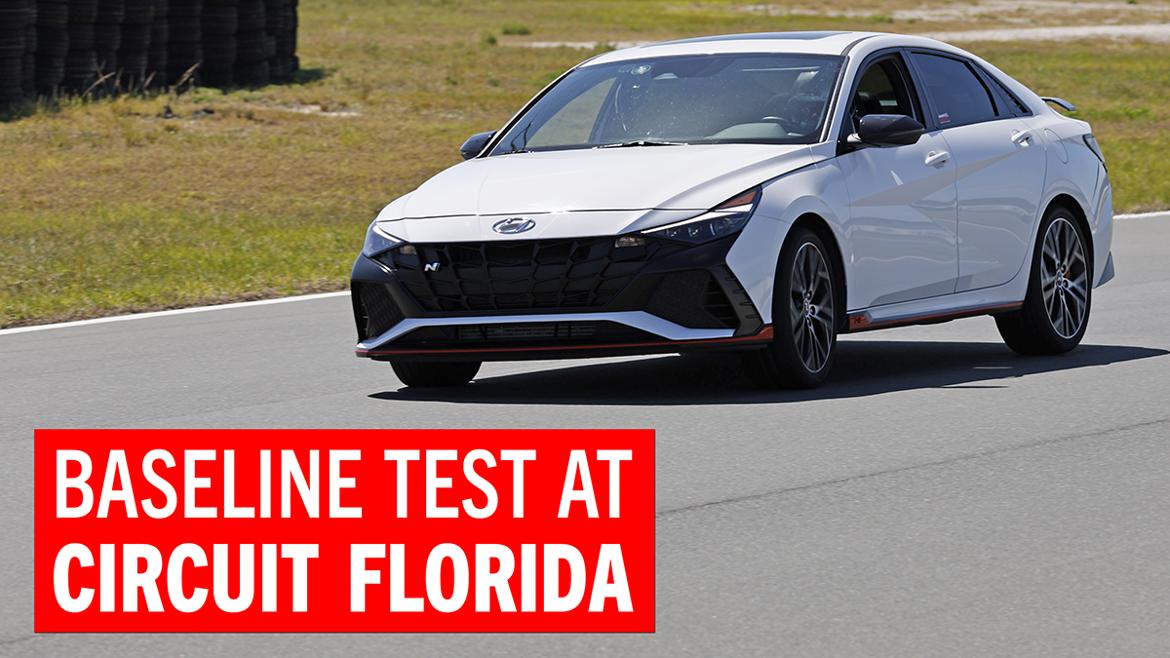
Photography by Chris Tropea
Speed and comfort.
You need those two things on the One Lap of America. The event packs 18 events–autocross, time trials and drag racing–plus more than 3100 miles of transits into one week.
Experience told us that the Hyundai Elantra N should do well both on and off the track. We’ve put hundreds–thousands?–of miles on these cars over the years, while our own track testing of cars pulled from the press fleet has impressed us: These are shockingly track-capable machines right off the showroom floor.
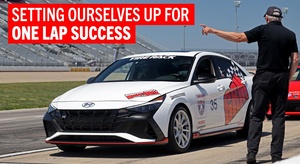
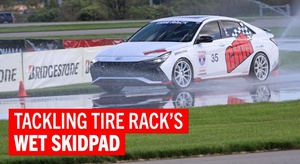
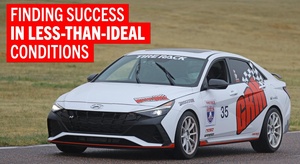
How good was the Elantra N that we just bought for this year’s Tire Rack One Lap of America Presented by Grassroots Motorsports? Before prep works begins–and the event starts in less than two week–we ran ours at Circuit Florida.
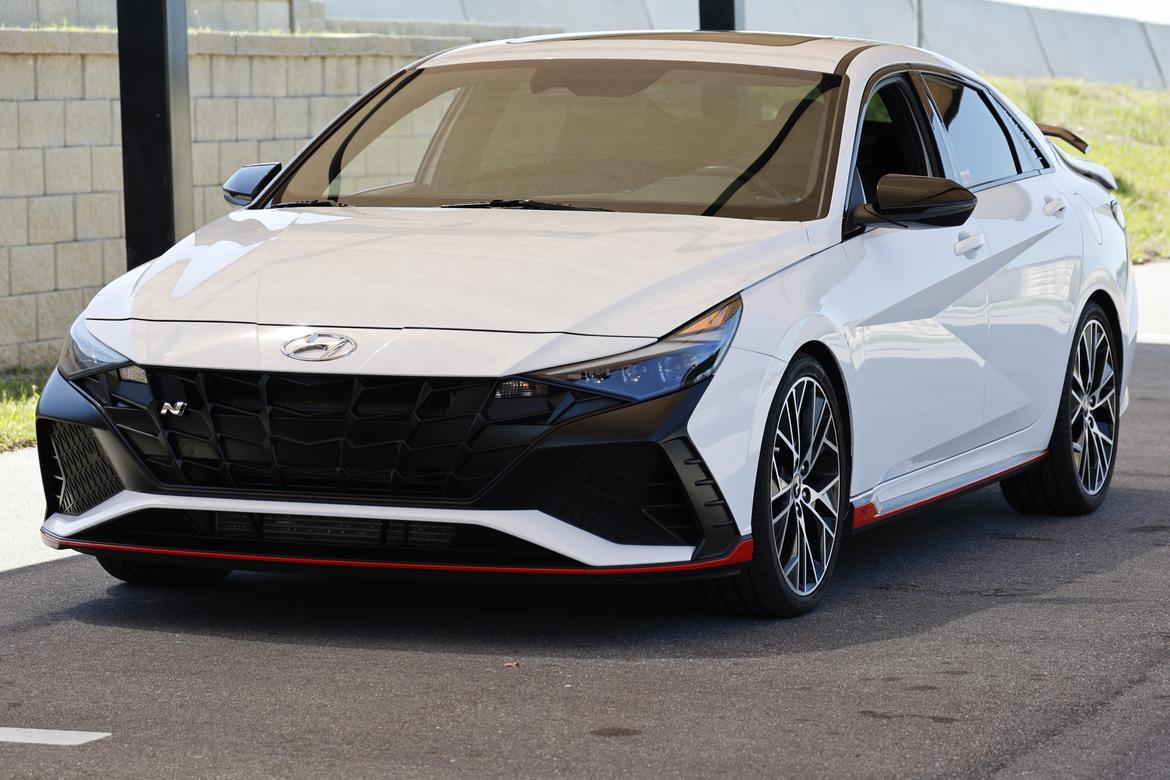
Our Elantra N was already running at somewhat of a disadvantage thanks to mismatched Falken and Michelin rubber at various corners plus unknown alignment settings, but that’s why they call it a baseline.
The Elantra N makes a strong first impression by how well it engages all four wheels in cornering. Yes, you absolutely CAN spin an Elantra N–ask me how I know–and that’s because, unlike so many other FWD performance cars, its default failure when you overcook the traction limits isn’t simply terminal understeer. The rear end carries its fair share of the load and then some, and a communicative brake system lets you precisely dial the load to those rears, particularly in early phases of cornering.
The whole dynamic presence of the Elantra N has a big “factory hotrod” vibe about it. And, well, that makes sense because that is actually what the Elantra N is, but so many sedans signaling their performance intent are little more than glorified badge packages and fancier wheels. The Elantra N has a bit of a raw edge to it that is just an utter delight on track.
Despite the exceptional chassis and the great brakes, the Elantra N’s real killer app is its eight-speed, dual-clutch transmission and associated brain. Shifts are instant and seamless, with the electronic controls doing an exceptional job at minimizing–or, more accurately, eliminating–torque spikes and driveline reactions during shifts.
Running out of gear during a long corner exit? No sweat. You can make that upshift with little to no additional correction with wheel or throttle aside from what you’re already doing to negotiate the corner. Downshifts have a bit more of an effect on chassis stability, but the platform communicates its attitude quickly and precisely, so there’s minimal destabilization.
But the Elantra N DCT’s true party trick is how effective it is in fully automatic mode. Like, we aren’t just talking about D being good enough; it might even be the best option for fast laps.
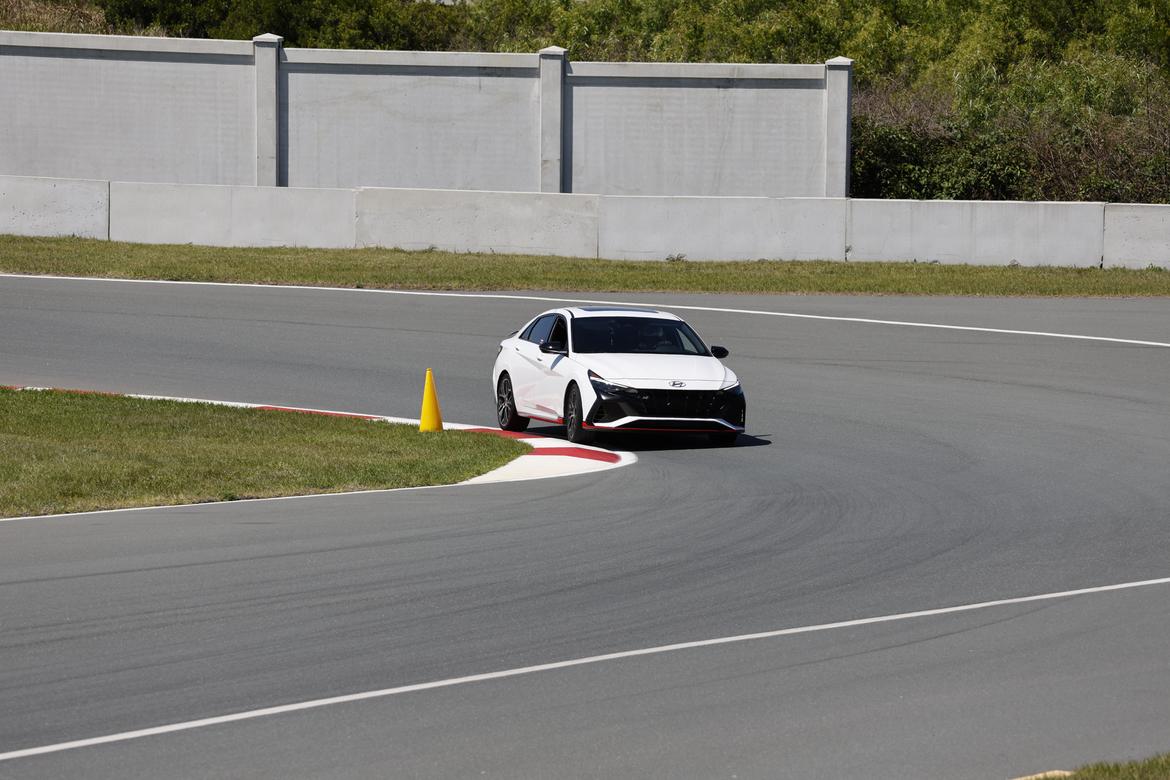
In full-automatic mode, the DCT is willing to make its lightning-quick up- and downshifts anywhere and everywhere. This simply keeps the engine in its powerband at all times.
This was particularly helpful in the transition-heavy middle section of Circuit Florida, where the DCT was more than willing to snap off a quick upshift that it would hold for only 80 feet or so before dropping back down a gear on its own as we bent into the next corner–all while all 10 fingers were wrapped firmly around the thick, well-placed wheel.
In fact, our best lap of the day was achieved with the car in D, not in M. If the purists were freaked out by DCTs replacing stick-and-clutch manuals, now the DCT purists have something new to be worried about.
The only bit of learning curve we had to work around in full-automatic mode was the timing of the 3-2 shift entering certain corners. The computer delayed that shift longer than our internal rhythm might have dictated, so you kind of have to time your turn-in with that downshift. That’s because if you initiate the direction change prior to the downshift, it might not give you the downshift that’s more ideal for lap times.
We didn’t notice this timing discrepancy in 4-3 corners, though. And again, lap times were as good or better in automatic mode, so this maybe says as much about how we were doing it wrong in manual mode as it does anything else.
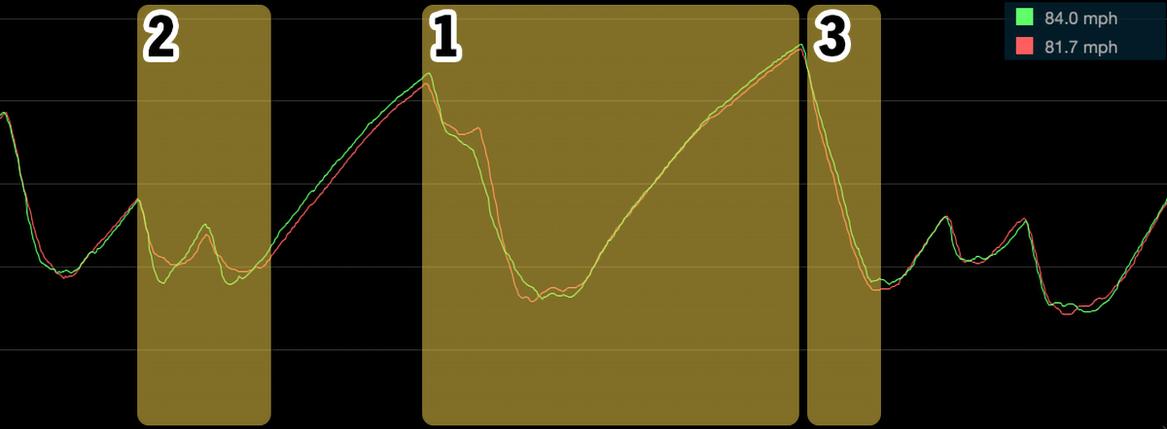
1. N Grin seems to have the most visible effect once the Elantra N is in fourth gear. You can see that the acceleration stays strong in both of these sections after the 3-4 shift on the laps where we engaged N Grin (green trace) versus the lap where we didn’t (red trace). It’s not dramatic, but it is noticeable, and when thousandths of a second count, we’ll take whatever we can get.
2. In manual mode (red trace), we were entering corners faster than we were in automatic mode (green trace) because the automatic mode slightly delayed that 3-2 downshift a bit longer than we did. While the delta graph shows that we lost a little time on corner entry, we gained a ton of time back on exit and down the subsequent straight. “Slow in, fast out” seems to be a real thing after all.
3. This was our most dramatic jump in the delta graph, and it was mostly due to a cleaner brake application and a better entry into the right-hand corner at the end of the straight. Chalk this one up to getting used to the car after a few laps and just executing well on this particular lap. It’s a good indication of how drivable the Elantra N is and how quickly a driver can access 100% of its considerable capability.
This shift-timing discrepancy meant that we entered a few slower corners a couple mph slower in auto mode than in manual mode, but exit speeds were better, and the VBox data showed an overall time improvement from those sections despite the slower entry speeds.
We also experimented with the N Grin Shift button, which supposedly provides a 20-second period of additional boost with a mandatory rest period of about 40 seconds in between uses.
Results were … inconclusive?
We used N Grin on the two longest straights of Circuit Florida, and the VBox’s delta graph showed improvement on both sections–but it certainly wasn’t dramatic.
There’s a slightly better acceleration rate in fourth gear, but very slight. On the longest, straightest straight, it was enough to add a single mph to terminal velocity, which is certainly not a definitive indicator. It really warrants more testing on longer straights–or even on a dyno or drag strip–to get a proper picture of how it works and what it accomplishes. At this point, there are too many variables and too small a sample space to draw any real conclusions about N Grin’s true benefit–aside from the cool light show on the dash when you activate it.
Our 35,000-mile example lapped Circuit Florida with a best time of 1:36.15, which is just over a second faster than a Subaru BRZ tS. That lap time was achieved in automatic mode, and the car was around 0.7 second slower in manual mode.
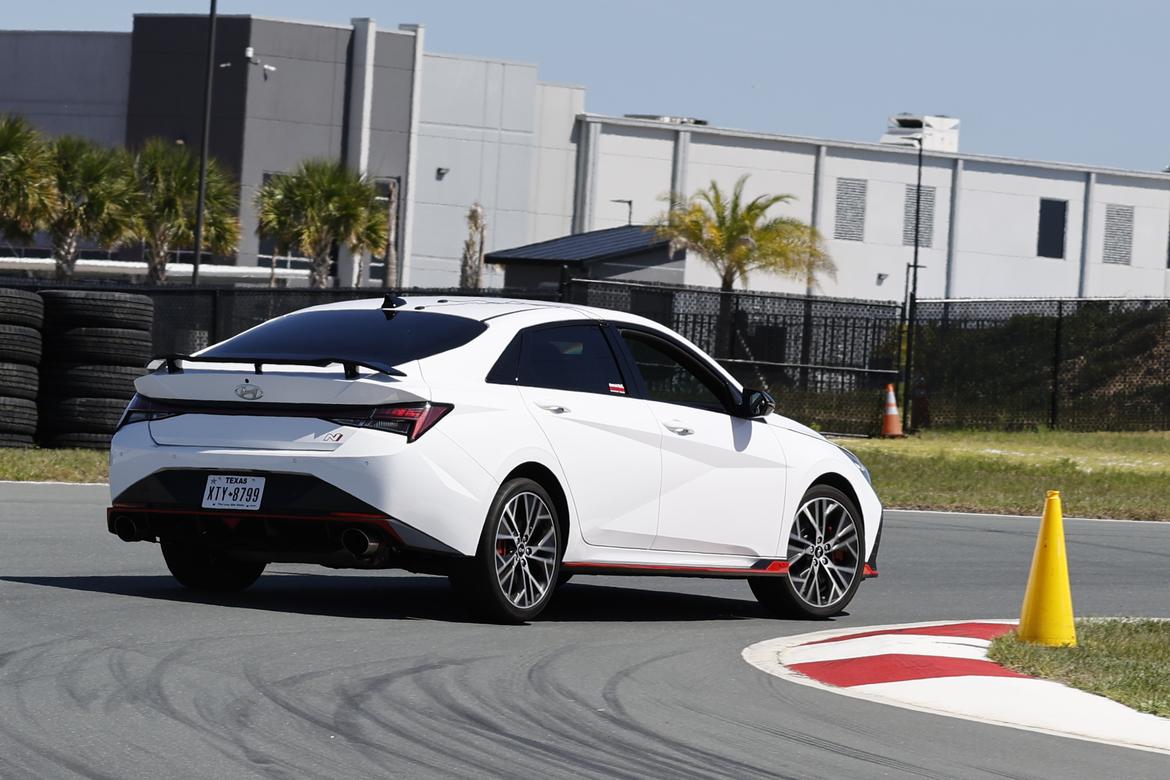
Looking at the data, we could have achieved similar lap times in manual mode, but one advantage of automatic mode is that it showed us a couple spots where we could have been more aggressive with up- and downshifts. On an event like One Lap of America, where you have almost zero time to work out a proper strategy on track before you have to lay down a time, the automatic mode is going to be a huge ace in the hole for banging off a solid lap with little to no practice.
One thing Elantra N owners will naturally ask, Did you do the octane learning procedure after filling the tank? And the answer is yes, we did. That involves driving at highway speeds for 10 minutes every time the tank is filled. Without octane learning, peak boost is reduced by 3 to 4 psi.

Guess I'm going to have to try driving in automatic next time I'm on track... great article!

I've always been happy with mine just leaving it in auto mode. Did you turn ESC all the way off?

digijoe said:Guess I'm going to have to try driving in automatic next time I'm on track... great article!
Yeah it was honestly a bit shocking. Part of me didn't;think want it to be so good, but now I know how the manual purists felt when DCTs started hitting. It really is super smart.
turboshadow said:I've always been happy with mine just leaving it in auto mode. Did you turn ESC all the way off?
ESC and traction control al the way off, N1 mode, stick in D.

The downshift anomaly is the main reason I don't like automatics or auto mode. I find mistimed downshifts annoying.
With that said if I were competing in the car than I would indeed use auto mode as you did for at least the first session.
The question I have is can you simply override the auto mode in places where you need to? Basically can you quickly switch it on and off?

I haven’t followed Elantra N’s closely… but is it known what’s different in the suspension compared to the based Elantras? I.e, we know about the wheels and tires. I assume there’s differences in the shocks and springs. But are there custom bits in the uprights and LCA (ala Civic Type R) in the N?
Tom1200 said:The downshift anomaly is the main reason I don't like automatics or auto mode. I find mistimed downshifts annoying.
With that said if I were competing in the car than I would indeed use auto mode as you did for at least the first session.
The question I have is can you simply override the auto mode in places where you need to? Basically can you quickly switch it on and off?
I wouldn't so much say that the timing was wrong, just that it didn't match my typical rhythm. I'm definitely willing to hear its opinions if it means the lap times go down.
I think overriding it would be as easy as sliding the lever into the manual gate then back into the D gate after you passed the section you wanted to take control for.

sleepyhead the buffalo said:I haven’t followed Elantra N’s closely… but is it known what’s different in the suspension compared to the based Elantras? I.e, we know about the wheels and tires. I assume there’s differences in the shocks and springs. But are there custom bits in the uprights and LCA (ala Civic Type R) in the N?
From my limited knowledge, the extra $$ for an N over base gets you these performance upgrades:
Adaptive Dampers and Sport-tuned suspension
Multi-link rear suspension (I assume base has twist beam?)
More power (276 vs 147)
DCT or stick vs CVT
19" wheels/better tires -- PS4S
eDiff
There is also a mid-tier package called "N Line" which has some of the above but not all.
N also comes with a bunch of interior bits and the like that make you feel like the car is faster. That's worth something, right?
In reply to JG Pasterjak :
In my wife's first Santa Fe I used to do the manual gate shuffle and that worked pretty well.
Andy Hollis said:sleepyhead the buffalo said:I haven’t followed Elantra N’s closely… but is it known what’s different in the suspension compared to the based Elantras? I.e, we know about the wheels and tires. I assume there’s differences in the shocks and springs. But are there custom bits in the uprights and LCA (ala Civic Type R) in the N?
From my limited knowledge, the extra $$ for an N over base gets you these performance upgrades:
Adaptive Dampers and Sport-tuned suspension
Multi-link rear suspension (I assume base has twist beam?)
[…]
N also comes with a bunch of interior bits and the like that make you feel like the car is faster. That's worth something, right?
oh, looks like you’re right on the twist beam (via cars.com/research/compare):
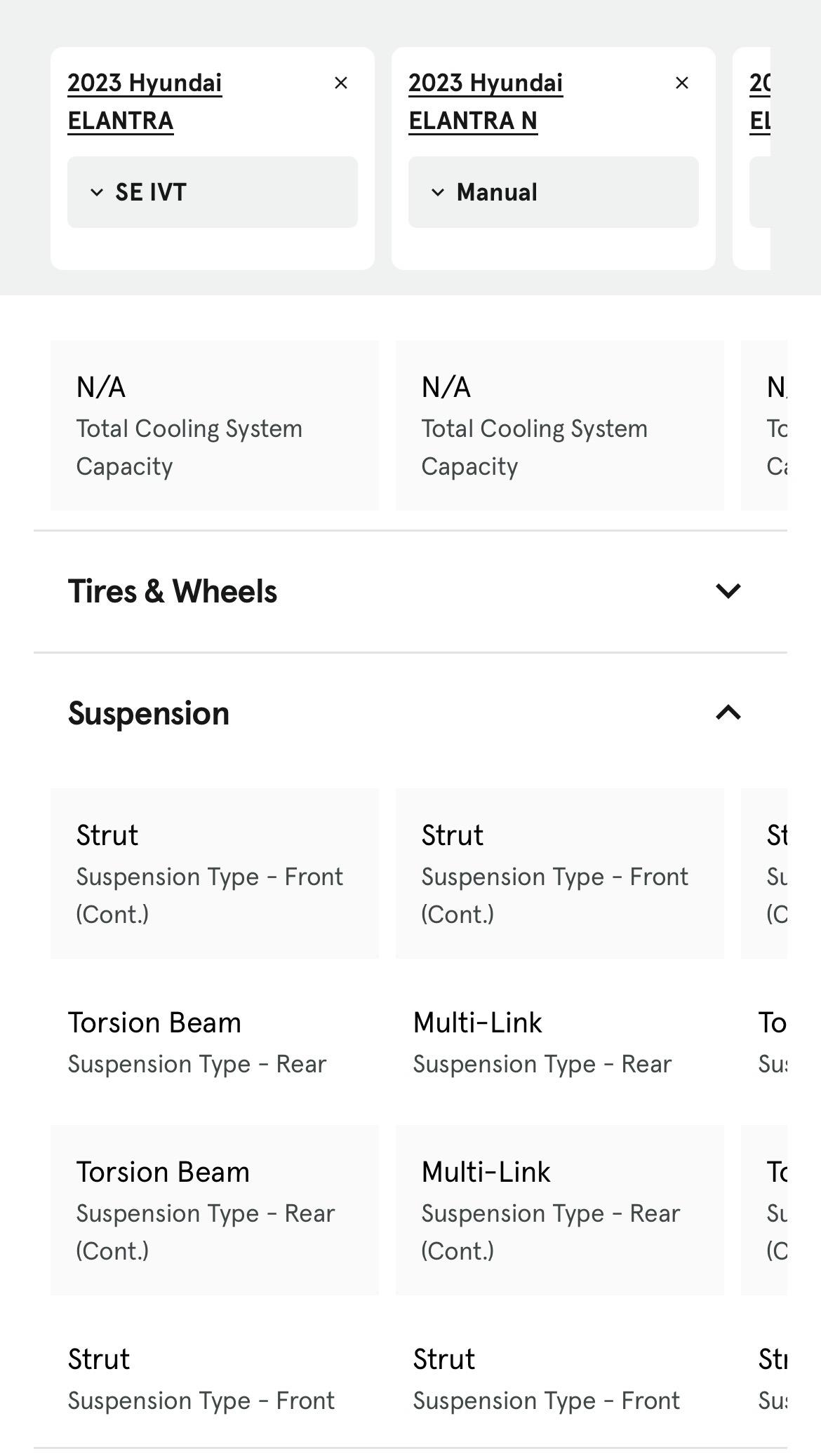
so much for “N-ifying a base or HEV {what I’d be more curious to do} Elantra”.
re: Fancy Interior Bits Make One Faster
I’ll agree to it.
Displaying 1-10 of 32 commentsView all comments on the GRM forums
You'll need to log in to post.