1998-2007 BMW 3 Series
The E36-chassis BMW M3 is a wonderful car, and we’ve been saying so since its introduction more than 20 years ago. The M3 simply has it all: great brakes, a balanced chassis and plenty of power. So in addition to commuting and highway cruising, it excels in nearly any motorsports arena, from autocross and track days to road racing, drift and even rally.
One small dose of reality: Many of those same M3s are now 20-plus years old, and they’re aging day by day. While the drivelines have proved to be tough, the same can’t exactly be said for the interiors. Plus, the exteriors look a bit dated, and not in that classic, early-E30 way.
What’s a BMW-desiring human to do? Look at the E36’s follow-up, the E46. The E46 M3 is still a pricy date, so concentrate on the bread-and-butter 3 Series models–anything with a 325i, 328i or 330i badge on the tail end. Choose from a wide range of body styles, too: sedans, coupes, convertibles and even wagons.
Our favorite is the 330i. It commands a premium if fitted with the ZHP performance package, so just seek out a good 330i. Call it the best of the rest. You can also call it a budget E36 M3, since the 330i puts down 225 horsepower–only 15 less than the fabled M3 and with just a slight weight penalty.
Expert Advice
Rennie Bryant
Redline BMW Performance
“Look for low-mileage, adult-owned cars with service records. Stay away from salvage title and flood-damaged cars. Convertibles can be problematic and expensive to repair, so unless you specifically want one, stay away from those, too. And keep in mind that an automatic transmission needs to be rebuilt at around 150,000 miles.
The first thing to do when you get one of these cars is change all the fluids and filters. The biggest failure is a cracking of the rear subframe mounting points, so look closely at the four places where the bolts hold the subframe to the body. Look at the valve cover gasket and oil filter housing gasket, too, as they are prone to leaking. Also inspect the lower control arm bushings, a common failure point.”
Behind the Wheel
It’s an updated take on the proven E36: airy cockpit, great ergonomics and that smooth inline-six.
The Takeaway
It may lack some of the M3’s bite and its limited-slip diff, but a 330i makes a great daily driver or track toy.
1990-2005 Mazda Miata
We’re going to make this one easy: Simply buy the nicest $5000 Miata you can find. Don’t get too hung up on year or option package. Get thee a Miata.
By now, everyone in class should be familiar with the Miata story: Mazda pretty much reintroduced the concept of the lightweight roadster with the original NA-chassis model, which ran from 1990 through 1997. The NB chassis took over for the 1999 model year and ran through 2005. Technically, no, there wasn’t a 1998 Miata.
The earlier cars offer less power but slightly classier looks–hey, we’re suckers for those flip-up headlights, chrome door handles and other timeless details. In stock form the later cars offer more performance, but in most cases backdating parts is a bolt-on proposition.
Those first Miatas have now roamed the planet for more than a quarter-century, and while they’re aging well, there are some rusty, worn-out cars in the mix. Once you find a solid example, plan on spending a long time with it: The Miata is a keeper.
Expert Advice
Bryan Goodwin
Good-Win Racing
“We suggest searching for an NB Miata with as little mileage and damage as possible. The 1999-2000 cars are your best performance option, but if competition and track time aren’t in your plans, we recommend the much more reliable 2001-’05 cars.
Check engine lights and leaks are always a concern. Check any codes and avoid any cars that are running poorly.
Once you’ve bought the car, go ahead and change the fluids, belts, plugs and plug wires if you lack full service records to prove it has been done recently. These cars are amazingly reliable with reasonable care.”
Behind the Wheel
Here’s all you need to know about driving a Miata: The top goes down, the chassis is totally balanced, and never before has an engine with less than 150 horsepower felt so adequate.
The Takeaway
Every few years, the market welcomes another “Miata-killer.” Notice how most of them are no longer in production?
1994-2005 Ford Mustang
The Ford Mustang has represented a performance value for half a century. For about $25,000–entry-level-minivan money nowadays–the latest Mustang offers a minimum of 300 horsepower along with head-turning looks and a willing chassis.
Small problem, though: Late-model Mustangs have been maintaining their value quite well, so even a 10-year-old GT will run you about $10,000.
Have your heart set on a pony car but only have half that budget? Look earlier. No, not at the Fox-body cars, since those are either totally worn-out or appreciating in value. We mean the SN95 Mustang, a solid $5000 purchase today.
The SN95-chassis Mustang first appeared for the 1994 model year and carried on through 2004, with one major exterior makeover in between. Both of its body designs–the curvy first silhouette and the aggressively arched and angular second one–were fairly revolutionary upon their release.
Underneath, though, much carried over from the previous Fox-body car, including the strut front suspension and four-link rear suspension. While a V6 engine came standard, let’s just jump to the Mustang GT and its standard V8–the tried-and-true 5.0-liter at first and then the overhead-cam 4.6 starting in 1996.
Expert Advice
Scott Boda
Steeda Autosports
“The 1994-’95 Mustang GT is a good car to target since they were the last ones that came with the pushrod 5.0-liter V8. Avoid the 1996-’98 GTs. If you must buy a car with modifications, try to ensure that most of the aftermarket parts came from the same company.
Once you have the car, change the oil, make sure to use premium fuel, and help preserve the paint with a wash and wax.”
Behind the Wheel
The SN95 Mustang seemed so futuristic when it first debuted, especially inside: Curving, sweeping lines replaced the harsh angles and ’70s decor that dominated the Fox car. Today, well, some of those design elements seem a bit dated, especially the dual cockpit pods–one for the driver and another for the passenger.
The Takeaway
Is this the most advanced car on our list? No, not really. But hey, it’s a Mustang, and that opens the door to all sorts of Mustang perks: a V8 engine, rear-drive handling and a very, very healthy aftermarket.
2002-2006 Acura RSX
Those old wishbone Hondas may seem like unassuming compacts, but their incredible foundations make them true works of art. From the end of the 1980s into the first innings of the 2000s, front and rear double-wishbone suspensions graced the Honda Civic, Honda CRX and Acura Integra siblings. Camber gain gives them great handling, and their ride heights can be lowered with relative abandon.
On top of that, their drivetrains have a Lego-like ability to mix and match. Integra-powered CRX? Done. Boosted engine? Easy. Bolt-on turbo kits–plus every other conceivable hop-up part–quickly flooded the aftermarket as these Hondas dominated the day’s sport compact scene.
Then reality caught up. So many of these cars were stolen, trashed, chopped and subjected to questionable modifications that the seemingly infinite supply started to dry up. A tendency to rust, especially in the back corners, further chipped away at their numbers.
The 2000s brought more blows: Honda’s new-for-2001 Civic scrapped the front double wishbone in favor of struts, and Subaru’s new WRX delivered turbo performance in a simpler, turnkey package. Plus, you really can’t drift a front-driver. The EP3-chassis Civic Si never really caught on, earning cult-classic status at best.
Honda’s one last salvo landed in Acura dealerships: the RSX. Yes, it had struts up front, but when equipped with the Type-S package, it also had 200 horsepower on tap. Unfortunately, it was late to the sport compact party, arriving just as the scene was fizzling out. That bad timing is good news for you, though: It spared many examples from the full “The Fast and the Furious” treatment.
Expert Advice
Chris Dye
K Series Parts
“Look for a 2002-’04 RSX Type-S, since the ECU is cheaper to modify. The RSXs are very reliable, so mileage isn’t a huge issue. Stay away from heavily modified cars unless the seller obviously knows his stuff. Steer clear of automatics, too.
After buying one, make sure all of its suspension and steering components are fresh. Liven it up with a cold-air intake and either a Hondata or K-Pro reflash.”
Behind the Wheel
No Civic ever felt this nice. The RSX delivered a truly upmarket feel thanks to nicer fabrics and improved details.
The Takeaway
Once you work out the kinks in the suspension–a big rear anti-roll bar goes a long way–the RSX feels right at home on track.
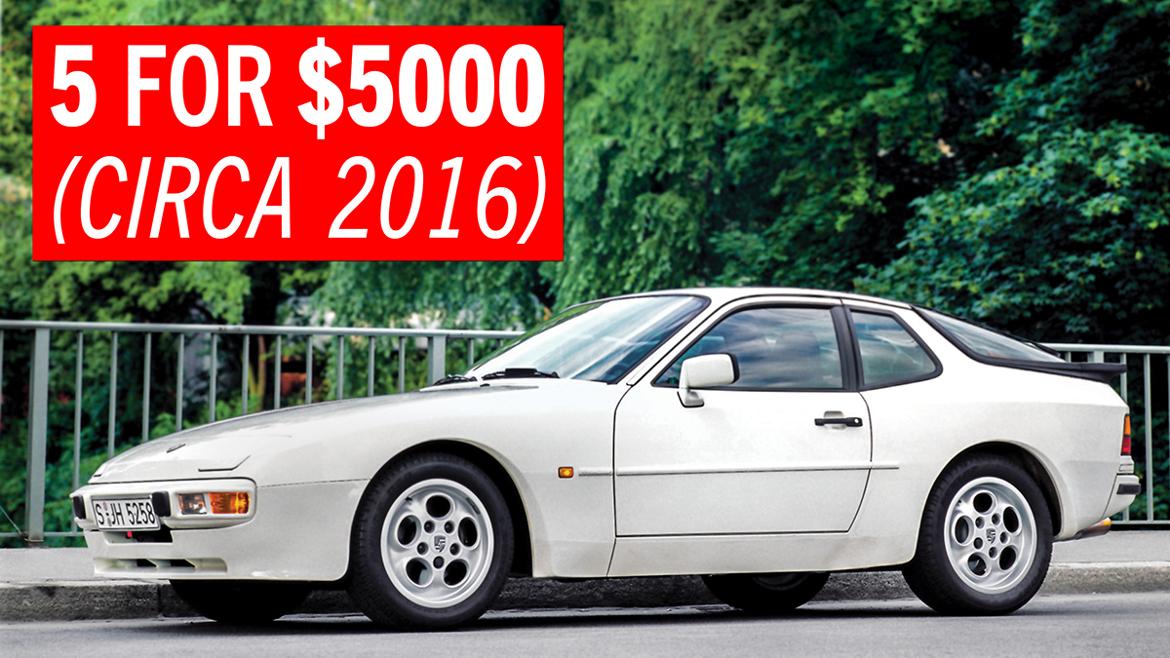
1983-1991 Porsche 944
Let’s say you have a hankering for something a little exotic. And European. Something with international racing heritage at the highest level of motorsports. It has to be fun to drive, too, of course.
The Porsche brand is the manifestation of those desires, even once you add a sub-$5000 price tag to the list of requirements. Yes, values for air-cooled 911s have shot through the roof and are quickly approaching the Outer Rim Territories, but there’s another whole phylum of Porsche that the collectors have missed–so far, at least.
Meet the 944.
This one picked up where the Audi-powered 924 left off, welcoming a proper Porsche engine into that timeless body. When cooking up the 944, the factory upgraded the brakes, reworked the suspension, and flared the fenders (and as we all know, box flares are cool). The track-worthy, rear-mounted transaxle, meanwhile, carried over into the new car.
Over its decade-long production run, the 944 came in several flavors, from the base eight-valve cars up through several turbocharged variants. Our advice: Buy the cleanest, best example for your price range. In our book, there’s no shame in choosing a known ownership history over a turbocharger.
Expert Advice
Lou Verdiales
Aero Dynamics
(386) 304-0380
“Run away from any damaged or overheating engines. Vital components to check are the cam timing belt, balance shaft belt, belt rollers and water pump. The condition of the hoses can also indicate how well the car has been maintained. Many 944s rust where the battery sits from past acid leaks, so be prepared to patch any holes in this area–and check all grounds while you’re at it.
Bottom line: Never buy a nonrunning car, and always have an experienced party do a prepurchase inspection.”
Behind the Wheel
Warning: The original 944’s dashboard contains angles, as it hails from a time when the VW Rabbit was fairly modern. The steering column also doesn’t move, so either the wheel is in your lap or it isn’t. A mid-1985 refresh updated the interior, but either way this is an unapologetically old-school driver’s car.
The Takeaway
If you end up putting a Porsche in your driveway, make sure to join the Porsche Club of America. “It’s about the people, not the cars” is the group’s constant refrain, and you know what? They’re right.