Back in the simpler times of the 1980s, the world celebrated mini-pickup trucks as more than just economical alternative for hauling some cargo. Thanks to their low cost–many well-equipped small trucks could be had for less than $10,000–plus utility and economy, mini-trucks also had a magnetic appeal to a lot of young buyers–particularly young males–who wanted to express themselves through their vehicle.
And it kind of makes sense. Small trucks of the time were light. They also had manual transmissions, torquey engines and gear ratios suited to hauling cargo. Not so ironically, that combo was also well suited to hauling ass.
These mini-trucks of the era became a bit of all things to all people. They were utility vehicles for anyone taking their Jet Ski to the lake or operating a lawn care business. At the same time, they were a reasonable and personalizable alternative to a sports car or muscle car for first-jobbers who wanted something simple and fun.
The SCCA even got in on the party by introducing a pro racing series for mini-pickups, which produced some of the most exciting wheel-to-wheel competition of the early showroom stock era.
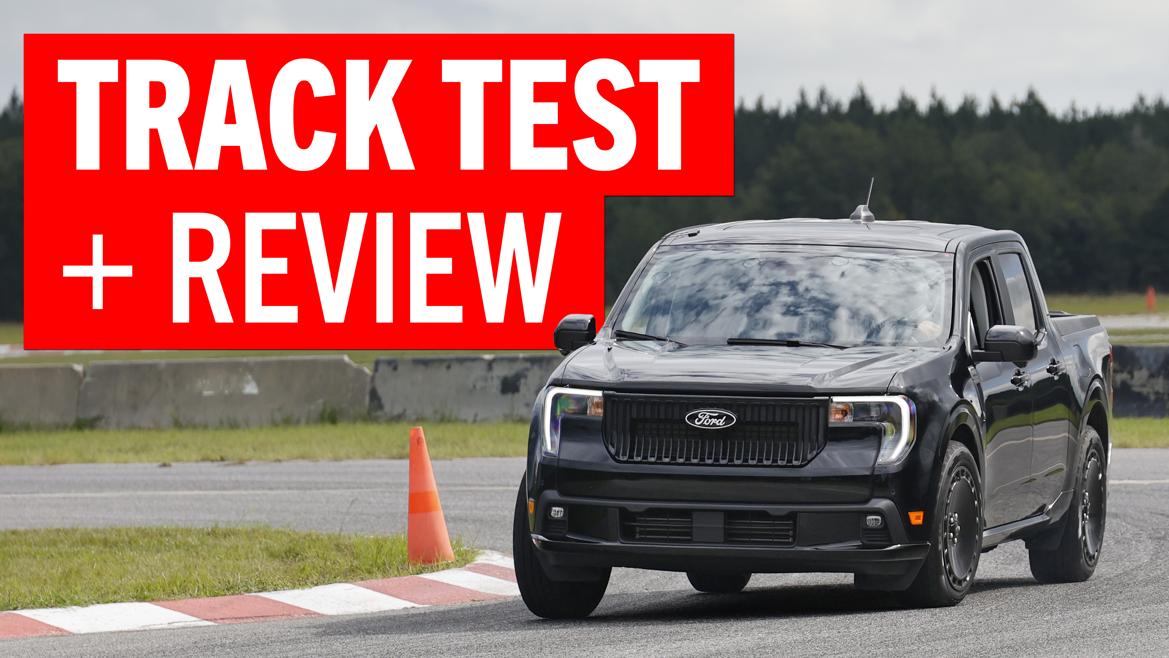
Fast-forward to today, and we have the Ford Maverick Lobo. First, we have to hand it to whoever slammed their shoe on the table and championed this thing in Ford boardrooms against what had to be overwhelming opposition.
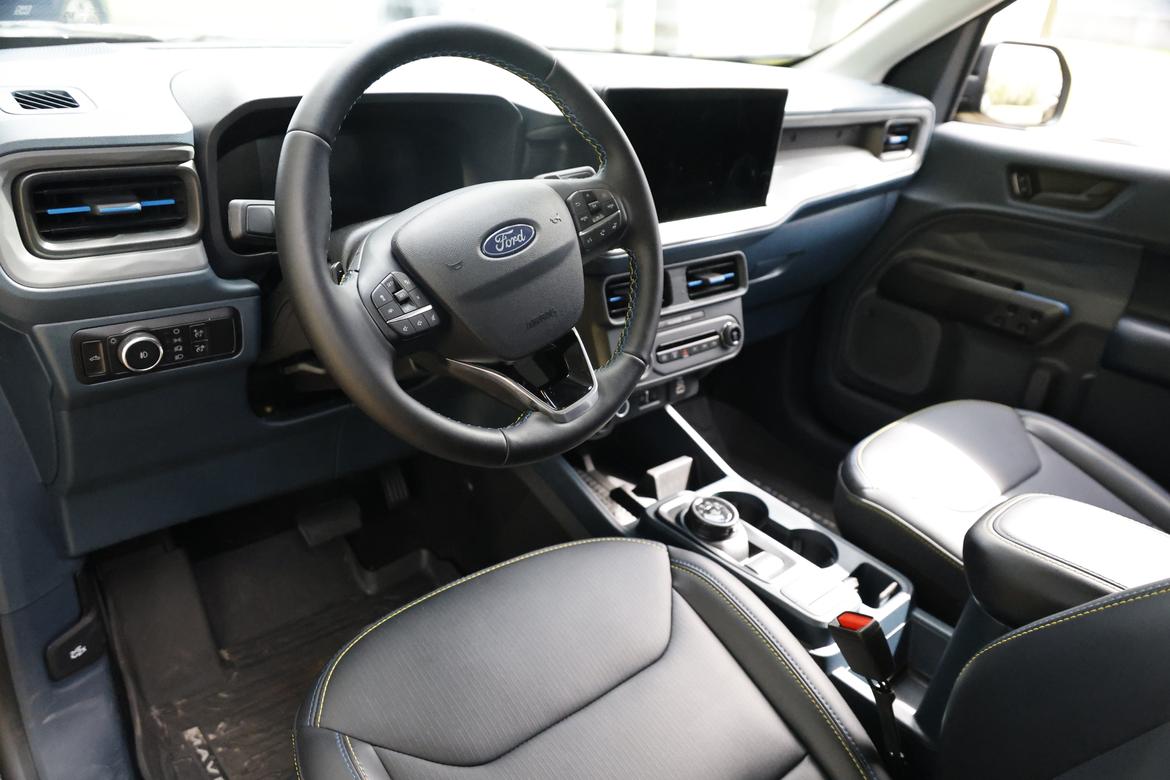
There’s just not much of a case to be made for a small truck with a “Track” setting in the drive mode options, so the fact that it exists at all is already a small win. That said, the execution doesn’t quite live up to the idea, but we’ll get into that shortly.
First, let’s talk a bit about what the Maverick Lobo actually is, and that all starts with a standard Ford Maverick platform. Instead of the hybrid drivetrain, though, the Lobo gets a 2.0-liter EcoBoost producing 250 horsepower at 5500 rpm and 277 lb.-ft. of torque at 3000 rpm. It’s a grunty and flexible engine through most of the rev range, which is probably why Ford dropped a gear, giving the Lobo a seven-speed transmission while the regular Maverick gets eight speeds.
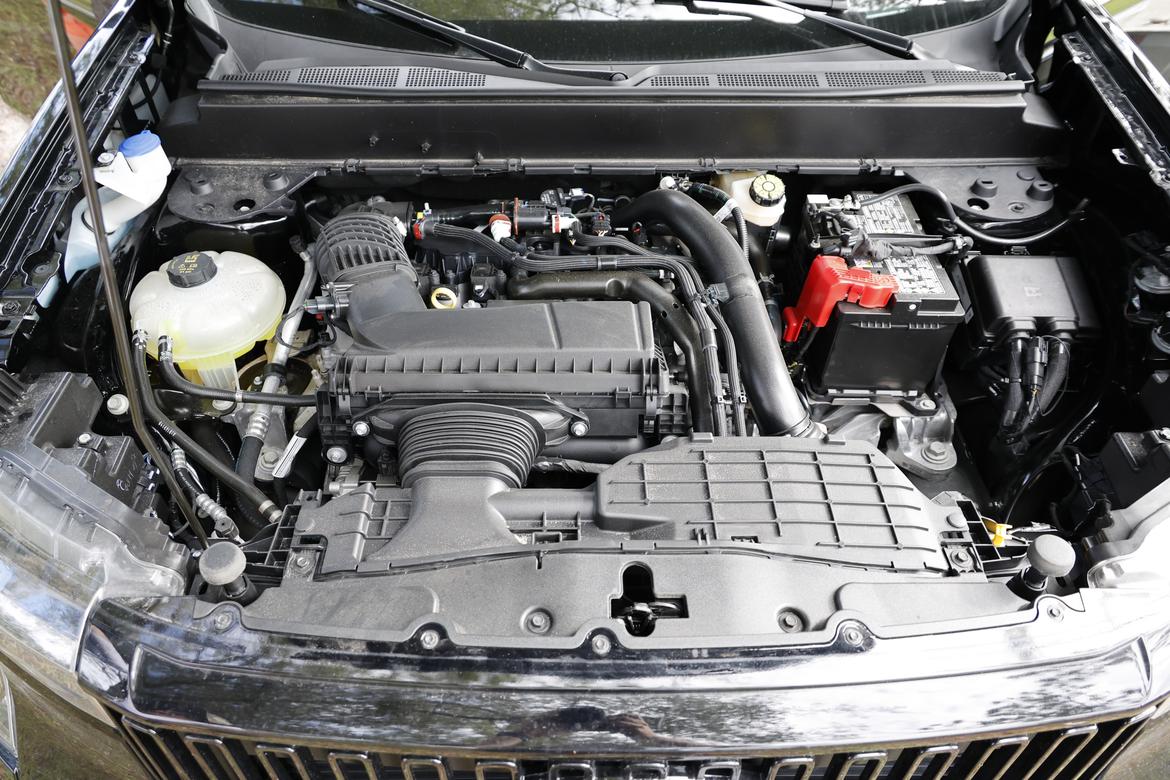
In reality, they’re the same transmissions, but the Lobo’s skips the second gear found in the regular Maverick. The 4.69:1 first gear remains in both trims, as do the rest of the gear ratios.
Underneath, the Lobo has more in common with a modern sporty sedan than a retro mini-truck, with struts in the front and a multi-link trailing arm independent suspension in the rear.
A torque-biasing rear differential handles traction duties out back, and the Lobo is dropped 1.1 inches in the rear and half an inch in the front, giving it a slightly more athletic stance. That stance may contribute to the Lobo’s reduced tow capacity, though, as Ford lists only a 2000-pound tow rating for the Lobo–even though it’s the most powerful Maverick on the option sheet.
Ford also upgrades the Lobo with a few other goodies from the parts bin, like 13.0-inch front rotors and larger calipers and pads from the Euro-Spec Focus ST. We had few complaints about the brakes on the Lobo, even on track, although they did feel a bit taxed after a few hot laps of the Florida International Rally & Motorsport Park.
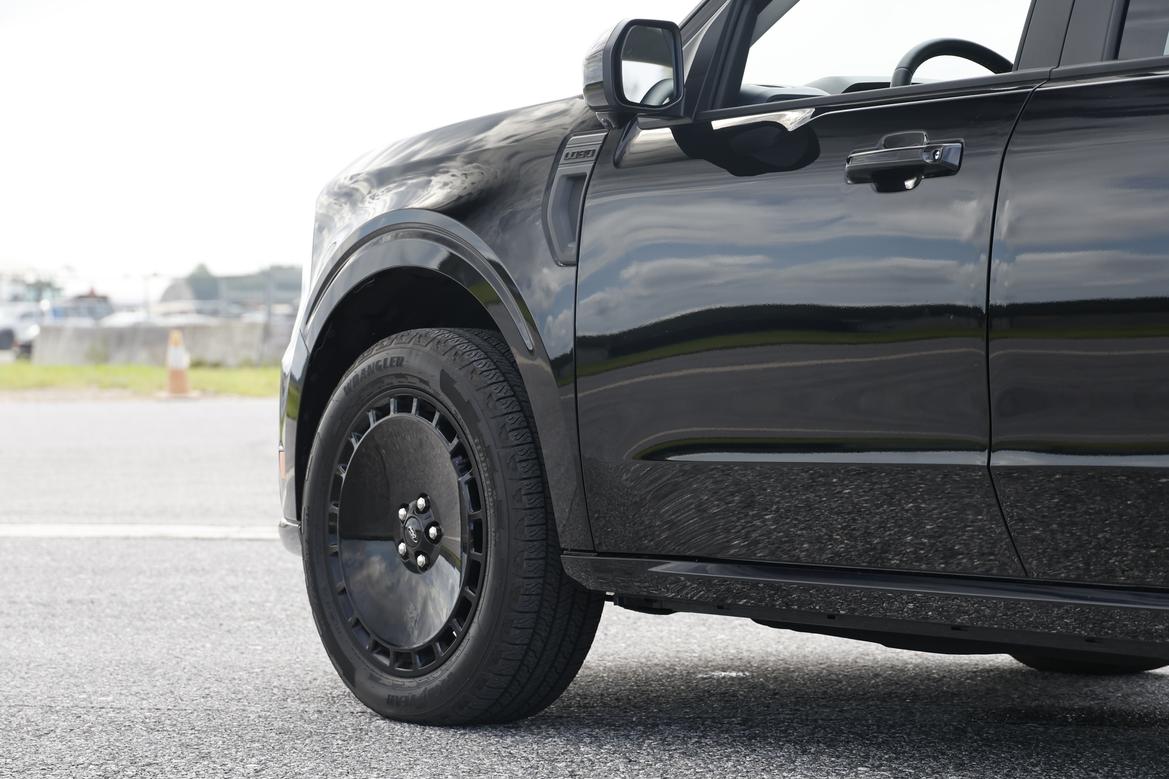
Oh yeah, we totally track tested it. I mean, when you select “Track” mode, the Lobo even shows you a little animation of a car on an autocross course sliding around and hitting some cones, so how could we not?
More on the track experience in a minute, but we will say that the street experience is solid, if not bordering on very good. Ergonomics and sight lines are excellent, and the Lobo–unlike the mini-trucks of yore–is a feature-rich vehicle with a sunroof, all of today’s driver-assist features and top-of-the-line audio. It’s almost enough to ask whether this highly equipped truck betrays the spirit of the original, stripped-down mini-trucks.
On track
Regardless of the level of content crammed into this miniature truck (which is actually similar in size to a short-bed 1975 F-150), the Lobo’s performance would do the mini-trucks of old proud–and simultaneously frustrate the crap out of them.
On track, the Lobo is its own best friend as well as its own worst enemy, with better manners, drivability and tossability than it has any right to have while being hamstrung with a woefully misapplied set of tires and very poor transmission programming.
Despite giving the Lobo an overt, on-road performance mandate, Ford chose to equip it with a set of tires far more suited to light off-road or inclement weather use. The 225/55R19 Goodyear Wrangler Territory HT is a fine tire in its own right, but it’s mismatched to the intentions of this chassis. A set of summer rubber, or even a set of slightly more road-friendly tires, would go a long way toward turning the Lobo into a far more capable carver.
The transmission programming is also substandard, as we’ve experienced with other recent Ford automatics on track. Even in full auto mode when using the paddle shifters, it forces upshifts, delays downshifts and generally becomes a frustrating companion to track driving.
Couple that with an engine whose output is all torque, all the time, and this makes it tricky to get repeatable laps. The flat pull of the 2.0-liter gives no real tactile or aural indication of where it is in the rev range. So you’re forced to drive entirely by the tach–and to shift a few hundred rpm early, lest the transmission controller sense you’re nearing redline and thwart your shift timing. Dear Ford, just throw an 8HP in this thing already.
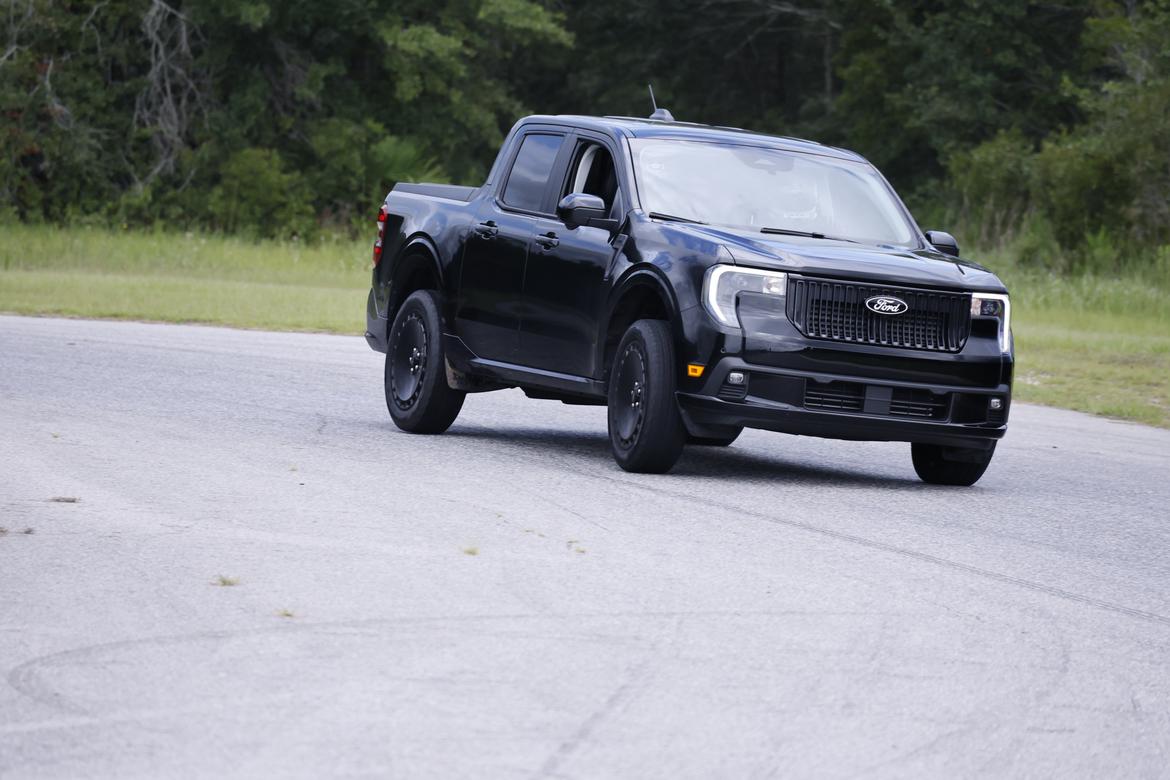
Complaints aside, the Lobo is better than it has any right to be on track for a modern interpretation of the genre. The tires may not deliver much grip, but all that slip angle is easy to manage given the good chassis control and decent steering. Brakes are also decent, although the pad compound does start to go a little soft after a few hard laps. But they do retain enough bite to finish a session.
Data Dive
How much would a set of real tires help the Lobo? Let’s compare it against our 2011 BMW 328i project car in stock form minus a set of BFGoodrich g-Force Phenom T/A tires.
[Performance tires that won't break the bank? | Budget UHP tire test.]
Our VBox data from the FIRM shows very similar acceleration graphs (red for the Lobo and green for the BMW). Likewise, both vehicles display braking performance that’s more similar than different, with the nod maybe even going to the Lobo for its excellent, linear deceleration performance.
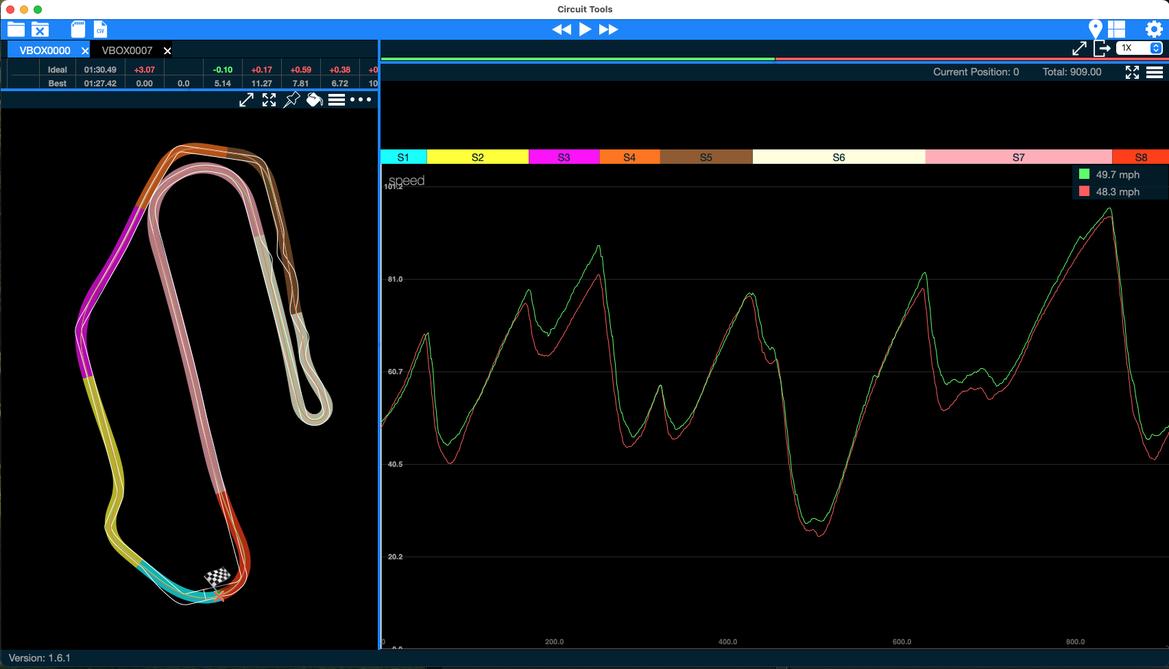
But as soon as the cars get to the corners, the Lobo’s lack of grip becomes apparent. The BMW runs a full 5 mph faster in the FIRM’s quick Turn 4, for example, and enters the sweeping Turn 8 nearly 6 mph quicker.
Ultimately, the BMW turned a lap a few seconds quicker than the Lobo–1:27.42 versus 1:30.84–almost entirely on the strength of additional cornering performance.
Still, the traces of the Lobo are smooth, showing that the chassis is predictable and drivable. Only absolute grip separates it from a quicker lap.
Well, grip and transmission performance.
Shifting the Lobo is an exercise in frustration, as it’s likely to upshift rather than hold a gear, or to delay a downshift when entering a corner just enough to throw off your timing.
Couple that with the flattest torque curve this side of the Kansas plains, and it can make for a high-stress lap that’s difficult to repeat. We found the best repeatability when we upshifted early–not really a penalty because of the strong pull by all that torque–and downshifted late. It was not the timing we wanted from a good track companion, but it mostly worked.
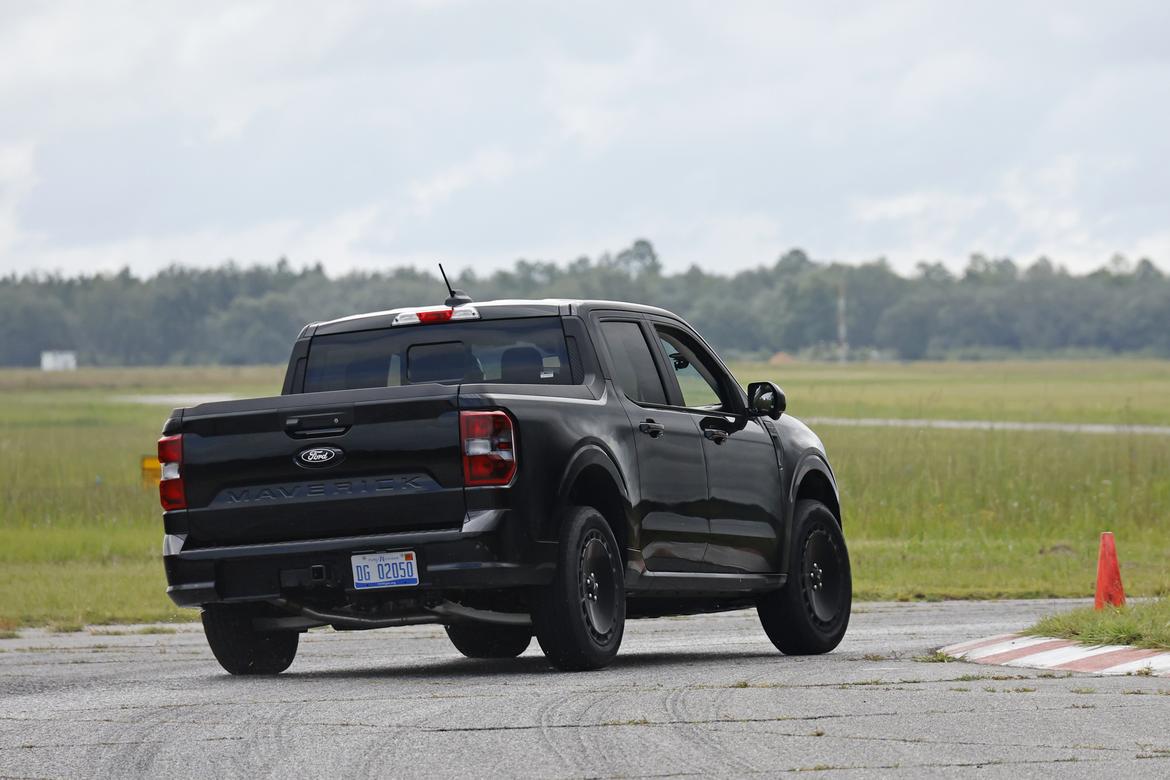
It has some frustrating flaws, but overall the Maverick Lobo is a nice modern take on a classic formula. It’s fun, comfortable and useful on the street (as long as you don’t need to tow much) while delivering somewhat capable track manners.
At more than $43,000 as tested, though, that’s where it likely strays the furthest from its sporty, mini-truck roots. Anyone who’s priced Rush tickets this year knows that nostalgia comes at a price, though–and you’ll probably want to set aside a few bucks for a more aggressive set of tires.
Comments
My local dealers are selling Lobos for roughly $10K less. What packages are you getting for that $10K difference? Also, the seats should be mentioned as a poor track choice. squishy without a ton of side bolster and slippery leather/faux leather.
At a tick over 33k, spending some money on tires isn't such a big deal, and I suspect that Ford will offer a reprogram at some point.
And that's why I'm passing on going to Rush. I'd rather buy a set of track tires.
leec
New Reader
11/10/25 2:01 p.m.
The Lobo rear diff is the same as the Tremor rear diff. It's an electronically controlled torque-vectoring rear differential, not as you described, a simplistic torque-biasing one, and oh yes, it's just like my Focus RS, and then found in my Tremor and now they put them in Lobo Mavericks, and all came with the typical compromised multi-purpose tires, and they all became winning vehicles when the correct choice of tires as then selected for a specific type of competition are used. I think only my Shelby GT 500 CFTP came with excellent paved track tires, but also it's a "slightly" higher priced vehicle. The LOBO is what I asked for in 22 for a Rally Cross truck after using an FX4 first, and then the Tremor came out. Now I'm no longer limited by the stability nannies in those that stopped excessive maneuvering cold and severely limited off road performance, it would only let you drive so hard, then start braking. Just took them a while to decide to produce the LOBO. Just like the RS, it's really more of a rally vehicle than a track or drifter, [why the 4WD]. Just Ford's marketing people refuse to limit it to just that specific market as there are many more potential drifters and AXers than rally folks. The Bronco's lineup got all the off road PR love! 3 cylinders anyone? They're so cute! Now bring your "faster" BMW with the same type tires, as it originally came with stock, to CFR's next rallycross and we'll see what "compromised comparison" means! Totally different animals.
In reply to Kreb (Forum Supporter) :
leec said:
The Lobo rear diff is the same as the Tremor rear diff. It's an electronically controlled torque-vectoring rear differential, not as you described, a simplistic torque-biasing one, and oh yes, it's just like my Focus RS, and then found in my Tremor and now they put them in Lobo Mavericks, and all came with the typical compromised multi-purpose tires, and they all became winning vehicles when the correct choice of tires as then selected for a specific type of competition are used. I think only my Shelby GT 500 CFTP came with excellent paved track tires, but also it's a "slightly" higher priced vehicle. The LOBO is what I asked for in 22 for a Rally Cross truck after using an FX4 first, and then the Tremor came out. Now I'm no longer limited by the stability nannies in those that stopped excessive maneuvering cold and severely limited off road performance, it would only let you drive so hard, then start braking. Just took them a while to decide to produce the LOBO. Just like the RS, it's really more of a rally vehicle than a track or drifter, [why the 4WD]. Just Ford's marketing people refuse to limit it to just that specific market as there are many more potential drifters and AXers than rally folks. The Bronco's lineup got all the off road PR love! 3 cylinders anyone? They're so cute! Now bring your "faster" BMW with the same type tires, as it originally came with stock, to CFR's next rallycross and we'll see what "compromised comparison" means! Totally different animals.
Given that the Lobo costs so much less than the Tremor (at least in my market) it'd be cool to be able to rallycross it also, but the suspension's stiff and the clearance short, so it'd have to be a pretty smooth course to shine, regardless of tires. Then there's the question of width vs height....
leec
New Reader
11/11/25 12:53 p.m.
In reply to Kreb (Forum Supporter) :
You need to actually check the two truck's specs, and get a better dealer, and clearance certainly isn't a problem as Miatas and Fiestas also compete on SCCA courses, as they aren't designed for slow rock climbing, but are as fast as autocross courses, [max supposed to be 60 MPH] and many courses, when they become hard packed, it's actually better to use AX tires. The base cheaper Tremor originally wasn't loaded with unwanted features, and as it is now available only as a "luxury" loaded version, just added weight and has size larger tire fitment that accounts for most of the miniscule height [clearance aprox. 1"] differential. Get a 23 Tremor and you'll have a very slightly less competitive truck than the shiftable & tossable LOBO.
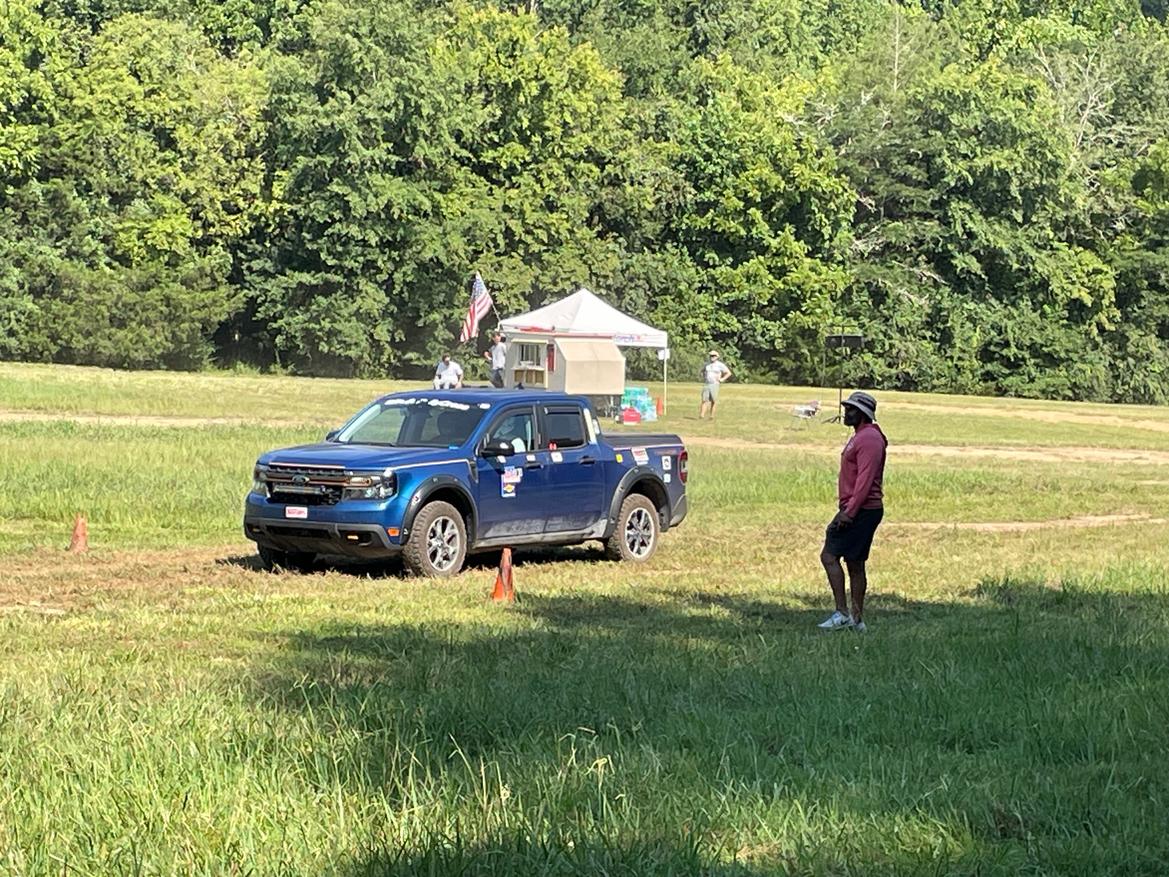
It's a super-neat truck and a compelling do-it-all vehicle, but it needs to be lowered to run an SCCA Autocross IIRC. Eibach offers 2 options for not too much money, so does Good-Win Racing, and Steeda. With new coils and some tires it would be pretty killer, just fix that transmission.
Fred930
New Reader
3/30/26 2:11 p.m.
Actually, I'm astounded that Ford named this truck, "Maverick".
For those readers not old enough, or simply unable to remember the early '70's, the Ford Maverick was a low end, cheap, and reasonably crappy automobile (at least in my opinion) ..... The type of vehicle where rubber floor mats and an AM radio were probably expensive "options". A cut above the Pinto by virtue it didn't catch fire - at least my girlfriend's didn't at the time - it certainly does not evoke fond memories of a glorious time in Ford's history! But I suppose this stellar marketing work was done by the same creative group that put the "Mustang" name on a goofy electric SUV!
In reply to Fred930 :
But from an ROW perspective, Ford had been using the Maverick name since the late 80s for a few different SUVs, as well as a rebadged Escape, in other countries. It's only OGs here in the USA that remember our version!
Displaying 1-10 of 11 commentsView all comments on the GRM forums
You'll need to log in to post.