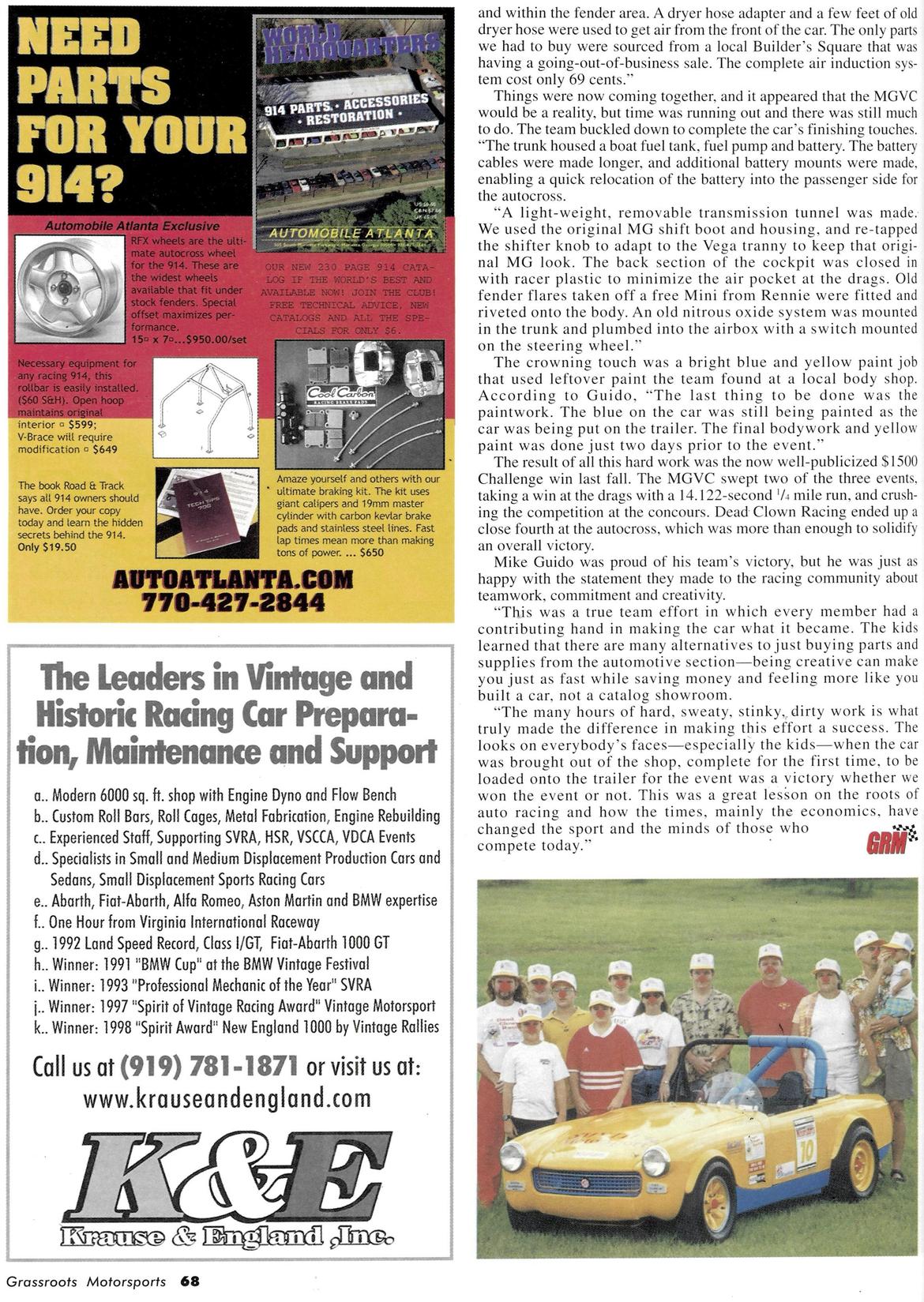


Photograph by Tony Giese
[Editor's Note: This article originally appeared in the June 2000 issue of Grassroots Motorsports. Some information may have changed and prices have been left as they originally appeared in print.]
When we first conceived of the $1500 Challenge, we knew that it would take an impressive automobile to win the grand prize. What we did not know was how impressive it would be, or what, exactly, about the car would impress us so much. We knew, in other words, that Dr. Frankenstein was out there somewhere; we just didn't know if his creature would more closely resemble Boris Karloff or Robert DeNiro.
Enter the clown.
For years, Mike Guido made his living in makeup and a big, spongy nose. He was the World's Fastest Clown–a racing harlequin who delivered an anti-tobacco message to kids while he competed in various pro racing series. Long story short, big tobacco won, sponsorship money disappeared, and the Clown was officially laid to rest a few years ago. A cardboard headstone resides in the front yard of Guido's Melbourne, Fla., home to this day.
Let's face it, anyone who would don a clown suit to take on a juggernaut like the tobacco industry is a natural competitor for the $1500 Challenge.
Guido was, indeed, up to the task. He saw the Challenge as a throwback to racing's past–a past that he was quite fond of.
"Over the years, auto racing has become a sport with more money and less talent finding its way into the winner's circle," Guido explains. "This Challenge took the sport back 20 years to where hard work, dedication and a lot of creativity made all the difference to build a winner.
"In a nutshell, this Challenge had a financially-equal playing field that was affordable to all, making it a challenge of the minds and the teams' dedication to win."
In particular, Guido compares the Challenge to a certain weekend spent co-driving with GRM's Rennie Bryant and the Redline BMW Performance crew.
"In 1983, I drove with Redline Racing in the 12 Hours of Sebring in a BMW 2002," Guido says. "We finished the 12-hour race on the same set of tires that we started with and finished mid-pack among many wealthy teams. It was a moment the team will never forget and may never get the opportunity to try again.
"Now, a front-running ITS team will spend more at an SCCA ECR [endurance race] than we did to complete the 12 Hours of Sebring. This challenge took me back to when I first started racing, a time I miss very much. It was a challenge I couldn't ignore."
While most folks were busy scrambling and shopping for a car soon after the Challenge was announced, Guido had already had his challenger offered to him. "Prior to hearing about the Challenge, I learned that a friend, Cary Williams, was moving and had to get rid of an old MG Midget," our former clown explains. "He said I could have it for free–just come and get it.
"Not having time to get it and gut it, I kept putting it off. Then I read about the Challenge, and my mind started to spin. I talked to my Mini friend Satch Smyth, and he mentioned the old Cosworth Vega engine and drivetrain he and his brother Chris had.
"While I was still thinking about it, my UPS man, Kevin Blackett, came by, and I told him our possible plans. He said he also needed to get rid of an MG Midget that was in his yardjust come and get it.
"The first car we picked up was extremely rough, so we immediately tracked down Kevin. While we were picking up Kevin's car, he asked for more information on the Challenge, and then asked if he and his two sons–Joshua and Justin–could help. We thought 'great,' but it got better, as his wife, Lisa, and his six-yearold daughter, Elise, even joined in. Two very energetic kids from my Police Athletic League go-karting class, Nathaniel Gross and Josh Hayzlip, completed the team."
It would be teamwork that would make this effort so successful. In addition to being a talented racer and fabricator, Mike Guido also seems to be a Tony Robbins-grade motivator. Maybe it's all the years as a clown, or all those years panhandling for racing sponsorship, but Guido can inspire folks to do his bidding.
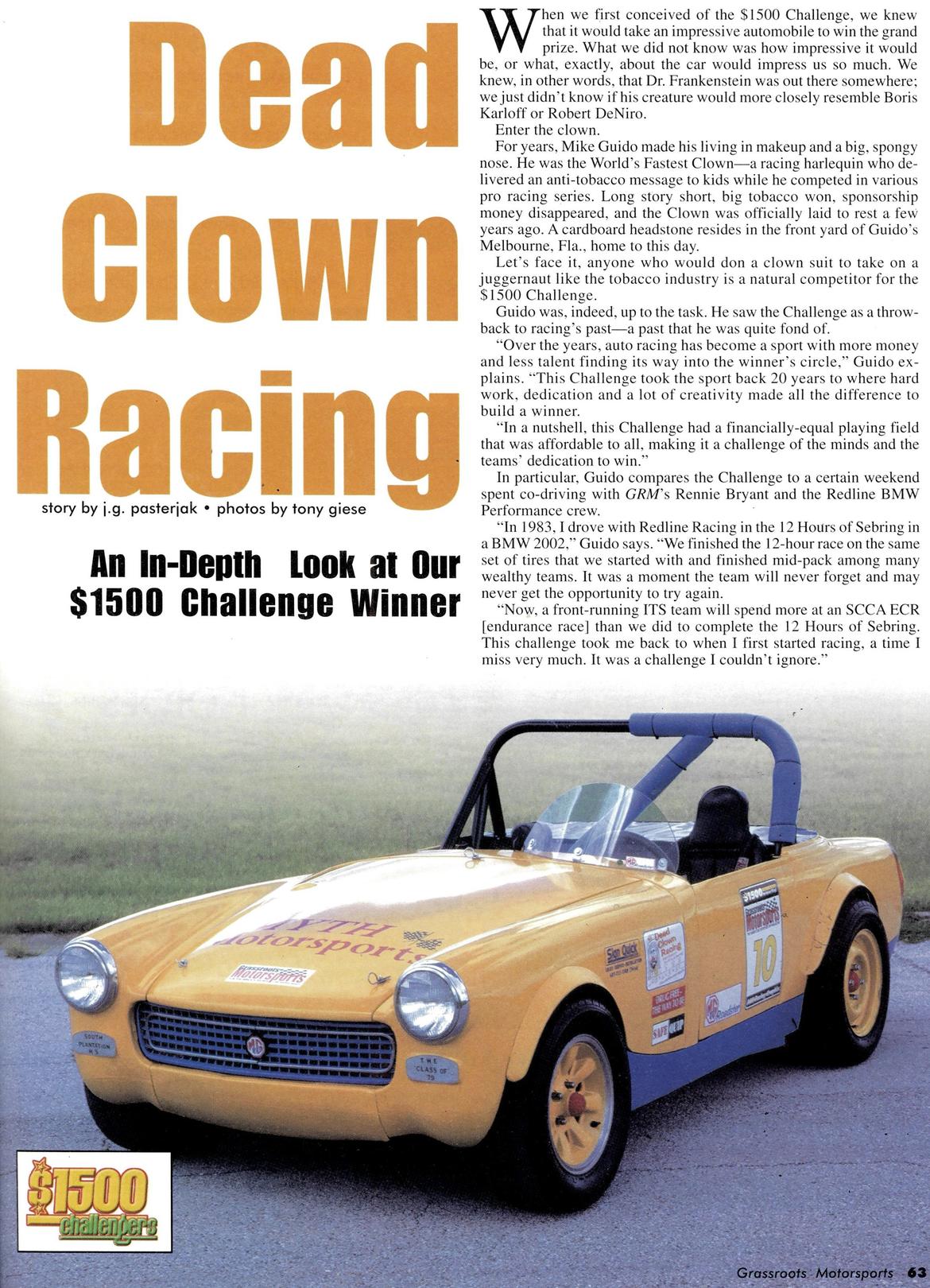
His bidding now was the construction of a Cosworth Vega-powered MG Midget. The team figured that this combination would give them the best chance at winning the three phases of the $1500 Challenge competition, with a low-weight/high-horsepower combination for the drags, an inherently good handling chassis for the autocross, and a fairly good-looking car that wouldn't be too hard to make pretty for the concours judging. The fact that the car was free didn't hurt, either.
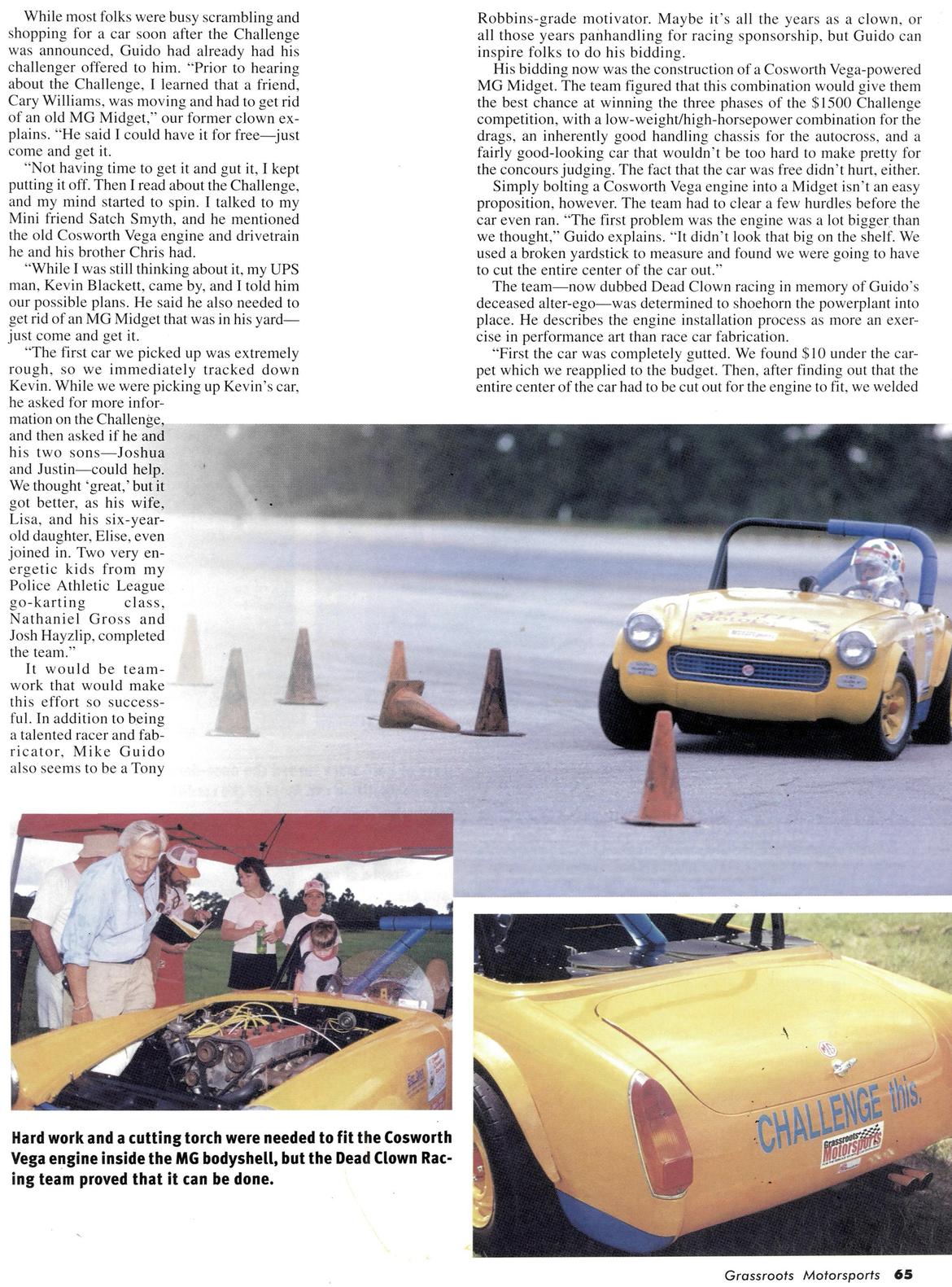
Simply bolting a Cosworth Vega engine into a Midget isn't an easy proposition, however. The team had to clear a few hurdles before the car even ran. "The first problem was the engine was a lot bigger. than we thought," Guido explains. "It didn't look that big on the shelf. We used a broken yardstick to measure and found we were going to have to cut the entire center of the car out."
The team–now dubbed Dead Clown racing in memory of Guido's deceased alter-ego–was determined to shoehorn the powerplant into place. He describes the engine installation process as more an exercise in performance art than race car fabrication.
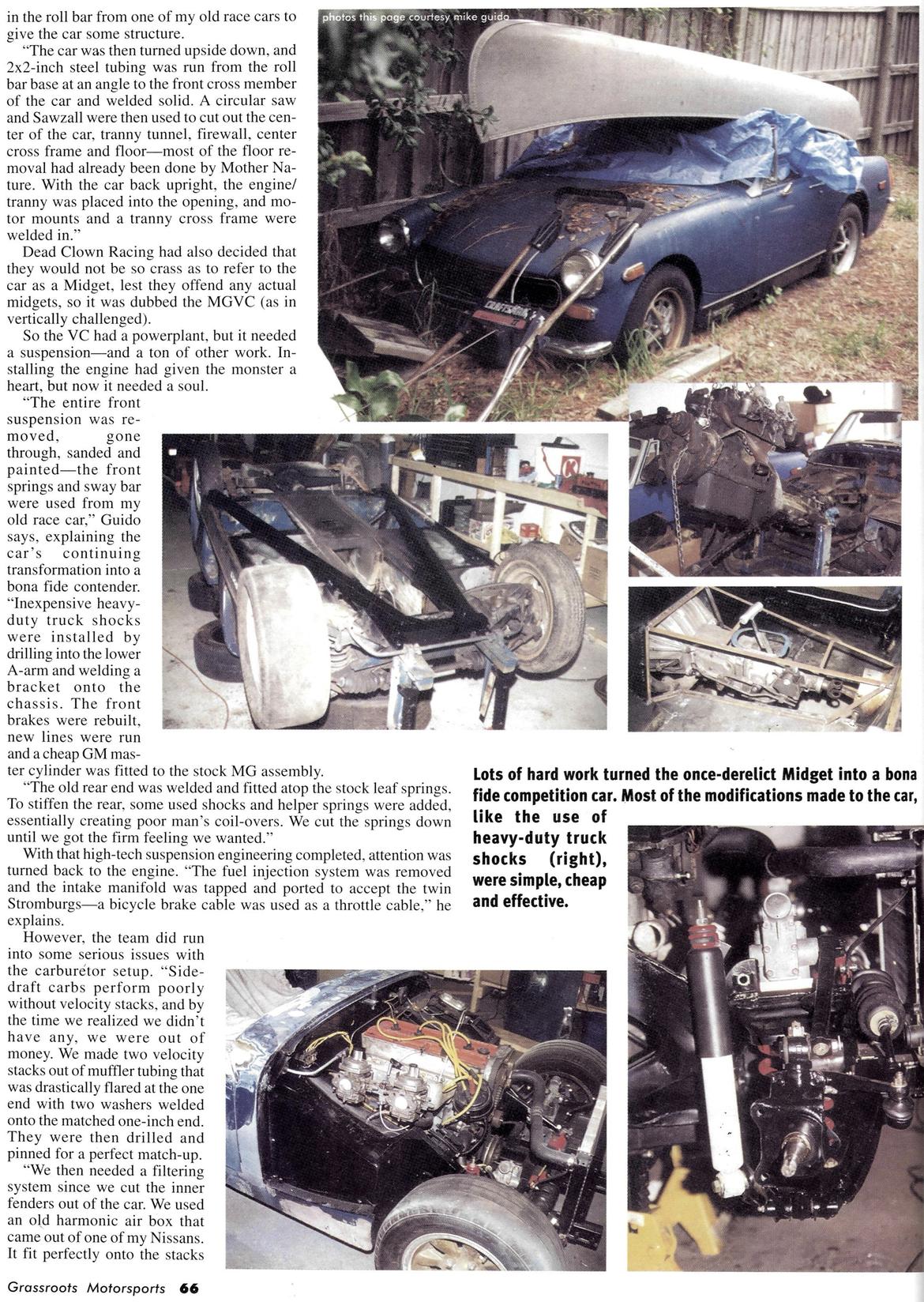
"First the car was completely gutted. We found $10 under the carpet which we reapplied to the budget. Then, after finding out that the entire center of the car had to be cut out for the engine to fit, we welded in the roll bar from one of my old race cars to give the car some structure.
'The car was then turned upside down, and 2x2-inch steel tubing was run from the roll bar base at an angle to the front cross member of the car and welded solid. A circular saw and Sawzall were then used to cut out the center of the car, transmission tunnel, firewall, center cross frame and floor–most of the floor removal had already been done by Mother Nature. With the car back upright, the engine/ transmission was placed into the opening, and motor mounts and a transmission cross frame were welded in."
Dead Clown Racing had also decided that they would not be so crass as to refer to the car as a Midget, lest they offend any actual midgets, so it was dubbed the MGVC (as in vertically challenged).
So the YC had a powerplant, but it needed a suspension–and a ton of other work. Installing the engine had given the monster a heart, but now it needed a soul.
"The entire front suspension was removed, gone through, sanded and painted–the front springs and sway bar were used from my old race car," Guido says, explaining the car's continuing transformation into a bona fide contender. "Inexpensive heavyduty truck shocks were installed by drilling into the lower A-arm and welding a bracket onto the chassis. The front brakes were rebuilt, new lines were run and a cheap GM master cylinder was fitted to the stock MG assembly.
"The old rear end was welded and fitted atop the stock leaf springs. To stiffen the rear, some used shocks and helper springs were added, essentially creating poor man's coil-overs. We cut the springs down until we got the firm feeling we wanted."
With that high-tech suspension engineering completed, attention was turned back to the engine. "The fuel injection system was removed and the intake manifold was tapped and ported to accept the twin Stromburgs–a bicycle brake cable was used as a throttle cable," he explains.
However, the team did run into some serious issues with the carburetor setup. "Sidedraft carbs perform poorly without velocity stacks, and by the time we realized we didn't have any, we were out of money. We made two velocity stacks out of muffler tubing that was drastically flared at the one end with two washers welded onto the matched one-inch end. They were then drilled and pinned for a perfect match-up.
"We then needed a filtering system since we cut the inner fenders out of the car. We used an old harmonic air box that came out of one of my Nissans. It fit perfectly onto the stacks and within the fender area. A dryer hose adapter and a few feet of old dryer hose were used to get air from the front of the car. The only parts we had to buy were sourced from a local Builder's Square that was having a going-out-of-business sale. The complete air induction system cost only 69 cents."
Things were now coming together, and it appeared that the MGYC would be a reality, but time was running out and there was still much to do. The team buckled down to complete the car's finishing touches. "The trunk housed a boat fuel tank, fuel pump and battery. The battery cables were made longer, and additional battery mounts were made, enabling a quick relocation of the battery into the passenger side for the autocross.
"A light-weight, removable transmission tunnel was made.We used the original MG shift boot and housing, and re-tapped the shifter knob to adapt to the Vega transmission to keep that original MG look. The back section of the cockpit was closed in with racer plastic to minimize the air pocket at the drags. Old fender flares taken off a free Mini from Rennie were fitted and riveted onto the body. An old nitrous oxide system was mounted in the trunk and plumbed into the airbox with a switch mounted on the steering wheel."
The crowning touch was a bright blue and yellow paint job that used leftover paint the team found at a local body shop. According to Guido, "The last thing to be done was the paintwork. The blue on the car was still being painted as the car was being put on the trailer. The final bodywork and yellow paint was done just two days prior to the event."
The result of all this hard work was the now well-publicized $1500 Challenge win last fall. The MGYC swept two of the three events, taking a win at the drags with a 14.122-second 1/4 mile run, and crushing the competition at the concours. Dead Clown Racing ended up a close fourth at the autocross, which was more than enough to solidify an overall victory.
Mike Guido was proud of his team's victory, but he was just as happy with the statement they made to the racing community about teamwork, commitment and creativity.
"This was a true team effort in which every member had a contributing hand in making the car what it became. The kids learned that there are many alternatives to just buying parts and supplies from the automotive section–being creative can make you just as fast while saving money and feeling more like you built a car, not a catalog showroom.
"The many hours of hard, sweaty, stinky, dirty work is what truly made the difference in making this effort a success. The looks on everybody's faces–especially the kids–when the car was brought out of the shop. complete for the first time. to be loaded onto the trailer for the event was a victory whether we won the event or not. This was a great lesson on the roots of auto racing and how the times, mainly the economics. have changed the sport and the minds of those who compete today."

That was fast! I asked and you delivered! Thank you!

Noddaz said:That was fast! I asked and you delivered! Thank you!
You’re welcome.

Whenever we get that time machine working, I know one of the first places I'm taking it...
And y’all should have seen all the hate on Facebook. Okay, just kidding, but we did get angry letters about it–angry, typed-out letters.
THere Is NO way YoU can PainT a $1500 Car!!!1
In reply to David S. Wallens :
To be fair, we still get typed angry messages, but now it's usually just under a post on Facebook or Instagram.

Such a cool effort with such excellent results. Makes me happy there were a decent amount of volunteers, especially the younger folk, who could see the progress coming along and then witness what winning is like.

Haters gonna hate.
Colin Wood said:In reply to David S. Wallens :
To be fair, we still get typed angry messages, but now it's usually just under a post on Facebook or Instagram.
That is true. Or even just here.
Displaying 1-8 of 8 commentsView all comments on the GRM forums
You'll need to log in to post.