




Very cool! I've been waiting for an opportunity to give this track a try. The elevation changes sound fun.



Photograph by Tom Suddard
Motorsports country clubs face a tough proposition when it comes to circuit design. They need to deliver a fun and rewarding track experience to their members while also providing a comfortable living environment for the residential component of the club.
And as many of these facilities are located in more heavily populated areas, they need to balance local noise ordinances, NIMBYism and land-use realities while trying to exist as the type of facility that’s traditionally not the easiest on local resources.
Circuit Florida–located roughly equidistant between Tampa and Orlando, and close enough to I-4 that you could practically throw a Frisbee into traffic–certainly faced these challenges, but our visit showed how the facility is meeting the expectations of its burgeoning membership.

Photograph by Tom Suddard
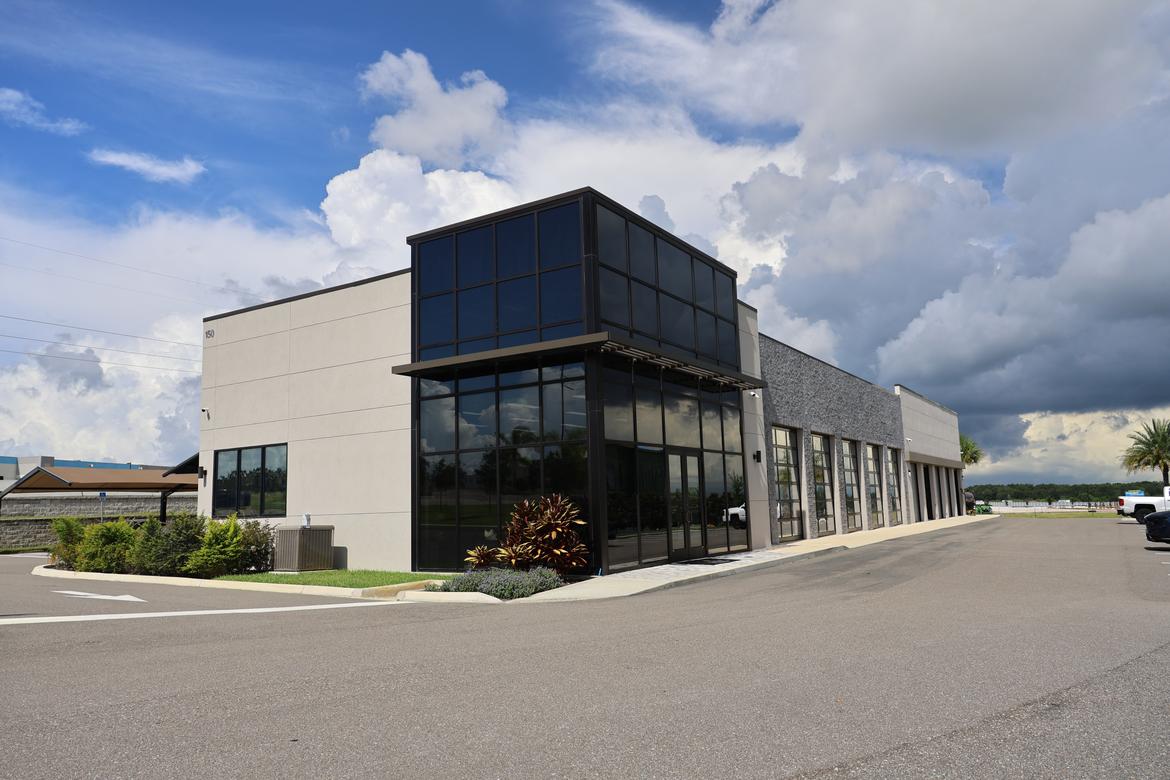
The first thing worth mentioning is Circuit Florida’s location, which is a pretty impressive accomplishment by the developers: “Polk County is actually the fastest-growing area in the country right now,” owner/developer/GM Paul Scarpello says of the track’s location. “We’re fewer than 45 minutes from Orlando, which is one of the top tourist destinations in the world, and between the Orlando metro area and the Tampa/St. Petersburg metro area, you’re looking at close to 7 million people.”
Photograph by Tom Suddard
Those kinds of numbers may not be entirely relevant to Circuit Florida’s business model as a private club, but they certainly provide some benefit to the members, who may want to enjoy the benefits of easy access to motorsports while retaining close ties to major cities and travel convenience.
Photograph by Tom Suddard
And being only a few exits away from the Most Magical Place on Earth® certainly provides some benefit to one of the track’s public-facing draws, the Superspeed Orlando exotic car track experience.
Photograph by Tom Suddard
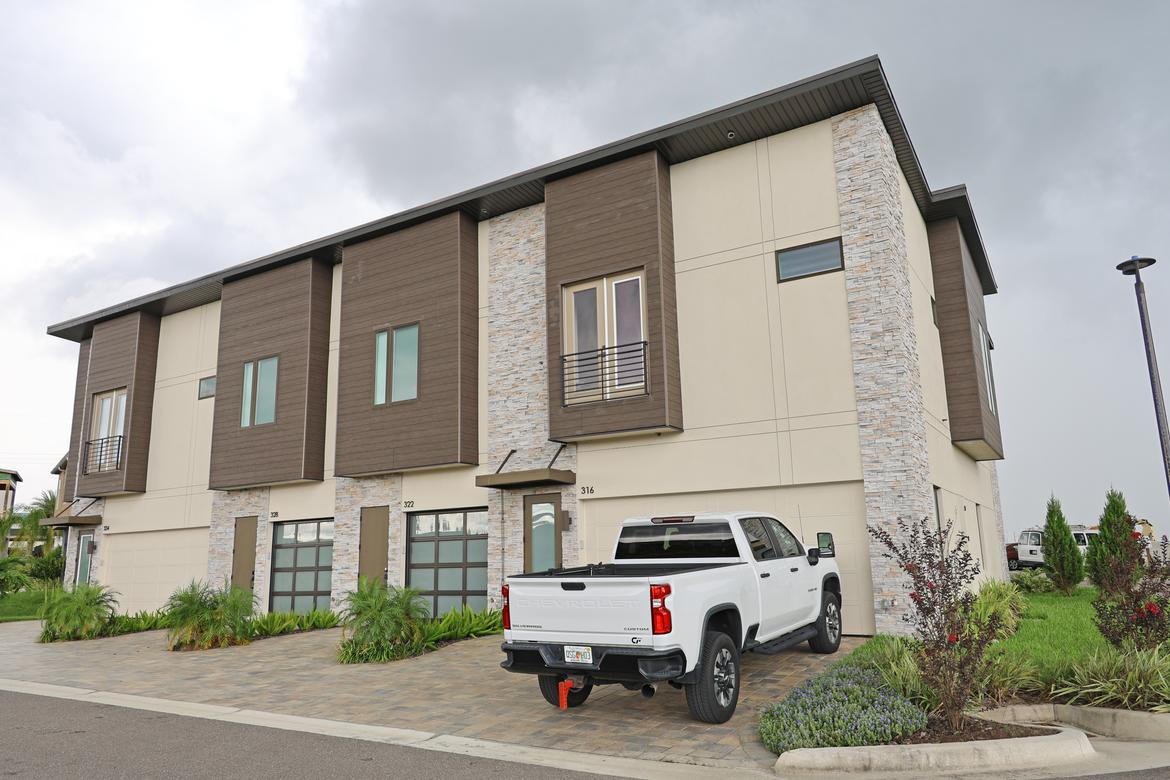
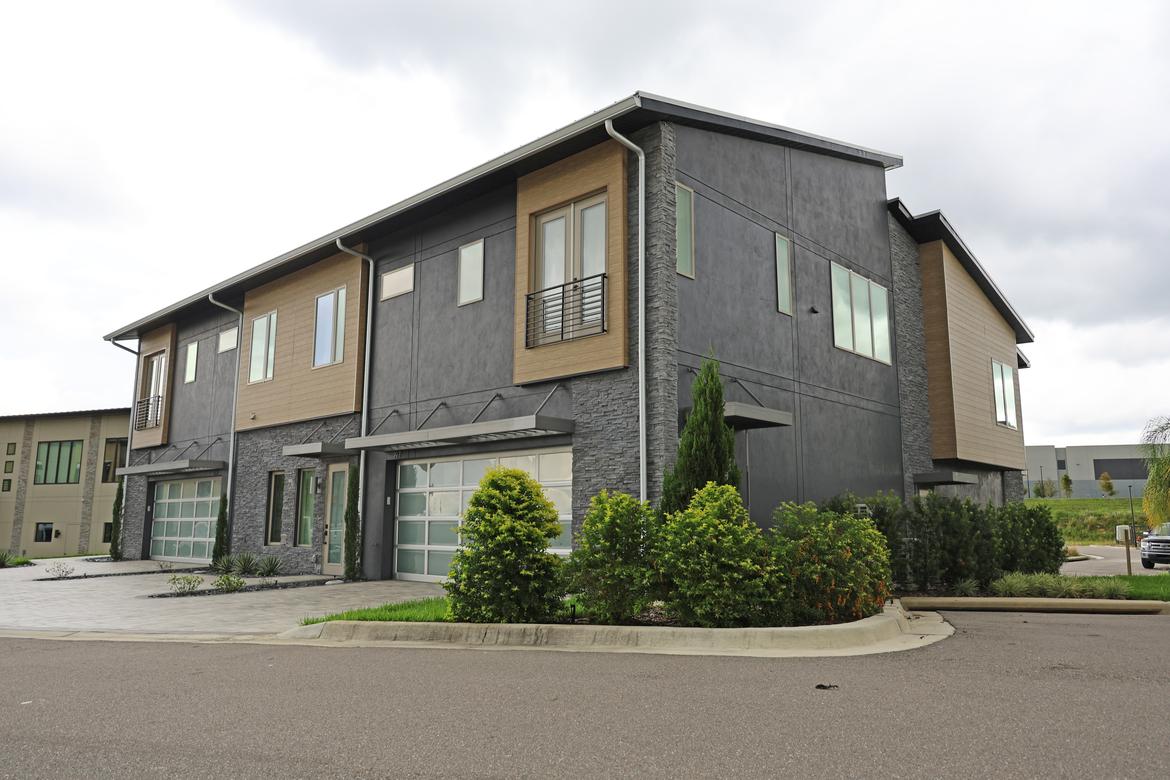
“Our zoning provides no restriction on stay length,” Scarpello adds. That’s developer speak for, “You can actually live here full-time,” which is actually a bit of a rarity in the motorsports country club space.
Many clubs, even those with residential-appearing facilities, are not actually zoned as full-time residences. If you have the means, however, you could legally–and quite comfortably, as we saw–live at Circuit Florida full-time.

Photograph by Tom Suddard
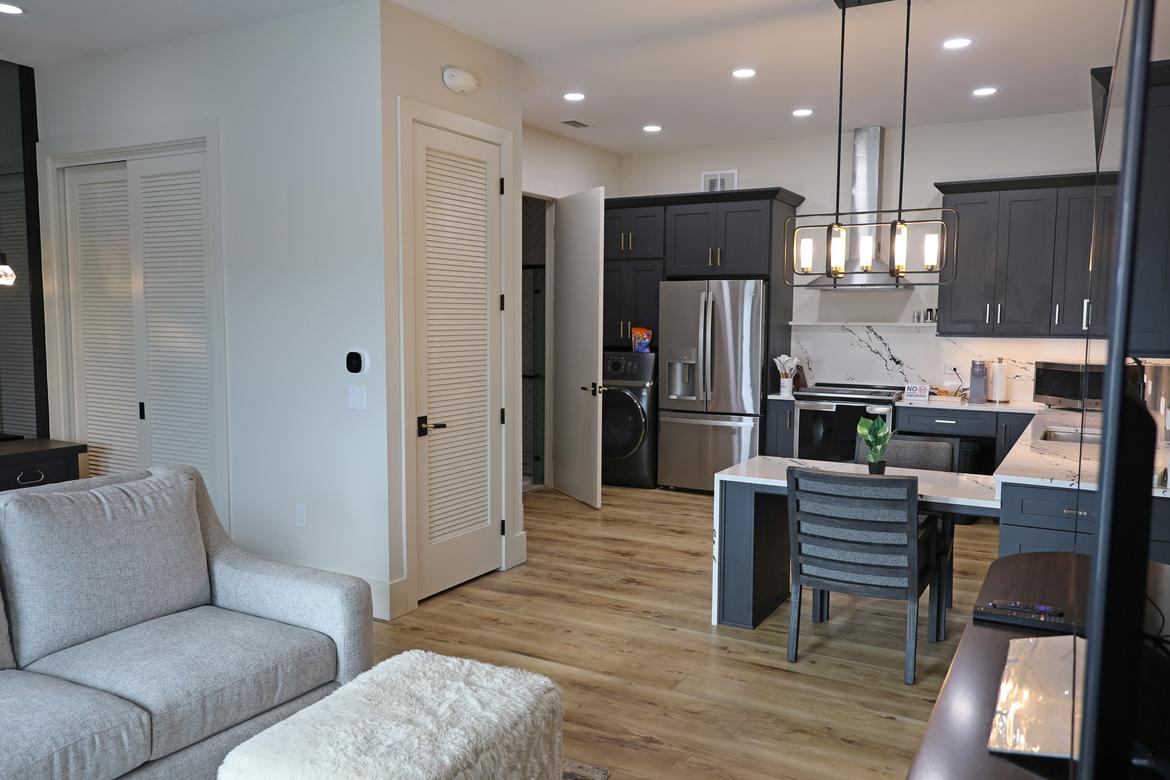
Residence prices are commensurate with condos in other “lifestyle” settings. At our end of I-4, meaning near Daytona Beach, you might pay slightly less for a similar unit in a high-rise overlooking the ocean, but at the west side of I-4, you’ll pay a little more per square foot for a condo in downtown St. Pete. Neither of those properties, however, will have a four-plus-car garage nor immediate, drive-on access to a race circuit.
Photograph by Tom Suddard
So while the residence prices, which mostly straddle the million-dollar range, sit outside of our reach (author’s note: good reminder to renew your subscription), they’re perfectly reasonable given the current real estate climate.

Photograph by Tom Suddard
The residences are also quite lovely and well appointed. Scarpello–who has a deep background in real estate development–and crew have designed a country club that doesn’t feel at all snooty or intimidating. The design has that nice Florida upscale-but-approachable vibe, and the deep and tall-enough-for-a-lift oversized garages make it clear you’re among friends.
Photograph by Chris Tropea
We could go on about how the development crew has done a great job making the place seem like a neighborhood that people like us won’t instantly get kicked out of, but any motorsports country club can’t skimp on the motorsports. It needs to provide members of varying skills and experience levels a rewarding experience while being an efficient user of space and also safe enough that the developers don’t need a body shop and a trauma center on site.
Bob Barnard, who was involved with the redesign at Road Atlanta as well as Daytona’s infield, fit more than a dozen corners into just 1.7 miles while using barely 50 acres of land. And somehow, he managed to give each of those corners its own unique flavor.

Photograph by Chris Tropea
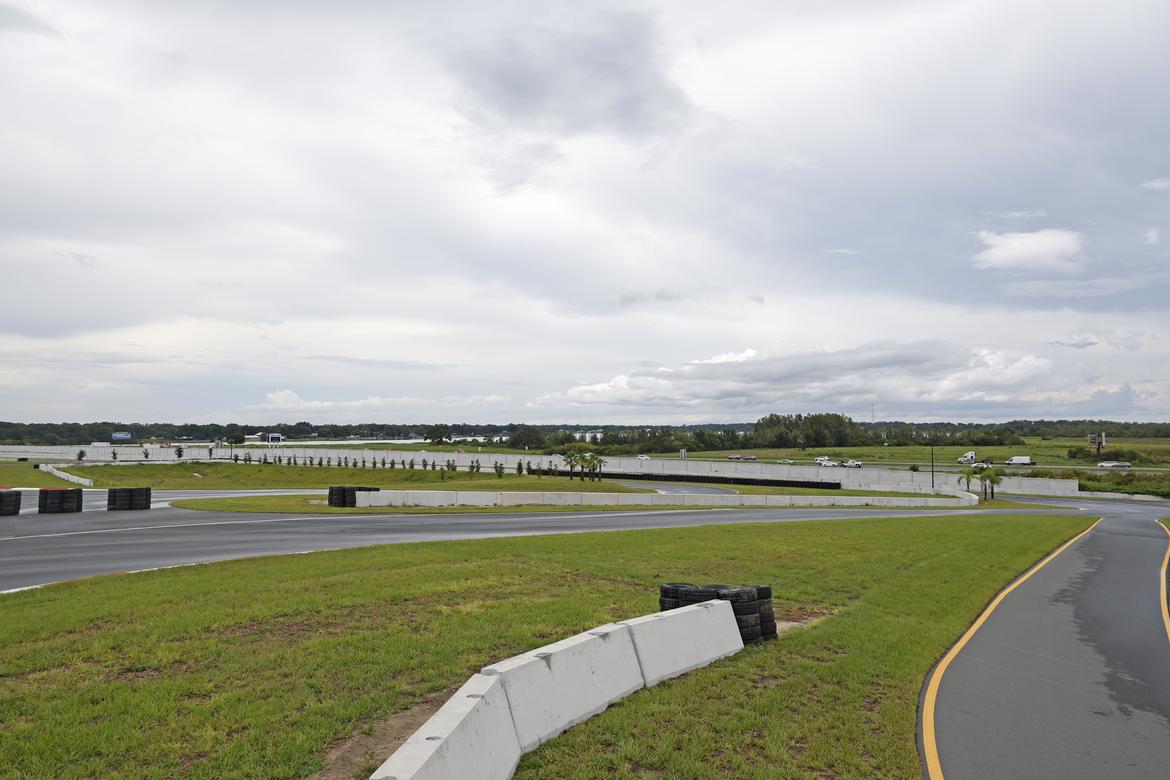
The first thing we noticed about the track–unlike pretty much every other facility in our state–are the elevation changes. The high and low points of the circuit sit about 40 vertical feet apart from each other, while nearly half of the corners leverage the natural terrain to provide some sort of elevation component that must be negotiated. This allows for a nice mix of climbing and diving corners and even a crest or two, making for a true Florida rarity of feeling vertical loads out on track.
And although the track does loop back on itself quite a bit–it reminds us of a good autocross course design that maximizes every inch of a parking lot or runway–the corners still have a nice level of variety. It’s fair to call Circuit Florida a “technical” track because nearly all the corners allow for some degree of variety in approach–depending on your car or particular driving style.

Photograph by Chris Tropea
In our BMW 435i, which we’d probably describe as on the slow side of your typical country club track participant vehicles, we topped 100 mph on three straights–and two of them led into unique braking areas.

The first long straight, which the club calls the Amazon straight, is so named because an Amazon warehouse lies just over the fence to the south (and no, they don’t just toss packages over the fence to deliver them, which we found kind of disappointing). It features a left-hand kink in the middle that we could take flat out. A 500-plus-horsepower car might require some speed adjustment.

The Amazon straight concludes in a right-hand 170° corner that’s fairly tight on entry but open toward the exit so you can unwind naturally. “We actually put in a lot of the curbing after the track opened,” Track Manager Adam Ricardel told us. “We wanted to see how it drove and make those decisions based on reality.” Ricardel added how opening up the exit of this slow corner should appeal to the Miata drivers.

After that turnaround at the west end and the short straight heading back east, you arrive at the busy middle section of the 36-foot-wide track. This section starts with a right/left chicane, leading to a short chute and a braking area for a left-hander that starts flat but quickly drops downhill at track-out.

Then you barely have time to settle the car for another left-hander, this one with a downhill entry that sweeps back uphill at the exit. It’s a fun rhythm section that has you going back and forth between aggression and restraint and enjoying the rare Florida race track hill.
From there, you head down another westbound straight to a braking zone featuring a left-hand kink right in the middle of the shutdown area. Less experienced drivers can certainly drive this area as two separate corners–slowing for the kink, negotiating it, then slowing again for the right-hand turnaround at the westernmost part of the circuit. The stability under braking and our BMW’s predictable Vitour P1 rubber allowed us to brake later, decelerating through the kink, then doing a final deceleration as we arrived at the entrance to the westernmost hairpin.
And that hairpin is going to change based on how you negotiate the kink. We chose to preserve speed down the previous straight, which meant we had to give up some entry radius into the slower right-hander at the end. But you could also choose to give up that speed earlier, getting you onto a less acute entry line into the hairpin, and turning it into less of a hairpin and more of a long sweeper. Our line pinched the entry but allowed us to open up through the rest of the corner, extending the next long straight that parallels the eastbound lane of I-4 just over the fence.

This straight led into another fun and challenging braking area and the “showcase” area of the track, which will be closest to the under-construction clubhouse and easily visible from several of the trackside condos. The braking area starts off on flat ground but falls away for the last 30% or so of its distance, making judging your brake initiation a real challenge.

The track then sweeps into a 100° downhill right-hander with some good, helpful road camber at the apex before shooting you uphill at the exit as you pass the pit entry.
From there, you’ll climb uphill–which is still a weird thing to write in a story about a Florida track–and hit a left-hander with a bit of crest in it.
Then it’s a short run to the easternmost turnaround on the track, which is laid out as two corners but can be driven as one sweeping line before you head back out onto the Amazon straight.
The track throws a lot at you and does tax your brakes a bit–there are three braking zones from 100-plus to below 45 mph in a minute-and-a-half lap–but it offers some different looks and gives you lots to think about.
The runoff areas are also generous, particularly at the higher-risk sections, like the kink in the braking area, or past the flat/downhill brake zone. It’s a track that clearly was designed to encourage you to experiment but not put you at a lot of risk for doing so.

Photograph by Chris Tropea
Also worth noting is the asphalt. Scarpello pointed out that the track’s paving contractor wasn’t simply a road builder, but a contractor well versed in track construction. The track is built with reinforced asphalt and not the road-grade stuff.
It’s more expensive, but you can feel the difference under the car. First, there’s no road crown in the middle of the circuit, giving great predictability across the entire width.
And the seams in the pavement are nearly undetectable, making it easy and confidence-inspiring to push the car across the entire width of the track (and then some, given the ample runoff and nice curb transitions in many spots).
Photograph by Chris Tropea
While Circuit Florida is an impressive facility, it’s still a private club with a $45,000 initiation fee and seven-figure condos. Still, there are those Superspeed Orlando events, plus some other exotic experience groups that use the track. Some driving schools and the occasional car club rental will give you access, too.
Should you get the chance to drive it, it’s certainly worth the effort.

Photograph by Chris Tropea

Very cool! I've been waiting for an opportunity to give this track a try. The elevation changes sound fun.

Lof8 - Andy said:Very cool! I've been waiting for an opportunity to give this track a try. The elevation changes sound fun.
It's pretty impressive they got such a fun track on such a compact footprint. If there's a notable omission it's a nice high-speed corner or two, but I also totally get why this isn't *that* kind of track. As it sits, though, it's a great place for testing or driver training or just having fun in a very low-risk/high reward kind of environment.

I didn't realize that you can't live full-time in many of those country clubs, so it's pretty cool that you could actually live at Circuit Florida.
Displaying 1-3 of 3 commentsView all comments on the GRM forums
You'll need to log in to post.


