Most of the crashed and abused ones have been flushed from the market by now, and some truly stellar stock and modified examples remain. The aftermarket for the car …
The Art of Shoehorning
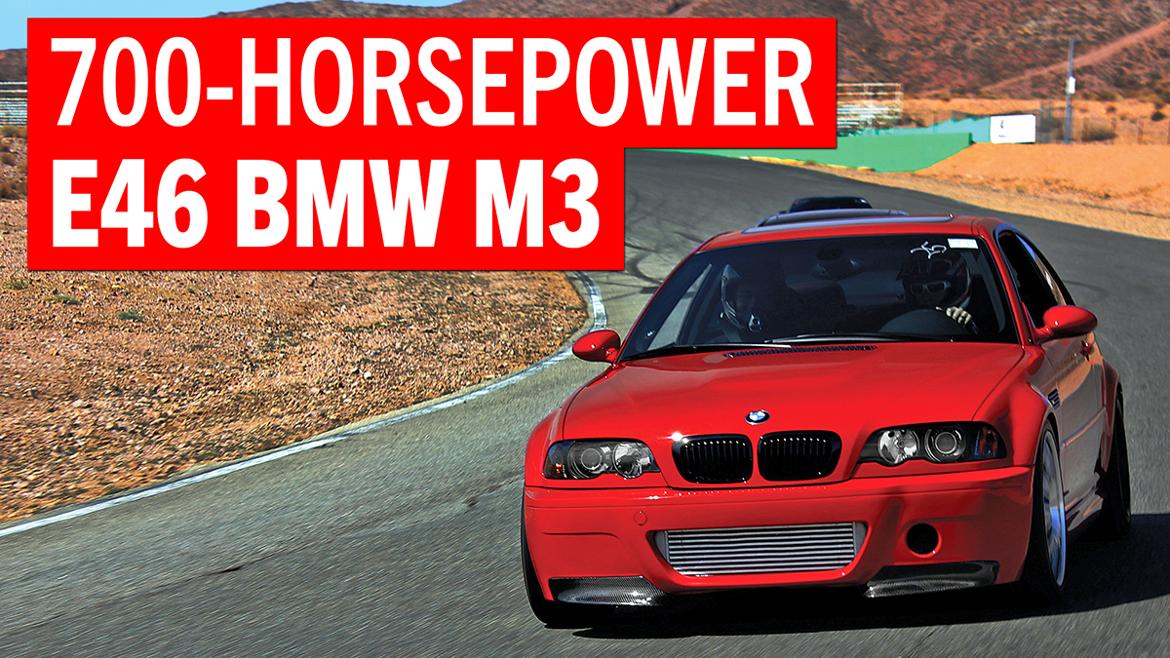
While BMW has fully embraced turbocharging in recent years, the S54 engine found in the E46 M3 wasn’t designed with boost in mind. Instead, it was given large cams, VANOS variable valve timing, and a lofty–for the time–11.5:1 compression ratio. While the engine block was formed from a tough iron casting, the engine layout did not leave much room for a turbocharger and manifold.
FSR’s solution? Design a new turbo system for the car. To work around the tight confines of the E46’s engine compartment, FSR TIG-welded a neat turbo header that hugs the side of the block while still allowing for 1.5-inch primary tubes. The crew set the final turbo position as high as possible, yet chose to allow 4-inch inlet plumbing and a 4-inch down tube–FSR says that was critical for extracting maximum power from the 3.2-liter engine. The team also felt that the factory composite manifold restricted top-end power at full boost, so they designed an aluminum replacement.
Tuned to the Moon
The key to making all these elements work together is the engine management system. AEM had just released their Infinity ECU application for the E46-chassis M3, and the new setup includes the ability to tune the drive-by-wire system as well as both intake and exhaust cam timing via the VANOS system.
“With control of the VANOS, this car makes boost before your foot hits the floor and carries that power to 8200 rpm thanks to the factory CNC-ported head and big cams,” Ian explains. “Contrary to popular belief, power can be made by modifying the exhaust cam timing on VANOS. It’s a small window, but when you find it, the torque gains are rewarding and very useful for track situations.”
Then there’s the link between the ECU and the car itself. “The adapter harness that AEM made for the Infinity on an E46 is truly plug and play,” says Ian. “It fits in the stock location–so you don’t have wires running across the engine–and installs in about 30 minutes. We are using the traction control that integrates with the BMW’s CAN system currently, and can easily set up launch control or map switching using the factory cruise buttons through the Infinity’s software. The system is so responsive that we allow the flex fuel sensor to detect the fuel type and modify the maps accordingly based on our programming.”
The combination of the FSR turbo kit and AEM Infinity ECU was the hot ticket. In its final configuration, the M3 dynos at 500 horsepower at the rear wheels–and that’s at 8 to 9 psi on pump gas. At 17 psi on E85 fuel, that figure leaps to 750 horsepower. Keep in mind that this is all coming through a stock bottom end, transmission and exhaust.
Because of the Infinity’s ability to switch between fuel types, the car can run E85 at the track as well as a more easily available pump-gas mixture on its days off. Thanks to inline fuel mixture sensors, the ECU is able to alter boost maps and interpolate between them depending on the percentage of ethanol flowing to the injectors.
FSR’s development mule has now seen hundreds of miles’ worth of track, drag-strip and dyno duty with no notable failures. Perhaps the most amazing thing about this car? Despite all that horsepower, the factory head gasket is still in place.