The Miata is back.
Time for a Face-Off
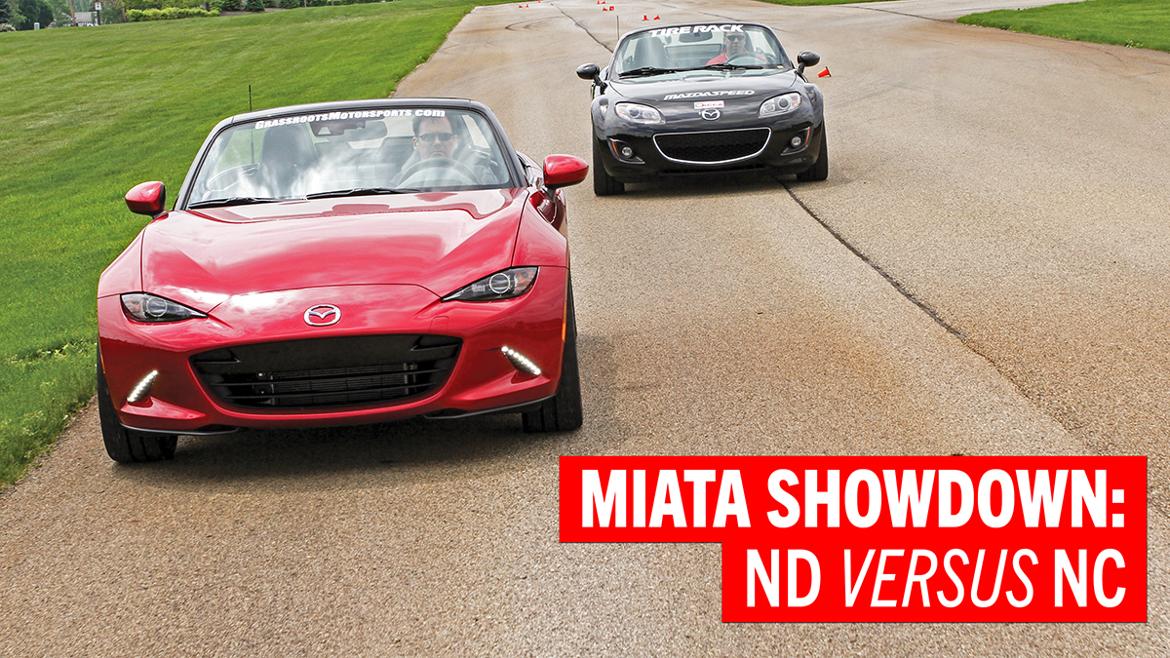
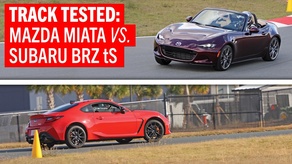
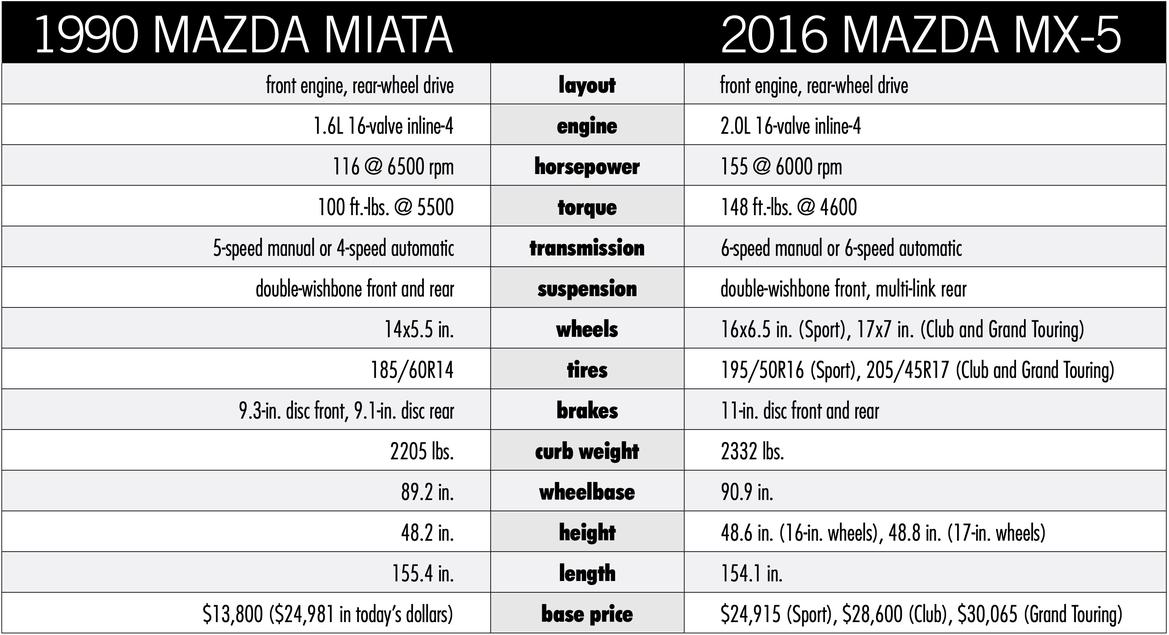
What else did the engineers leave on the table when they went back to the original Miata’s weight class? Does a step back in spec mean less performance? These are the types of questions we tend to ask; to get the answers, a shootout was in order.
The face-off would go down on Tire Rack’s private test track, located mere feet away from their corporate headquarters in South Bend, Indiana.
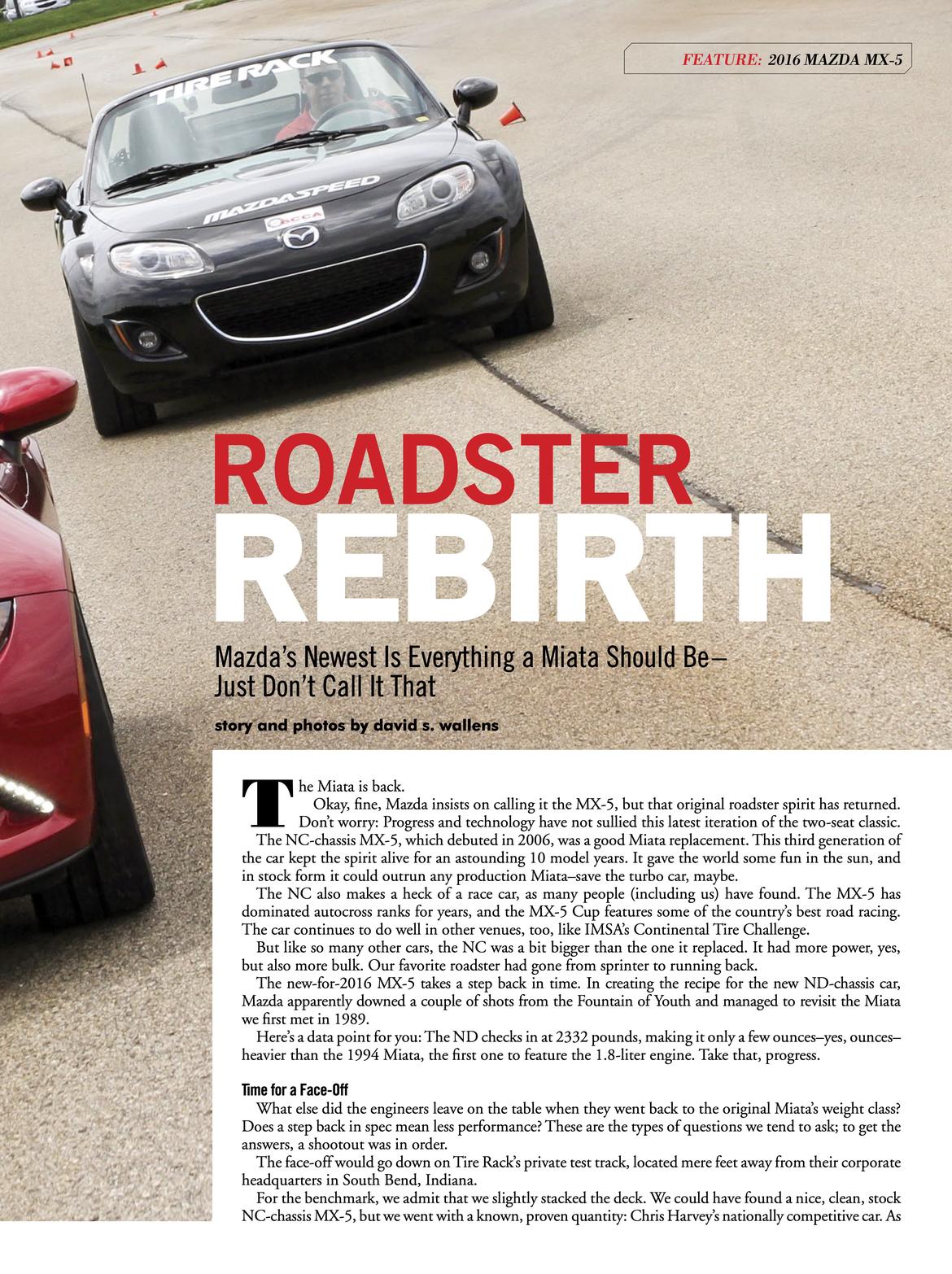
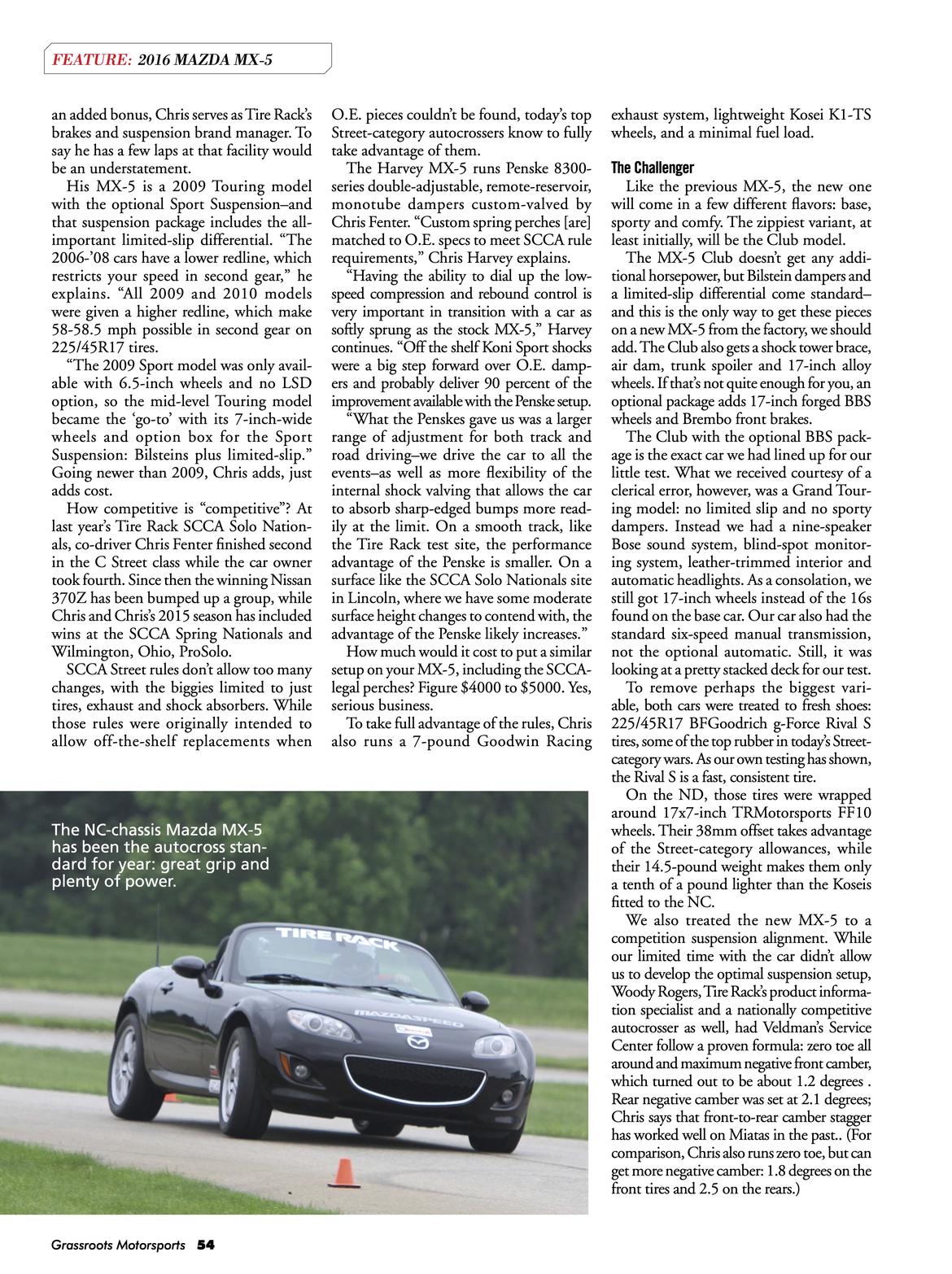
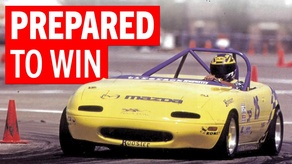
For the benchmark, we admit that we slightly stacked the deck. We could have found a nice, clean, stock NC-chassis MX-5, but we went with a known, proven quantity: Chris Harvey’s nationally competitive car. As an added bonus, Chris serves as Tire Rack’s brakes and suspension brand manager. To say he has a few laps at that facility would be an understatement.
His MX-5 is a 2009 Touring model with the optional Sport Suspension–and that suspension package includes the all-important limited-slip differential. “The 2006-’08 cars have a lower redline, which restricts your speed in second gear,” he explains. “All 2009 and 2010 models were given a higher redline, which make 58-58.5 mph possible in second gear on 225/45R17 tires.
“The 2009 Sport model was only available with 6.5-inch wheels and no LSD option, so the mid-level Touring model became the ‘go-to’ with its 7-inch-wide wheels and option box for the Sport Suspension: Bilsteins plus limited-slip.” Going newer than 2009, Chris adds, just adds cost.
How competitive is “competitive”? At last year’s Tire Rack SCCA Solo Nationals, co-driver Chris Fenter finished second in the C Street class while the car owner took fourth. Since then the winning Nissan 370Z has been bumped up a group, while Chris and Chris’s 2015 season has included wins at the SCCA Spring Nationals and Wilmington, Ohio, ProSolo.
SCCA Street rules don’t allow too many changes, with the biggies limited to just tires, exhaust and shock absorbers. While those rules were originally intended to allow off-the-shelf replacements when O.E. pieces couldn’t be found, today’s top Street-category autocrossers know to fully take advantage of them.
The Harvey MX-5 runs Penske 8300-series double-adjustable, remote-reservoir, monotube dampers custom-valved by Chris Fenter. “Custom spring perches [are] matched to O.E. specs to meet SCCA rule requirements,” Chris Harvey explains.
“Having the ability to dial up the low-speed compression and rebound control is very important in transition with a car as softly sprung as the stock MX-5,” Harvey continues. “Off the shelf Koni Sport shocks were a big step forward over O.E. dampers and probably deliver 90 percent of the improvement available with the Penske setup.
“What the Penskes gave us was a larger range of adjustment for both track and road driving–we drive the car to all the events–as well as more flexibility of the internal shock valving that allows the car to absorb sharp-edged bumps more readily at the limit. On a smooth track, like the Tire Rack test site, the performance advantage of the Penske is smaller. On a surface like the SCCA Solo Nationals site in Lincoln, where we have some moderate surface height changes to contend with, the advantage of the Penske likely increases.”
How much would it cost to put a similar setup on your MX-5, including the SCCA-legal perches? Figure $4000 to $5000. Yes, serious business.
To take full advantage of the rules, Chris also runs a 7-pound Goodwin Racing exhaust system, lightweight Kosei K1-TS wheels, and a minimal fuel load.
The Challenger
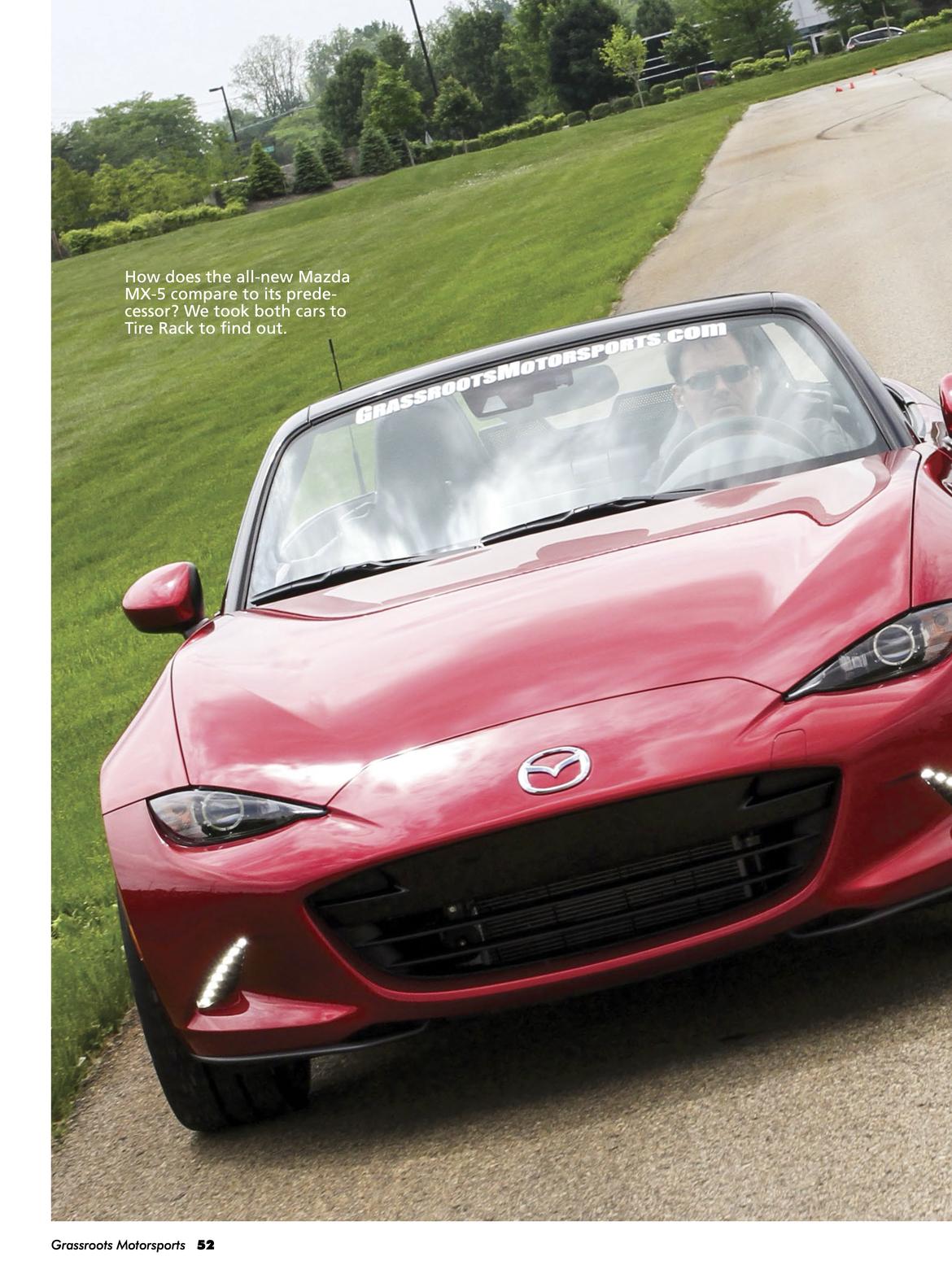
Like the previous MX-5, the new one will come in a few different flavors: base, sporty and comfy. The zippiest variant, at least initially, will be the Club model.
The MX-5 Club doesn’t get any additional horsepower, but Bilstein dampers and a limited-slip differential come standard–and this is the only way to get these pieces on a new MX-5 from the factory, we should add. The Club also gets a shock tower brace, air dam, trunk spoiler and 17-inch alloy wheels. If that’s not quite enough for you, an optional package adds 17-inch forged BBS wheels and Brembo front brakes.
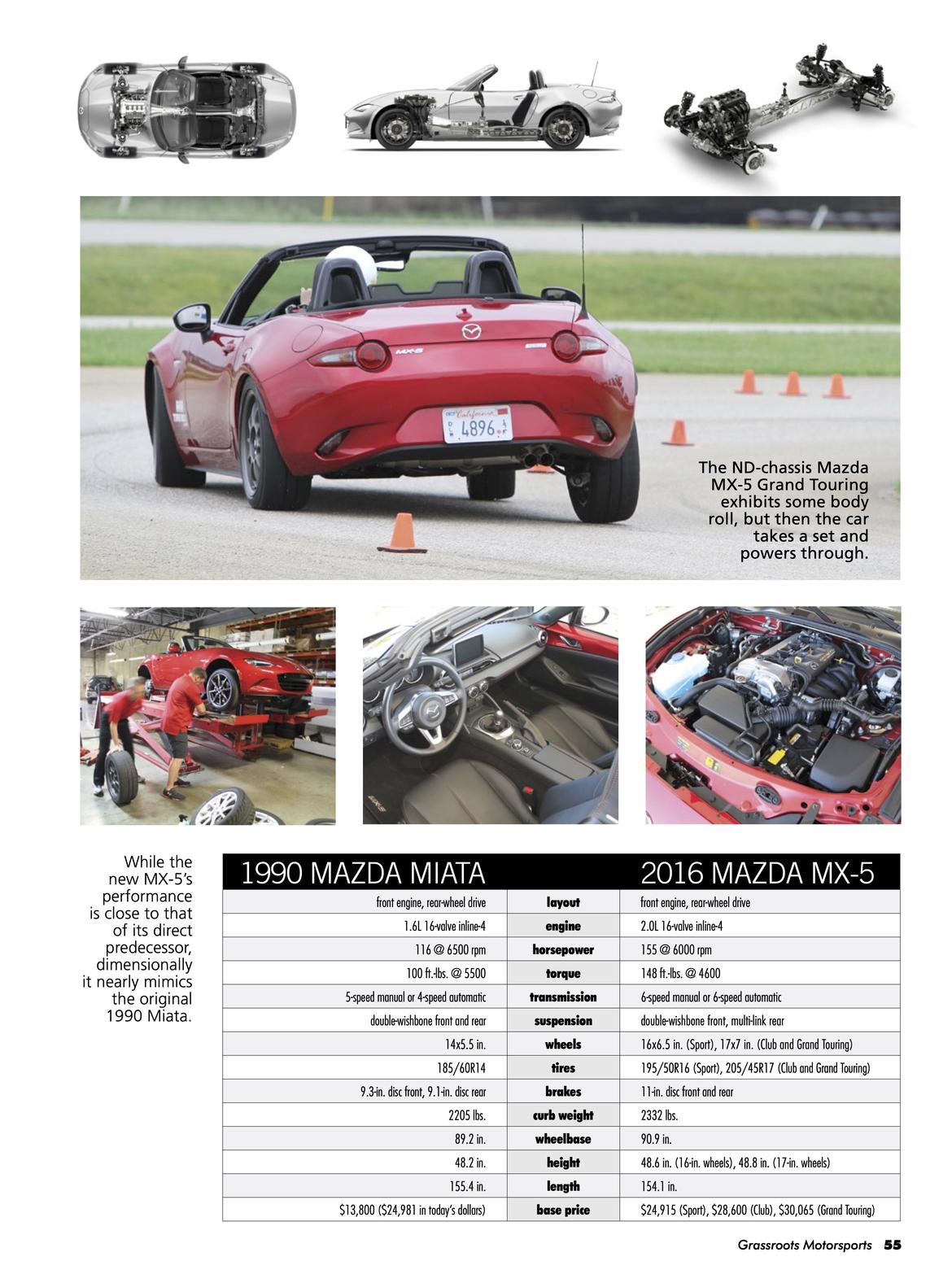
The Club with the optional BBS package is the exact car we had lined up for our little test. What we received courtesy of a clerical error, however, was a Grand Touring model: no limited slip and no sporty dampers. Instead we had a nine-speaker Bose sound system, blind-spot monitoring system, leather-trimmed interior and automatic headlights. As a consolation, we still got 17-inch wheels instead of the 16s found on the base car. Our car also had the standard six-speed manual transmission, not the optional automatic. Still, it was looking at a pretty stacked deck for our test.
To remove perhaps the biggest variable, both cars were treated to fresh shoes: 225/45R17 BFGoodrich g-Force Rival S tires, some of the top rubber in today’s Street-category wars. As our own testing has shown, the Rival S is a fast, consistent tire.
On the ND, those tires were wrapped around 17x7-inch TRMotorsports FF10 wheels. Their 38mm offset takes advantage of the Street-category allowances, while their 14.5-pound weight makes them only a tenth of a pound lighter than the Koseis fitted to the NC.
We also treated the new MX-5 to a competition suspension alignment. While our limited time with the car didn’t allow us to develop the optimal suspension setup, Woody Rogers, Tire Rack’s product information specialist and a nationally competitive autocrosser as well, had Veldman’s Service Center follow a proven formula: zero toe all around and maximum negative front camber, which turned out to be about 1.2 degrees . Rear negative camber was set at 2.1 degrees; Chris says that front-to-rear camber stagger has worked well on Miatas in the past.. (For comparison, Chris also runs zero toe, but can get more negative camber: 1.8 degrees on the front tires and 2.5 on the rears.)
The Results
Okay, enough talking. Time to record some lap times.
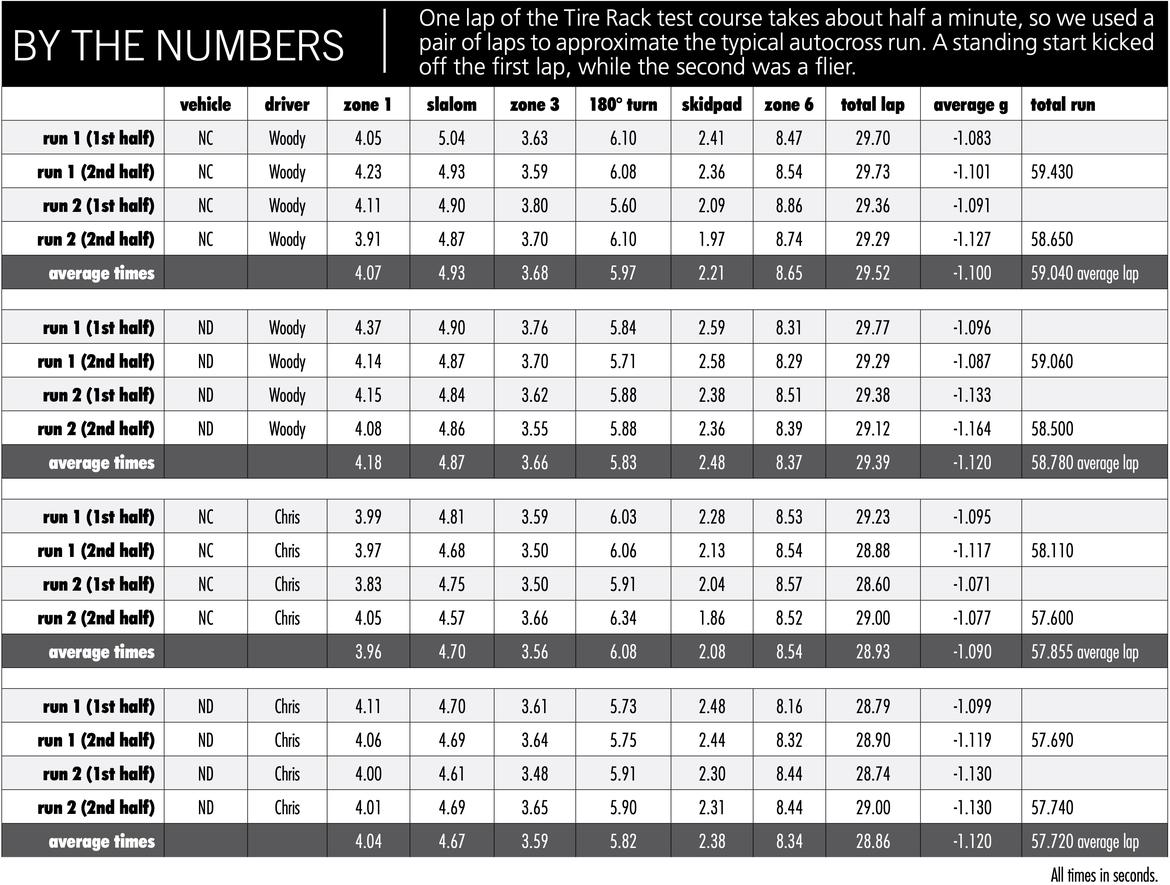
We used two drivers for this test, as Chris and Woody shared driving duties. Both have close to a zillion laps at their facility. Woody also ran all of the data using a Race Technology DL1 data logger.
After a few laps to remove any mold release agent from the new tires, the timers were started. Each driver would get two autocross-style runs in each car.
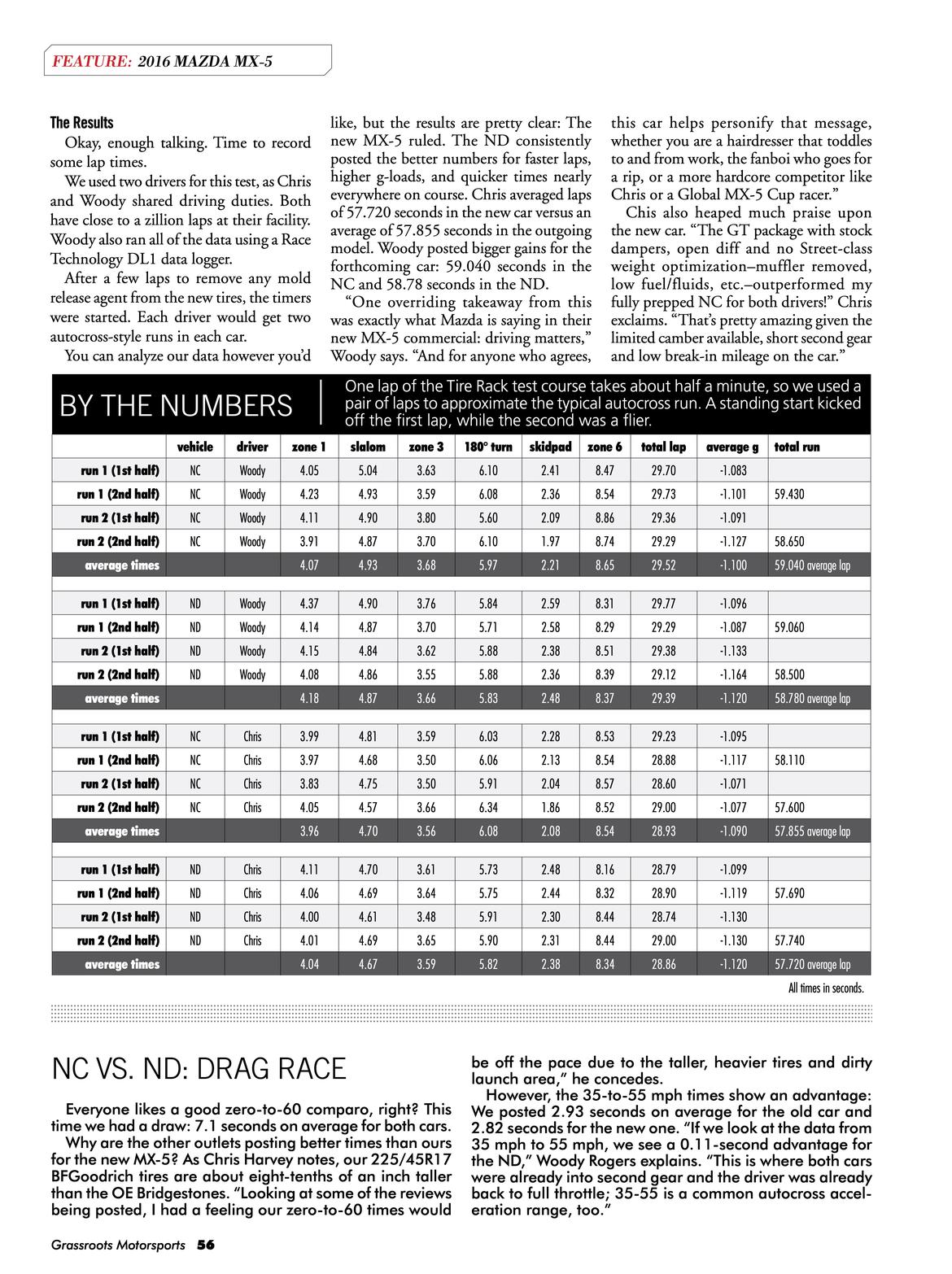
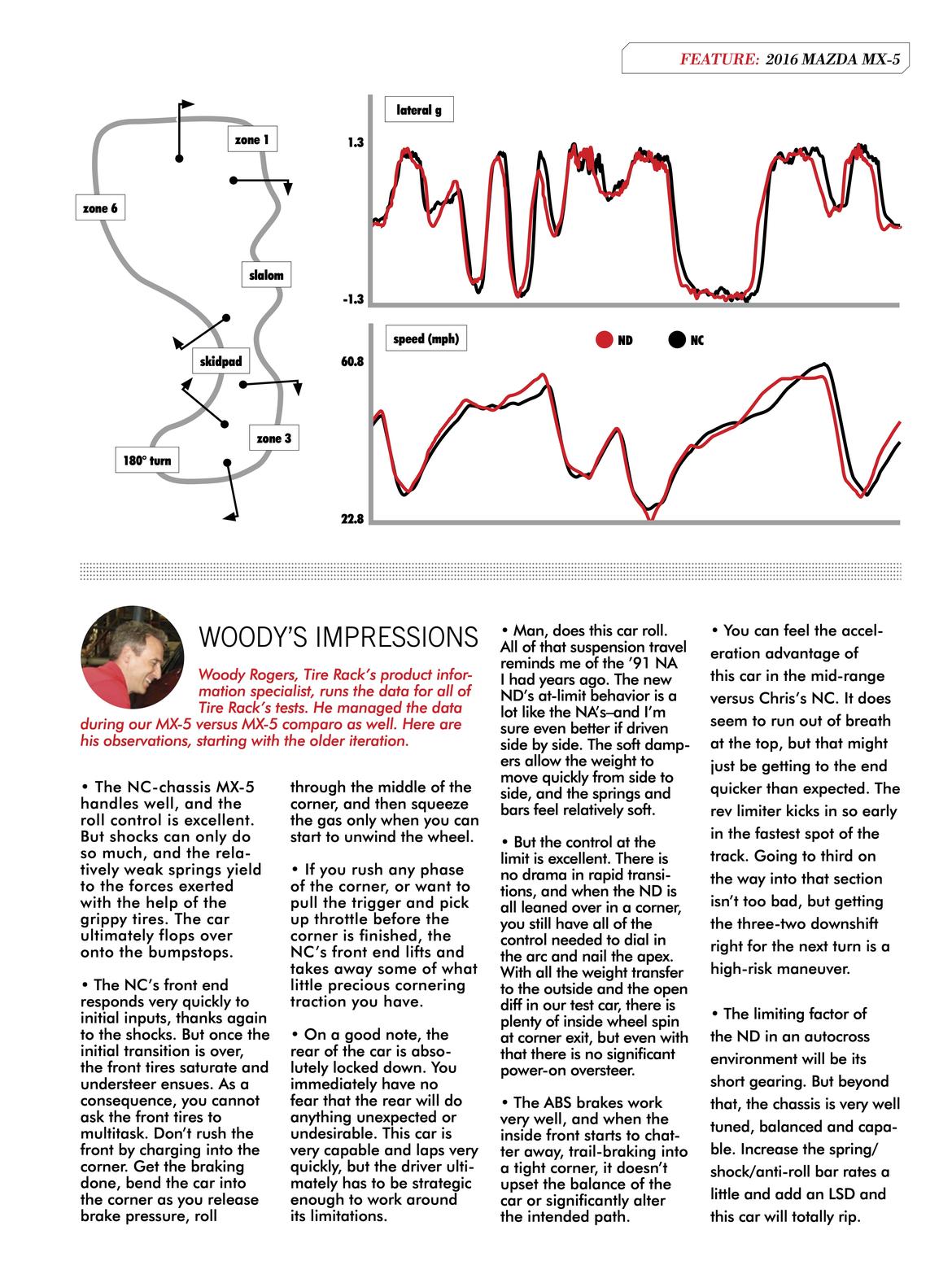
You can analyze our data however you’d like, but the results are pretty clear: The new MX-5 ruled. The ND consistently posted the better numbers for faster laps, higher g-loads, and quicker times nearly everywhere on course. Chris averaged laps of 57.720 seconds in the new car versus an average of 57.855 seconds in the outgoing model. Woody posted bigger gains for the forthcoming car: 59.040 seconds in the NC and 58.78 seconds in the ND.
“One overriding takeaway from this was exactly what Mazda is saying in their new MX-5 commercial: driving matters,” Woody says. “And for anyone who agrees, this car helps personify that message, whether you are a hairdresser that toddles to and from work, the fanboi who goes for a rip, or a more hardcore competitor like Chris or a Global MX-5 Cup racer.”
Chis also heaped much praise upon the new car. “The GT package with stock dampers, open diff and no Street-class weight optimization–muffler removed, low fuel/fluids, etc.–outperformed my fully prepped NC for both drivers!” Chris exclaims. “That’s pretty amazing given the limited camber available, short second gear and low break-in mileage on the car.”