


When I see the name Ross Bentley, I read the article. What a humble legend.


Need coaching? Certainly, we can all find ways to improve.
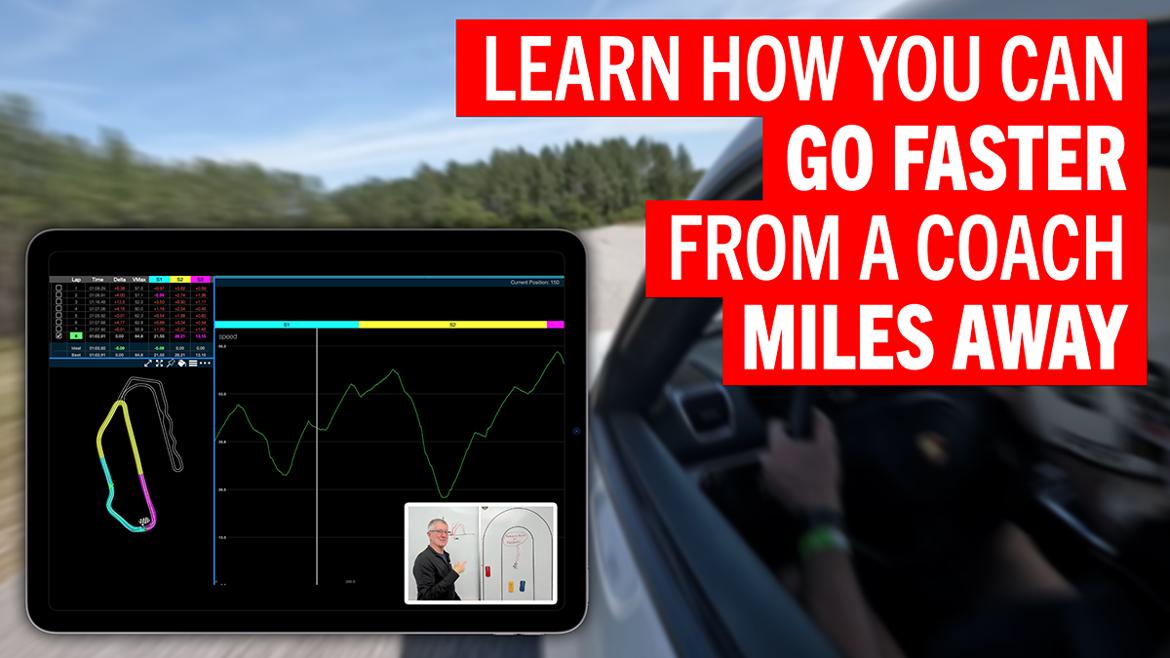
But what if we said you might not need that coach in your passenger seat? Or even at the track? The only thing you need is a camera or a rudimentary data system.
Crazy? Not these days. Ross Bentley does it for a living, working remotely with drivers all the way to IMSA–and all from the comfort of his own home in Vancouver.
“With technology now, I can see as much remotely as I could be in the car with you,” Ross explains. “It can be as effective–and sometimes more effective–because I get more views, more angles, more inputs of information than I could if I was in the car with you. I can also focus on one thing; I can’t help you go faster when I’m hoping just to survive [as a passenger]. And there’s less cost, generally, because there are no travel costs.”
Do you need to wire your car and your body with tons of sensors and cameras? No, not necessarily. One over-the-shoulder camera can do the trick, with a view pointed through the windshield and on the steering wheel.
“If all I had was that camera, it would still be a fantastic tool,” Ross says. “I can get a pretty good feel for how close to the limit you’re driving. Some of that comes from seeing your hand movement. If I see you turn into the corner in one nice, smooth arc, I’m going, ‘Nice line, really smooth, but you’re a bit slow.’ If you’re not making a correction every now and then, you’re probably not close to the limit. I’d probably say, ‘All I want you to do is brake later, so you’re carrying 1 to 3 mph more into the corner. I’d then watch for that.”
Got data? Share that, too.
“I put six of your best laps on top of each other,” Ross says. “I’d go, ‘Where’s the biggest variation?’ The biggest variation tells me the corner of the track that you’re not quite clear on how to do it. I’d go back to the video with that particular area of the track and see what’s going on there.”
Want to dive even deeper? Ross says he’d want to see a driver’s brake pressure, throttle position and steering position traces. “If a team just sends me speed and lateral and longitudinal g, I can tell a lot,” Ross says. “If they have brake, throttle and steering angle, it might take me 10 seconds to find something compared to 10 minutes with video or the basic data.”
Don’t have brake pressure or throttle position sensors? An additional camera showing your footwork can help.
“It’s more of a snapshot,” Ross says about the footbox camera. “Is the basic movement and positioning of your feet good? If we need to fix that, I want to confirm that you’re doing that. If positioning is good, then it becomes more about how you use your feet.”
After the feet are set, Ross says there are even more things you can do with a camera.
“Point that camera out the back,” Ross advises. “Then I can get a look at how you’re getting through traffic.
“Put the camera on the right-side A pillar, pointing at the driver’s face, and then I can see head and eye movement,” he continues. “If there’s not enough head movement–turning toward where the driver wants to go–then I know that’s a likely reason for inconsistency and, often, a lack of overall speed. Eye movement is harder to observe, whether at the track or remotely, but it’s just as important. The use of eye-tracking devices has given us insights into the vision practices of the best drivers, so vision skills can be trained better now. I developed a process for the way to use your vision on track so I could train drivers … and [it’s] much more than just ‘look farther ahead’ and ‘look where you want to go.’
“Also, head and eye movement often gives me a glimpse into the mental state of a driver,” Ross continues. “Picture someone who is lacking confidence and/or just in a bad mood. If they’re walking down a sidewalk, they will tend to look down more than they would when in a happy and confident state of mind.”
While sensors and cameras can provide a wealth of information to remote coaches like Ross, there’s one thing they can’t capture: “At the end of a session [at the track], the driver would come in and I’d ask, ‘How was that?’ If I see they’re breathing heavily, that’s a sign of how they were feeling in the car.
“I can look into their eyes and see if they’re comfortable in the car, if they’re not comfortable, if they’re scared. Over the phone, I can hear it in their voice. But there’s the human piece that’s limited with remote coaching. That is as important or even more important than what the data is telling me.”
While drivers sometime lie, the data doesn’t, which is a benefit to remote coaching. Furthermore, Ross Bentley’s track record proves remote coaching produces results.
“I’ve coached IndyCar winners, Le Mans winners and Daytona 24 winners without having sat in the car with them,” Ross says. “So if it works with them, why shouldn’t it work for you?”

When I see the name Ross Bentley, I read the article. What a humble legend.
Displaying 1-1 of 1 commentsView all comments on the GRM forums
You'll need to log in to post.


