


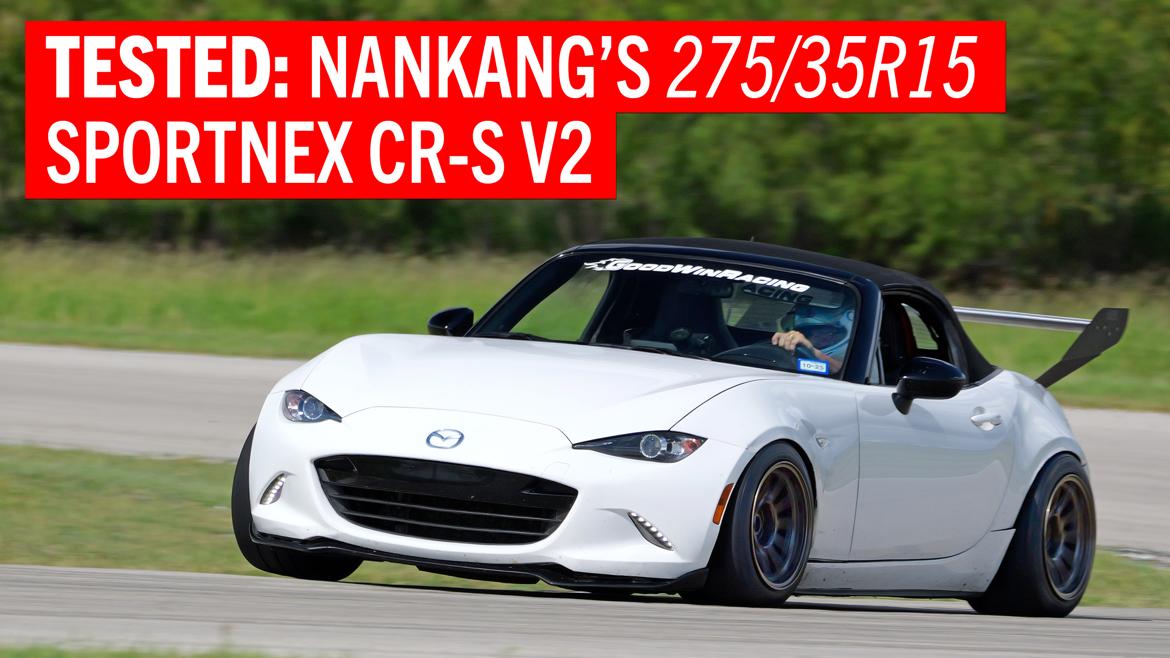
Dang, remember when we were happy to run 195s on a Miata? (At least I was.)


Photograph by Timothy Harper
“15s are dead.”
That’s the typical response when asking any major tire or automobile manufacturer about rubber in that diameter. Cars really haven’t been built with 15-inch wheels in decades.
So why are we so excited about a new, extra-wide Super 200 tire, Nankang’s latest 275/35R15?
Because many of us still race those older cars–think Miatas, golden-era Hondas, E30-chassis BMWs, Toyota MR2s and the like–that have smaller wheel wells that cannot easily accommodate today’s 17-inch and larger wheels.
As cars have become bloated to meet ever-more-stringent safety standards, brake diameters have swelled to better decelerate these portly beasts. And bigger brakes mean bigger wheels to clear them.
15s can also be used on some modern cars to further lower them without altering suspension geometry. For example, when used in SCCA’s C Street Prepared and D Prepared autocross categories, wide 15s are often fitted to the latest ND-generation Miatas like ours.
Back when GRM was called Auto-X magazine, the first cover car was a 240Z sporting 13-inch wheels. Back then, 175/70R13 tires were a thing. That was a high-performance fitment in 1984.
Soon thereafter, 185/60R14 was state of the art, followed quickly by 195/50R15, 205/50R15 and eventually 225/45R15. Matching wider wheel widths followed each of these sizes, with 15x9 being the widest to support those 225s.
As Hoosier entered the R-comp revolution, it pioneered even wider 15s: 245/40R15, 275/35R15 and even 295/30R15. Wheels followed suit: 15x10, 15x11 and even 15x12. Fenders were cut and flared, and abundant grip was had by all.
But when SCCA moved to street tires for most of its classes, the widest available fitment in a 23-inch-tall tire was reset back to 225. Competitors clamored. Eventually, Nankang, Falken, Maxxis and BFG all responded with 245/40R15s, but nothing more.
This was enough to satisfy most of these underpowered vehicles until the introduction of the XS and Max categories in autocross and time trials, respectively. These feature high-powered, run-what-ya-brung machinery, limited only by the use of a street tire. Suddenly, calls were heard for even wider 15-inch street tires to put down the big power these beasts could produce.
Over a year ago, Nankang finally heeded those calls by adding the 275/35R15 size to its Sportnex CR-S V2 line. But just as the new tire was ready, the market for it disappeared–due to a debilitating importation situation that kept new stock out of the U.S. for almost a year. That’s all been repaired now, and fresh Nankang rubber is once again available at the usual retail outlets, including in the new size.
[Tested: How does the new Nankang Sportnex CR-S compare?]
For our test, we also lined up a set of 245/40R15 Nankangs as well as a set of 225s, the latter already having some wear thanks to a previous test. They had been properly stored, though, while the numbers said that they were still in their prime.
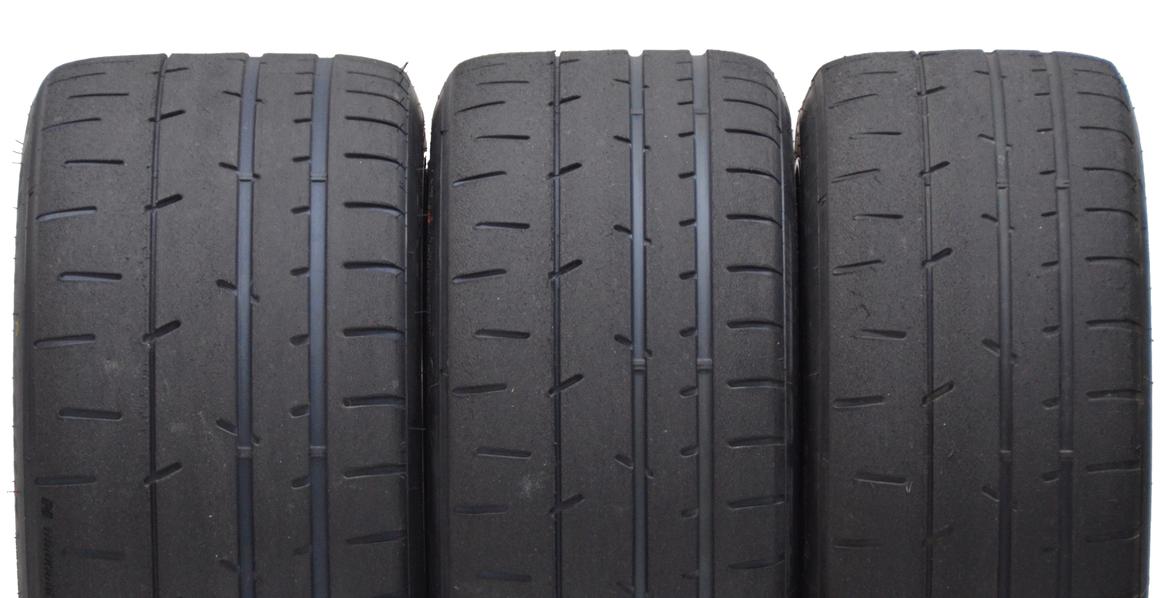
From left to right: 275/35R15, 245/40R15, 225/45R15. Photograph by Andy Hollis
As we’ve shown in multiple previous tests, wider tires are rarely quicker without wider wheels, so each tire was mounted on an optimal wheel width for that size: 225mm tires on 9-inch-wide wheels, 245s on 10s and 275s on 11s. Those last two fitments can be especially tricky to install over big brakes and without rubbing fenders. Offset and barrel design have to be perfect.
[Wheel width: Is wider always better?]
Enter Good-Win Racing. The company has been doing Miata parts development and retail sales for decades. In particular, the folks there have become experts in fitment of various wheel-and-tire combos from multiple brands. For each generation of Miata, they’ve done the homework to show what can fit with various levels of wheel well and brake mods. In many cases, they have worked directly with a manufacturer to produce a wheel with dimensions that provide the ideal wide fitment.
In our case, both the 15x10- and 15x11-inch wheels are exclusive Good-Win offerings built by Konig. While designed originally for the NB generation, these two Dekagram models have massive brake clearance that allows them to fit over the Brembos on our Triple Threat ND Miata test mule.
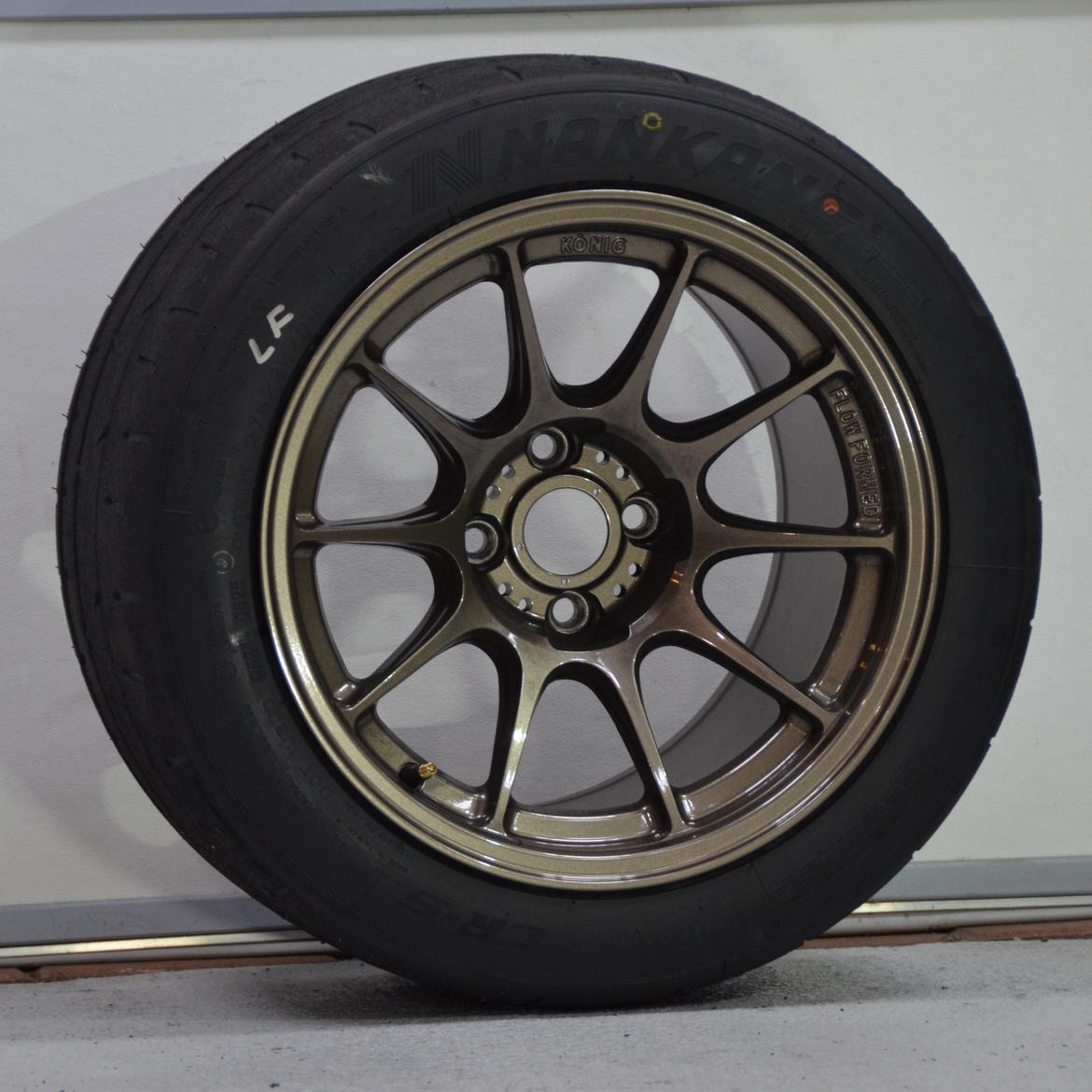
Photograph by Andy Hollis
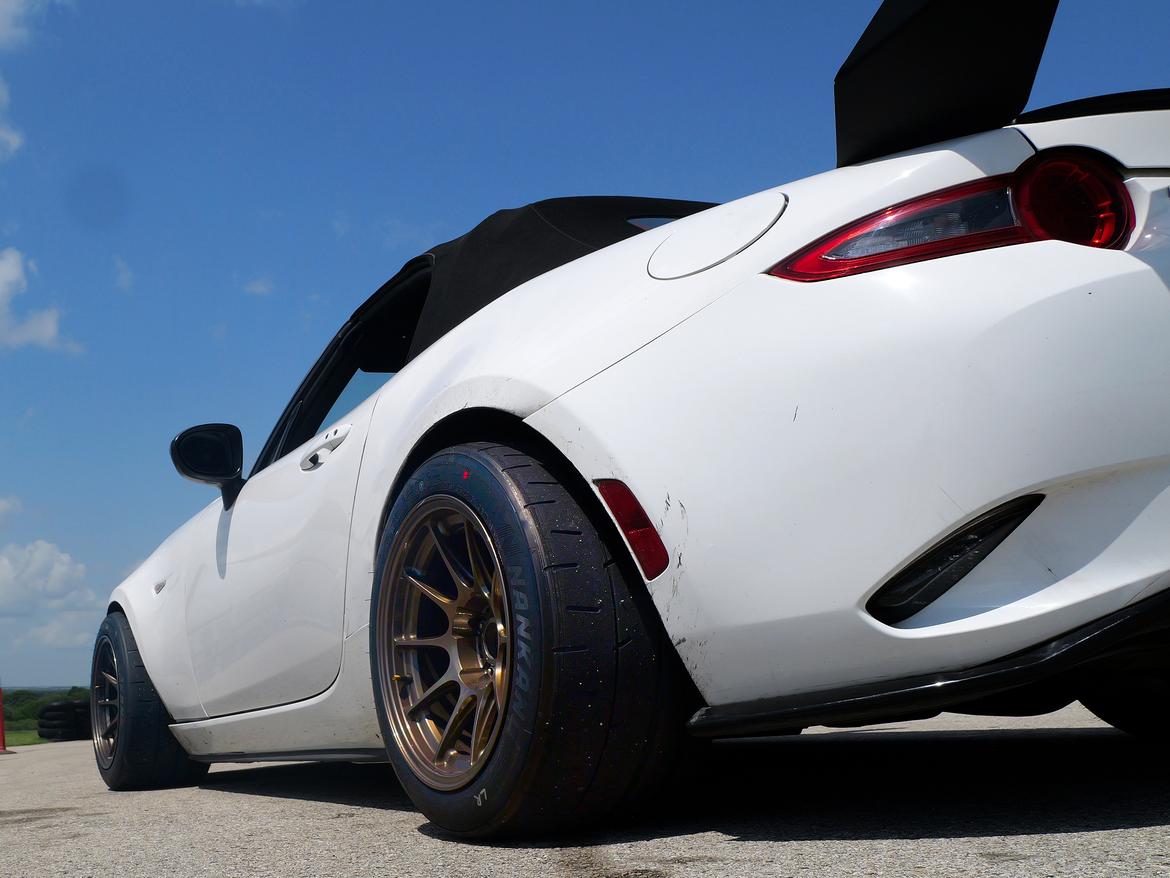
We did have to roll our rear fenders to accommodate the 275s, though. The result? Hella flush when cornering.
Both sets of new tires were given the usual initial heat cycle with six track laps of increasing intensity, bookended by highway drives to and from the track. While the 245s felt fairly normal on the road, the 275 steamrollers tramlined quite a bit, following every highway rut and undulation. Handling was also darty, requiring constant attention to the wheel.
Photograph by Timothy Harper
Test day at Harris Hill Raceway dawned in the low 80s and would climb close to 90 while we worked under the partly cloudy skies. The track was in great shape, having hosted an SCCA Track Night in America the evening before, but we still did a practice session to dial in our driving. After a short coffee break to let the tires cool, we turned on the lap timer.
We ran through each set of tires at 30-minute intervals, eventually circling back to the leftover 225s, hoping to see similar pace at the end.

*Prices current with Tire Rack as of June 24, 2025.
As all of our tires were the same model, you might expect them to have the same heat characteristics, but tread depth and age played a major role here. As we’ve seen in previous test stories, most street tires gain both pace and session consistency as the tread wears down.
Indeed, our year-old 225s used as a bracket tire were extremely consistent during the second session. During the opening effort, however, we saw an increased pace as the laps progressed. What happened? The track was cleaning up a bit more during that time. Ultimately, they served their role as a bracket to verify that the core test–245 versus 275–was valid, as we demonstrated similar ultimate pace.
By contrast, our fresh, full-tread 245s and 275s could only do two flyers before slowing a bit. Their taller tread blocks simply generated more heat–a significant factor on this hot, early summer day.
The big takeaway, of course, was to put a pace increase value on the inch of extra tread width by upsizing from 245 to 275. And that number was a solid six-tenths. Data logs show the increase came via two avenues: higher mid-corner speed in several sweepers and earlier corner exit throttle-up down each straight.
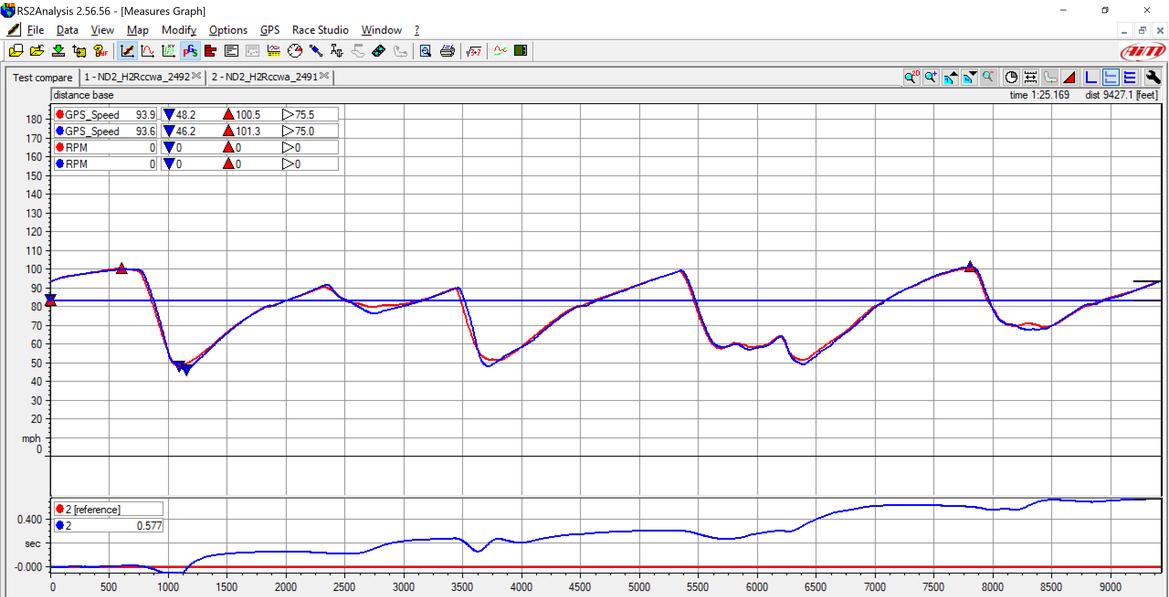
The data show where the 275mm Nankangs (red trace) hold the advantage over the 245mm Nankangs: in the turns.
Fitting wider wheels and tires can be quite the challenge, especially when the sizing gets to be this big. Fenders need massaging, steering may need to be restricted and spacers have to be dialed in. It can be a lot of work. Is it worth it? Now you have the data–and the prices–to help you decide.

Dang, remember when we were happy to run 195s on a Miata? (At least I was.)

I'm glad they were significantly faster...
...cuz the car looks significantly more bad-ass on that setup.

In reply to Andy Hollis :
Hella flush!

Beefcake. BEEFCAKE!!
It needs an Arby's sticker, just the hat.
And yes, it looks mean as hell with that setup.

one thing that I wonder about, is 6 tenths worth a weekend of entry fee's?
at $150 more per tire than the 10" wide 245 tires that works out to be around $600. for me, i'll find more time /w more time than i will with wider tires...

ClearWaterMS said:one thing that I wonder about, is 6 tenths worth a weekend of entry fee's?
at $150 more per tire than the 10" wide 245 tires that works out to be around $600. for me, i'll find more time /w more time than i will with wider tires...
Valid question. I'd say that the answer is likely yes for some people, especially when they're at the pointy end of the field, when 6 tenths is all that separates 1st and 2nd place.

Now I want a comparison of the Nankangs, Hoosiers, Vitours, and anything else in a 275/35/15 that'll fit the Challenge Corolla..........and do it on an autocross course, rather than a track. For science, you know.....

I always find these interesting because I mostly live in a world where the extra weight and rolling resistance of super wide tires kills the lap times.

Good on playing to the needs of the racers, but a bit late to the party.
It’s not that the Nankang 275/35/15 is bad… it’s just that the Vitour 305/30/15 is better.
dallasreed said:Good on playing to the needs of the racers, but a bit late to the party.
It’s not that the Nankang 275/35/15 is bad… it’s just that the Vitour 305/30/15 is better.
If you can effectively run a 22" OD tire, which pretty much nobody was setup for in the past.
Daniel Moore had to build a new transmission with a longer FD to make it work on his turbo EF hatch. Plus screw around with his suspension geometry to get the splitter off the deck. And lose camber.
It's far from a bolt-on solution.
Y'all need to get those 275/35-15 and 245/40-15 P1's off your promise list and onto the shipped list. Then you'll have the best of both worlds.
Displaying 1-10 of 33 commentsView all comments on the GRM forums
You'll need to log in to post.