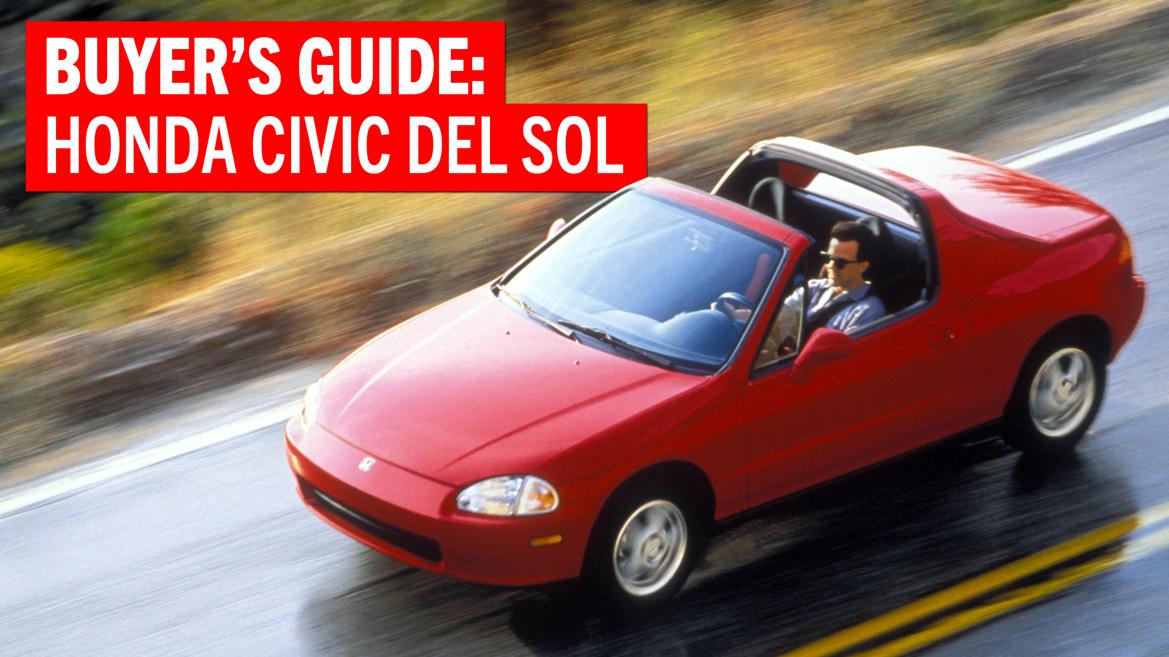
As the 1980s officially came to a close and the 1990s dawned, the Mazda Miata landed on our shores. The marker for affordable two-seaters soon contained three very different cars: the Miata, the Honda CRX …
Shopping and Buying
It's a Honda, so there aren't many trouble spots to look for when purchasing a del Sol, apart from the usual concerns about rust and previous accidents. Many owners report leaky targa tops and fragile trim pieces on the interior; after 1994, a change to the top seal reduced the leakage complaints. In sunny states, inexpensive del Sols aren't that hard to find, and many are priced similarly to contemporary Miatas.
The del Sol S's anemic powerplant makes it more of an economy car than a racer. The Si's mild single-cam VTEC engine is better, but the twin-cam del Sol VTEC is the one to have.
That said, the del Sol VTEC has also become the hardest to find. Adding to the problem is the fact that many classified ads for the del Sol Si mention the VTEC engine–technically the ads aren't wrong, but it can make things confusing. Is the car in the ad a single-cam del Sol Si or the twin-cam del Sol VTEC? If there's some confusion, a quick look at the engine will quickly confirm things.
As far as the current market goes, the nicest del Sol VTEC should have an asking price of no more than $10,000. We have seen nice adult-owned cars in the $6000 to $7000 range as well.
Aside from complete rats and cars with salvage titles, most of the del Sol Sand Si models currently advertised fall into the $3000 to $6000 range.
On Track Today
With the Miata around and thanks to its tepid performance at the beginning of production, the del Sol acquired a reputation as a lover, not a fighter. However, there are qualities to recommend it as a track car, and for a while there in the late 1990s the del Sol could be found on the grids of professional street stock endurance races.
The lowered ride height and short wheelbase provide sharp reflexes, and the del Sol is a decent autocrosser on the local level. Some owners spoke of chassis flex on the track, but with a roll cage installed, the del Sol is reportedly sturdy. Sam Lockwood of Lockwood Raceworks in Gainesville, Ga., can attest to the del Sol's strength. He says his racer "moved a concrete barrier at Sebring 3 feet, and we were able to fix the car and still run competitively the next day."
The downside to the del Sol's sturdy structure is a comparatively high weight, so competing with cars like the Mazda RX-7 and BMW 3 Series in the SCCA's Improved Touring S class is a challenge.
Things are a little different in NASA's Hon·da Challenge. The del Sol isn't an overdog in this series, but at least it gets a fairer shake. A few racers have turned to this platform: Thanks to its 2.0-liter CR-VTEC engine, Lockwood's car runs in the Hl class against other hybrids. Danny Foldes and Mike Lock are currently running their del Sol Si racers in the H4 class, where the cars face other single-cam VTEC machines like the Civic EX coupe. Thanks to the car's robust nature, we're also seeing del Sols turn up at noncompetitive track days like those run under the NASA banner.
Owner Profile
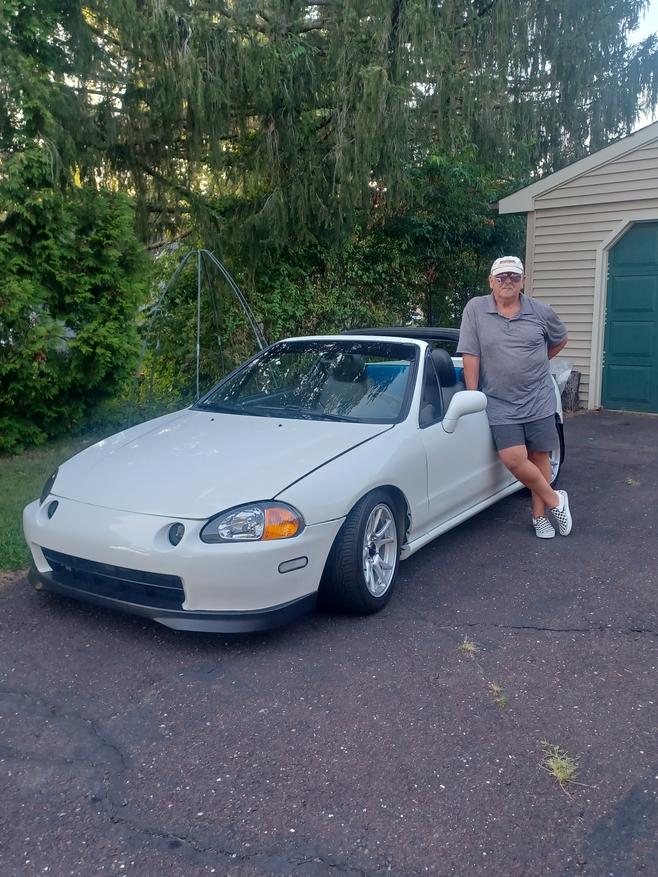
When putting together this story, we knew that we needed to photograph a del Sol, so we held a nationwide casting call via the Internet. We didn't expect the right car to be located in our own neighborhood; 16-year-old Wray Gillette lives around the corner from our editor.
Wray, who is dual-enrolled in high school and our local Advanced Technology Center, calls himself a lifelong car fanatic. "I chose a del Sol because they are somewhat unique cars, and mainly just because I fell in love with them the first time I saw one," he explains.
While he originally sought out a del Sol VTEC, their scarcity and appetite for premium gasoline made the Si model a more reasonable choice. He bought this 1995 del Sol Si in early August 2004.
The car was pretty clean when it came into Wray's possession, although he has carried out a few mods to suit his desires and needs. The suspension has been beefed up with the addition of KYB GR-2 shock absorbers and TEIN S.Tech springs, while a DC Sports header is now mated to a custom-bent 2.25-inch exhaust system. While the car wore stock wheels that had been painted black during our initial photo shoot, Wray recently added a set of 205/45WR16 Yokohama AVS ES100 tires wrapped around 16-inch Rota Grid wheels. He says some more upgraded suspension hardware is in his future plans.
"The ownership has been great," he says of the del Sol. "So far I have loved every minute of it. It's a great little sporty car, with a targa, and good gas milage."
Updates and Changes
The del Sol's body never changed during its model run, but Honda did periodically tweak things–possibly enough to dictate which year or years are more desirable than others to some.
1993: The original del Sol came in one of two flavors, S or Si. The S was the base model and featured 13-inch steel wheels and a single-com, non-VTEC engine. It still had the liftoff top. The upmarket Si was powered by the D16Z6 engine, Honda's popular 1.6-liter, single-com VTEC piece. The same 125-horsepower engine would also power the Civic Si and Civic EX from 1992 through 1995.
1994: As the inevitable comparisons to the Miata and MR2 began to surface, Honda saw the need for more power, and the del Sol VTEC came along for 1994. This one got the high-compression, B16A-spec twin-cam engine that was good for 160 horsepower. This was the hot 8000 rpm VTEC model, with timing, duration and lift of intake and exhaust valves modulated for maximum power. Only a five-speed transaxle was offered with this engine.
The del Sol VTEC also received a 15mm rear anti-roll bar matched to a healthier 24mm front bar. The more powerful engine woke up the del Sol's sleepy performance: Zero-to-60 times were shoved to about 7 seconds, besting the Si by a full second. Dual airbags also came along for 1994, and production stayed high, at about 21,000 units. (This figure practically ties the Miata here in the U.S., although the Mazda was able to maintain that momentum better.)
1995: The del Sol became its own model, dropping the Civic from its name. The car also got a minor face-lift that removed the auxiliary lights from the front fascia. Prices went up to $16,950 for the Si manual and $19,200 for the VTEC.
Sales had begun to slide, however, and although the del Sol was finding its own enthusiastic audience, it never really recovered from the CRX crowd's initial disappointment in the car. Only 14,000 cars were sold in 1995. On the plus side, new weather stripping stopped the leaks that had plagued the first cars. A remote trunk release was also added this year.
1996: With sales dwindling and the market getting more crowded, it was clear by now that the del Sol had to get serious about something: Was it an economy car or a performance car? Straddling the fence certainly wasn't working very well, as only 8400 examples were sold this year. (Honda learned this lesson well, and its next roadster would be the traditional, much more hardcore S2000.)
Changes to the del Sol for 1996 included the new D16Y8 engine replacing the D16Z6 in the Si model. This new single-com VTEC engine also had 1.6 liters of displacement, and while horsepower actually increased to 127, some enthusiasts prefer the earlier engine due to its better-flowing cylinder head. The del Sol S also got a small bump in horsepower–106 vs. 102–as the non-VTEC D16Y7 replaced the D15B7.
1997: The del Sol didn't receive any major changes this year. Only 5600 copies were sold before the model left U.S. dealerships. Some overseas markets sold the car for a little while longer.
Going Faster
The wide component compatibility the del Sol shares with other Hondas comes in handy when it comes to the powertrain and suspension. Upgraded suspension components can be sourced from the vast and powerful Honda aftermarket with ease. Since it's more or less a Civic beneath, the del Sol can also handle all of the popular B-, H- and even K-series engine swaps.
Likewise, the original B- and D-series engines are reasonably bulletproof, and there's a big pool of knowledge to tap into when it comes to reliability and power modifications. One bonus of owning any Honda is that nearly every crazy idea has been tried by someone, somewhere, so there are fewer setup mysteries.
While most all standard-issue Civic suspension and drivetrain components fit the del Sol, note that the exhaust is unique to the two-seater. A lot of del Sol owners just have their local muffler shop fab up something or start with a system originally designed for the 1992-'95 Civic hatch and modify the pipe as needed.
For junkyard bargain hunters, the del Sol shares many suspension components with the 1992-'95 Civic as well as with the 1994-and-up lntegra. The front lip fitted to the 1993-'95 Civic EX coupe nicely fits the del Sol. And if you're going in the other direction, the del Sol's sporty bucket seats have become a prized find for the Civic.
Behind the Wheel
The del Sol's close relationship to the Civic is immediately evident in the driving experience, which is both a good and a bad thing from an enthusiast's standpoint.
The del Sol hits the road with the typical light reflexes and responsive throttle of a Honda, and with a decent set of tires a del Sol doesn't understeer too terribly. Broking is similar to that of the Civic.
Unfortunately, the Civic parts also tend to dull the del Sol's handling, and contemporaries like the Miata, Nissan NX 2000 and Mazda MX-3 feel crisper and more confident when driven hard.
Power is dismal in the base model, of course, and not much better in the Si. Although light on its feet, the del Sol feels heavier than a Civic Si hatchback of the same generation, thanks in part to the stiff, tank-like targa body structure. There's a tendency for the car to feel slow, even when it isn't.
The exception is the VTEC, of course. The 160-horse del Sol sings just as well as its cousin, the Acura lntegra, and the power boost and suspension tweaks–like that rear anti-roll bar–give the car a much sharper edge. Fortunately, a base car can be upgraded to VTEC specs–and beyond.
Visibility isn't as good as in a Civic or Miata; the del Sol features the classic "driving-in-a-tub" feeling pioneered by the Porsche 356.
Shop View
While history has proved that the Honda Civic is a robust, reliable car–especially when it comes to the driveline–there are a few problem areas specific to the del Sol models. Most of these problems have to do with water getting where it isn't welcome.
One place that sometimes gets wet is the passenger compartment, and this can usually be traced to a problem with the top's seals. This was a big issue on the 1993-'94 cars, and Honda redesigned the seals for 1995, more or less stopping the problem. Some owners of 1993-'94 cars reportedly had the seals replaced under warranty. A new set of top seals can be purchased from Majestic Honda for about $400.
If the trunk is wet, the plastic clips that secure the rear sail panels are probably to blame. These clips eventually snap and allow water to enter the fender cavity and pool in the trunk. Fortunately the fix is easy, and the parts are not too expensive: Figure $2.45 each for the clips. (You'll need two of them–one per side–the part No. is 91505-SR2-003.)
While you're replacing those two plastic clips, clean out the drains that can be found under the soil panel. Clogged drains can also lead to a wet trunk.
To keep the trunk from getting too musty, two vents allow for some airflow. These vents are covered by plastic flaps, and over time these pieces become warped or cracked. As the flops fall apart, they can let water into the trunk. Patch or replace the flops as needed to solve the problem.
Although it could be considered more of an annoyance, some people have complained of squeaking tops, especially when the side windows are up. Lubricating the seals located on the side of the top with dielectric grease or silicone is said to help.
Finally, a few interior bits tend not to stand the test of time-again, more of an annoyance than an outright problem. Over time, the interior door panels tend to get wavy; new panels for both doors run about $500. Since the del Sol doors are unique to that model, inner panels from a Civic won't fit. Also, a lot of people have reported broken ashtray lids.