

[Editor's Note: This article originally appeared in the June 2000 issue of Grassroots Motorsports. Some information may have changed, and prices have been left as they originally appeared in print.]
The Chevrolet Corvette has been an important piece of Americana since its 1953 debut–as the ads used to say, "baseball, hot dogs, apple pie and Chevrolet." The car was introduced at a time when European imports defined the meaning of the term sports car. and the new Corvette capitalized heavily on its position as America's first true sports car. Its staying power in the marketplace and at the racetrack has furthered the Vette's cult-like status among enthusiasts.
It took a couple of years, however, for the Corvette to actually live up to its initial claims. The car was always a standout in terms of its styling, but that very first model could not offer performance to match its looks–a combination that would be found on some other models, as well. So each new design of the Corvette has been anticipated eagerly, yet with a touch of apprehension: Would the new car be worthy of the name?
The answer, with the 1984 introduction of the fourth-generation Corvette (referred to as the C4), was a resounding Yes. The car tallied up nearly 360,000 sales before being replaced by a new Vette in 1997. It also brought back much of the luster to the Corvette name.
The C4 Corvette was a revolutionary design for Chevrolet. Instead of a traditional body-on-ladder-fame design, the C4 used a steel backbone to solidly link the transmission and differential, much like a Lotus. A steel unibody was then bolted to the backbone and powertrain, creating a rigid structure upon which the targa-topped, fiberglass bodywork was attached. By comparison, older Corvettes were essentially a ladder frame with a huge blob of fiberglass bolted on, making a heavy and somewhat flimsy structure. The new design yielded a 250-pound decrease in weight with an increase in torsional rigidity.
These improvements allowed the engineering team, led by David R. McLellan, to substantially redesign the suspension for improved performance. The two most prominent changes were the use of transverse fiberglass leaf springs instead of four conventional coil springs, and the replacement of Zora Arkus-Duntov's old three-link rear suspension with a more effective five-link design.
Like any successful design, the C4 required only subtle improvements in 13 years of production. Nearly all of the changes were focused on improving the handling and power of the classic American sports car, with only few trim changes to differentiate the years. This means that the low-budget enthusiast can find an older car for relatively little money and then peruse the salvage yards for hop-up parts.
In the early '80s, VS-powered sports cars were as out of place in the American car scene as a Clint Eastwood spaghetti-western at the Sundance Film Festival. The demands for fuel-efficient and environmentally-friendly engines were increasing faster than the engineering know-how to make clean power.
Still, the 1984 Corvette, introduced in March 1983, was fitted with a 350-cubic-inch V8 featuring Chevrolet's Cross-Fire Injection; these engines struggled to develop 205 horsepower but did produce 290 ft.lbs. of torque. Hauling 3200 pounds of fiberglass and steel from rest to 60 mph took around seven seconds.
In 1985, the Vette received the L98 engine. Displacement remained at 350 cubic inches, but the new engine featured Bosch's Tuned Port Injection system along with a mass airflow sensor and tubular intake runners. Output was up to 230 horsepower and 330 ft.-lbs. of torque. knocking about a second off the car's 0-60 time.
Midway through 1986, the L98 powerplant received better-breathing aluminum heads, helping raise engine output to 235 horsepower. (All 1986 convertibles and late-1986 coupes came with the new heads.) Another five-horsepower gain was seen the following year thanks to roller valve lifters.
The 1988 model saw another small, five-horsepower gain thanks to the less-restrictive exhaust system fitted to coupes ordered with the 3.07:1 rear axle ratio. All convertibles and coupes with the 2.59:1 rear axle ratio remained at 240 horsepower.
In 1990, the L98's output was raised slightly once again, as an increased compression ratio, revived cam profiles and an air intake speed density control system added five more horsepower: coupes with the 3.07:1 and 3.33:1 ratios were now making 250 horsepower, while the other coupes and all convertibles were at 245.
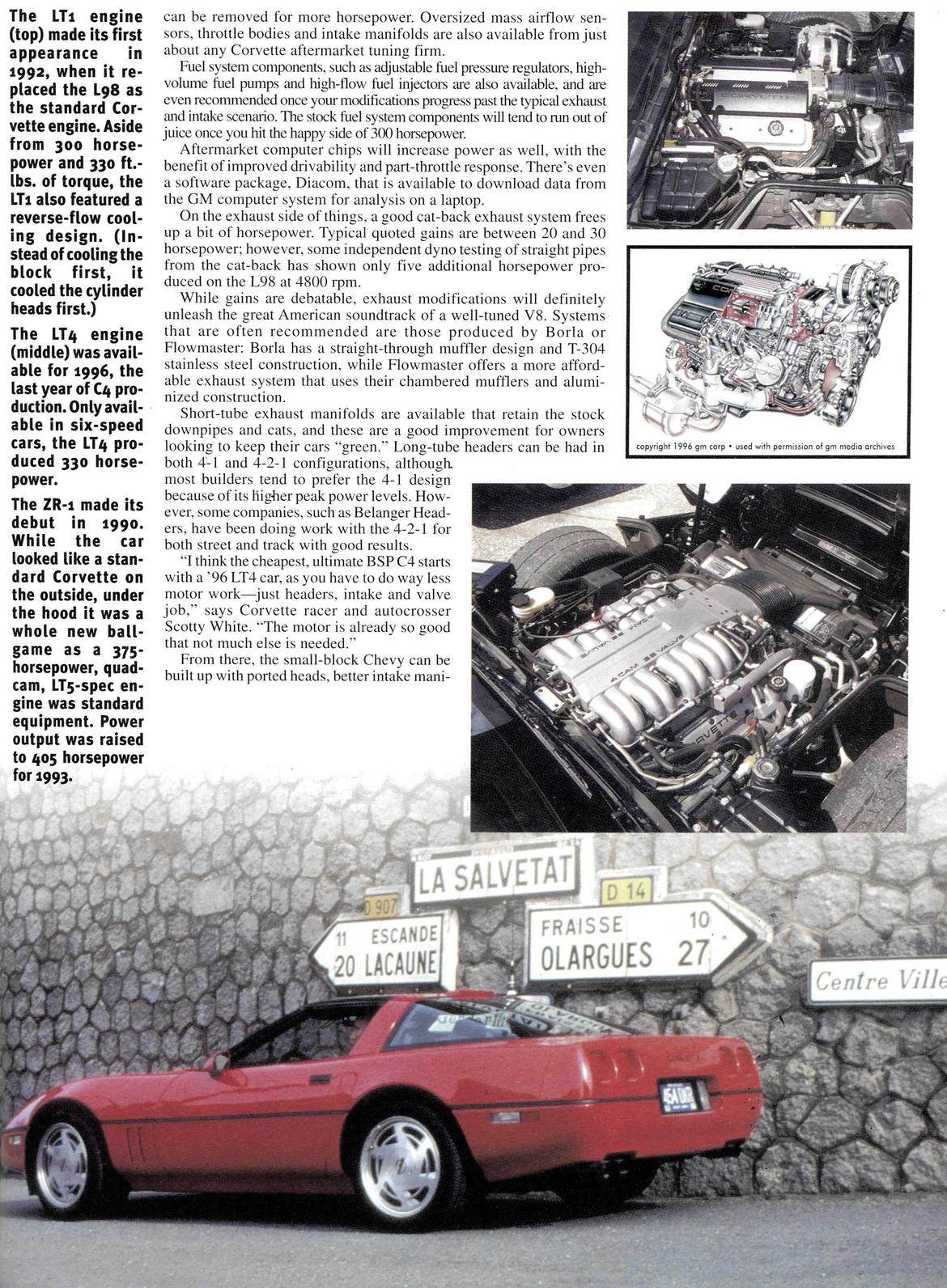
The LT1 powerplant was introduced in 1992, and subsequently output was up to 300 horsepower and 330 ft.-lbs. of torque-0-60 times were down to the five-second range. Revising the cam profile for the 1993 model helped add 10 more ft.-lbs. of torque. In a move that had no effect on engine output, stronger connecting rods were used starting in late 1995.
In 1996, the last year of its production, the C4 Corvette was blessed with the LT4 engine, which pumped out 330 horsepower from its 350 cubic inches. The LT4 was only available with the six-speed manual transmission; its increased power was courtesy of a higher compression ratio (10.8:1 vs. 10.4:1), new aluminum heads, improved cam profile and Crane roller rockers. Cars with the automatic box were still powered by the LT1.
The "King of the Hill" ZR-1 came out in 1990 as a sister product to the standard Corvette. It featured the 375-horsepower LT5-spec engine co-developed with Mercury Marine. Cylinder head changes carried out for the 1993 model year raised output to 405 horsepower, but the car never sold as well as expected.
The steep price tag (close to 60 grand) and rapidly shrinking differentiation from the "base" Corvette were to blame for the ZR-I 's poor sales, and Chevrolet dropped the model from the lineup after 1995. Still, most magazine road tests have the ZR-1 accelerating from zero to 60 in just under five seconds.
From 1984 through 1988, all manual-transmission Corvettes came with a Doug Nash four-speed box that featured overdrive in the top three gears. This gearbox design, dubbed the 4+3, was adequate, but over time the shifting deteriorated due to linkage wear.
A more robust ZF six-speed came out in 1989. vastly improving the shift quality and gear spacing. A shorter final drive was fitted when the six-speed was released: 3.54:1 at first, then 3.31:1 later on. The shiftless types also saw improvements, as the early 700R4 automatic transmission was eventually changed out for the more robust 4L80E.
Since 1963, the Corvette has been one of the few American performance cars with a fully-independent suspension. On the C4 Vette, the front suspension continued its double A-arm design, with the substitution of a single reinforced fiberglass leaf spring in place of the individual coil springs that were found on earlier cars. This unconventional spring design mounted below the lower control arms and shaved approximately 25 pounds off the car.
The rear suspension was upgraded from a three-link design to a five-link arrangement, also using a fiberglass leaf spring. The steering mechanism was changed from GM's aging recirculating ball system to a rack-and-pinion design, too.
An optional handling package was offered, dubbed–in typical GM parlance–the Z51. Stiffer shock absorbers were fitted, and a 25mm front anti-roll bar replaced the standard 20mm unit. The steering ratio was raised from 15.5:1 to 13:1, and other improvements included heavy-duty lower control arm bushings and stiffer front and rear springs.
As could be expected, the ride of the Z51 equipped cars could best be described as punishing. In later years, the Z07 package replaced the Z51 as the sport tuned option, although this was more a change in nomenclature than any major re-engineering.
The engineers at GM responded to the criticism about the rough and jiggly handling with minor tweaks in subsequent years. Softer spring rates in both standard and Z5 l suspensions were fitted, as well as newly developed Delco-Bilstein shock absorbers.
As a direct result of the Corvette engineering team's racing experiences, many refinements were made in 1988. Seventeen-inch wheels were added to the Z51 suspension package and were also made a standalone option, and larger brake rotors and two-piston calipers were installed to take advantage of the larger wheels.
The front suspension geometry was changed in 1988 from 75mm of scrub radius to zero, which improved stability under braking. (Scrub radius is the distance between where the kingpin axis intersects the ground and where the center of the tire's contact patch meets the ground.) This may seem like a simple upgrade, but it required changes to the steering knuckles, upper and lower control arms, springs, shock mounts and shock absorbers.
The rear suspension geometry was also changed in 1988 to give a different camber curve that improved handling. As in the front end, this seemingly minor change required many new parts like hubs, suspension arms and shocks. The end result was an American sports car with world-class handling.
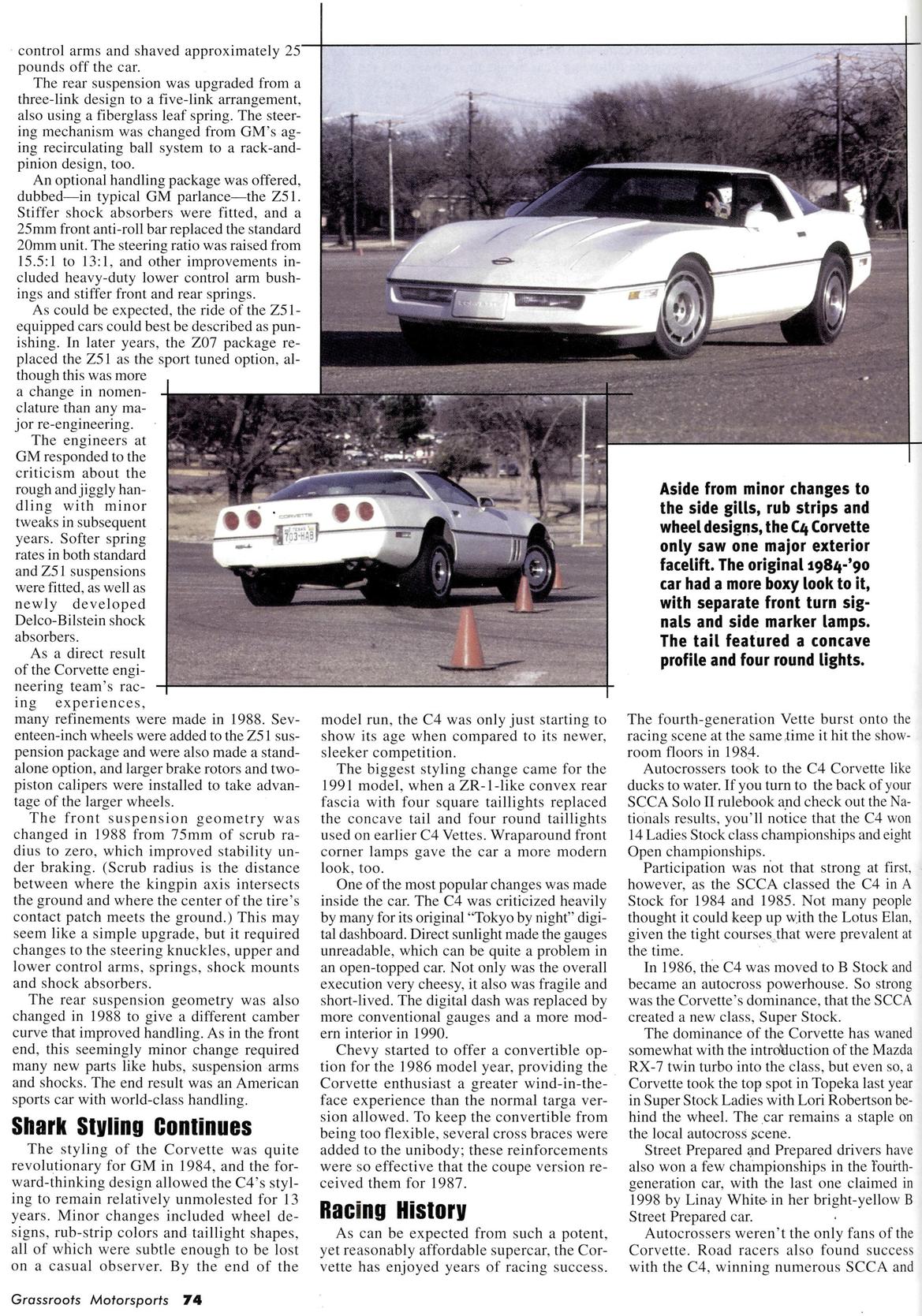
The styling of the Corvette was quite revolutionary for GM in 1984, and the forward-thinking design allowed the C4's styling to remain relatively unmolested for 13 years. Minor changes included wheel designs, rub-strip colors and taillight shapes, all of which were subtle enough to be lost on a casual observer. By the end of the model run, the C4 was only just starting to show its age when compared to its newer, sleeker competition.
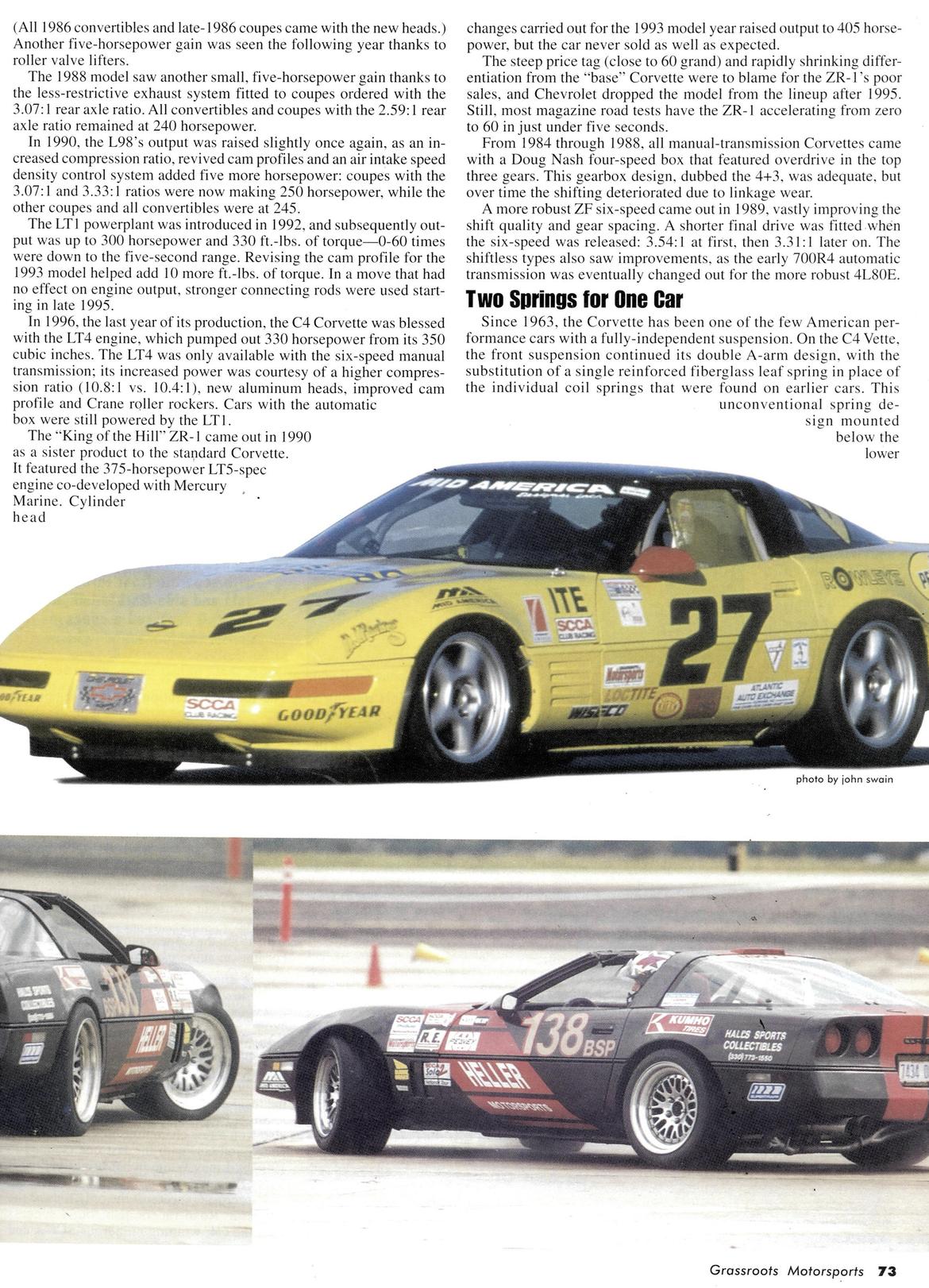
The biggest styling change came for the 1991 model, when a ZR-1-like convex rear fascia with four square taillights replaced the concave tail and four round taillights used on earlier C4 Vettes. Wraparound front corner lamps gave the car a more modern look, too.
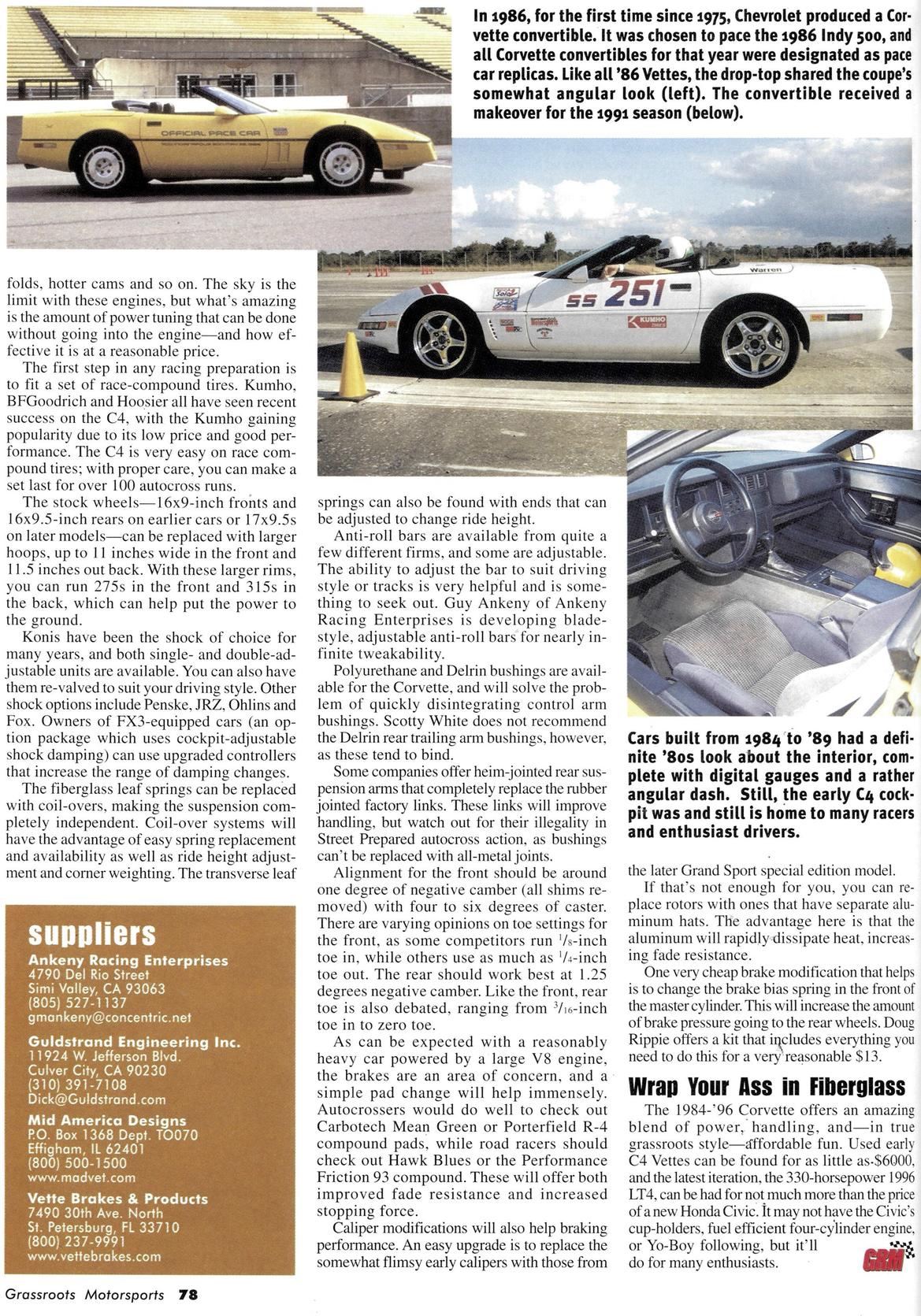
One of the most popular changes was made inside the car. The C4 was criticized heavily by many for its original "Tokyo by night" digital dashboard. Direct sunlight made the gauges unreadable, which can be quite a problem in an open-topped car. Not only was the overall execution very cheesy, it also was fragile and short-lived. The digital dash was replaced by more conventional gauges and a more modern interior in 1990.
Chevy started to offer a convertible option for the 1986 model year, providing the Corvette enthusiast a greater wind-in-the-face experience than the normal targa version allowed. To keep the convertible from being too flexible, several cross braces were added to the unibody; these reinforcements were so effective that the coupe version received them for 1987.
As can be expected from such a potent, yet reasonably affordable supercar, the Corvette has enjoyed years of racing success. The fourth-generation Vette burst onto the racing scene at the same time it hit the showroom floors in 1984.
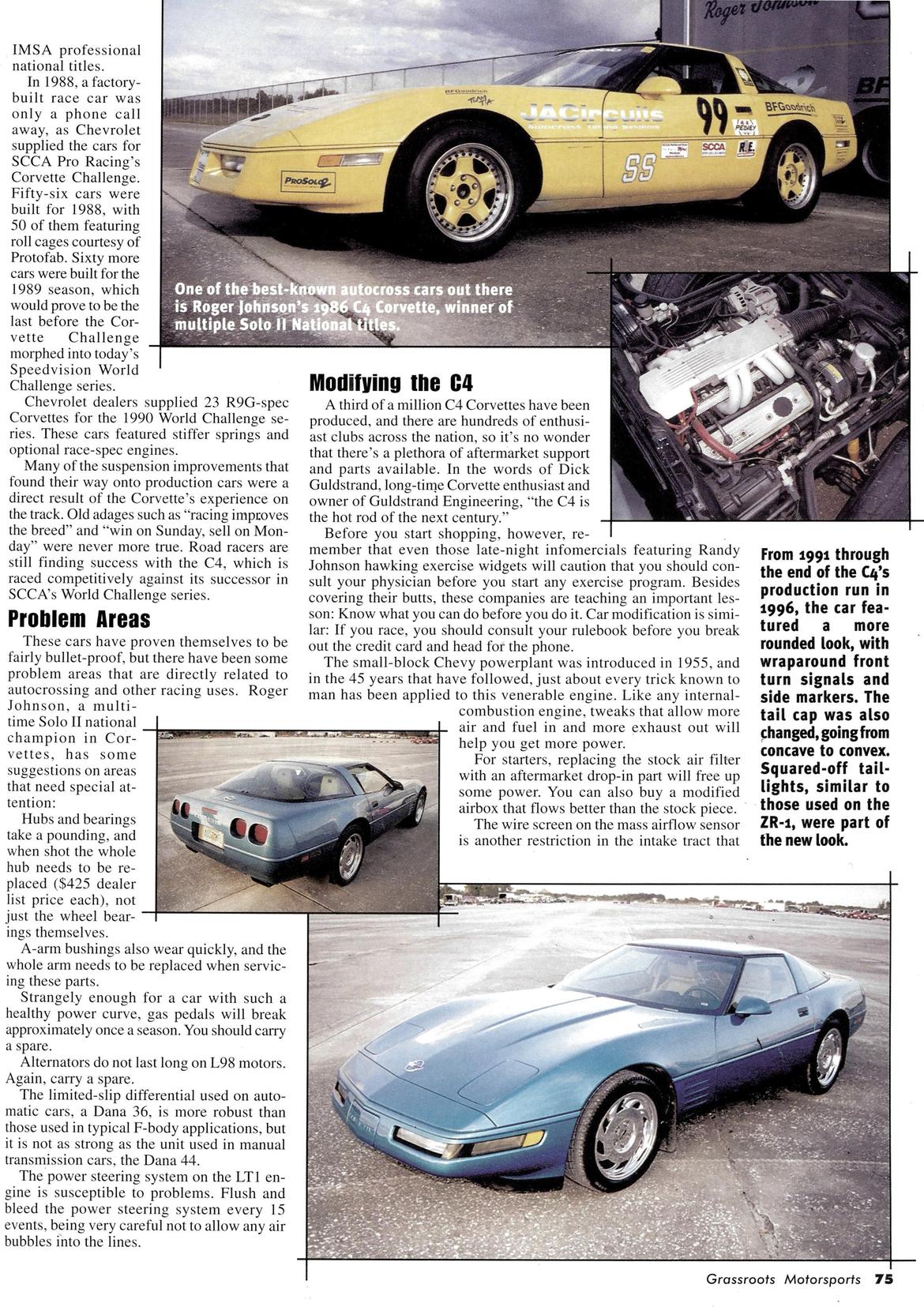
Autocrossers took to the C4 Corvette like ducks to water. If you turn to the back of your SCCA Solo II rulebook and check out the Nationals results, you'll notice that the C4 won 14 Ladies Stock class championships and eight Open championships.
Participation was not that strong at first, however, as the SCCA classed the C4 in A Stock for 1984 and 1985. Not many people thought it could keep up with the Lotus Elan, given the tight courses that were prevalent at the time.
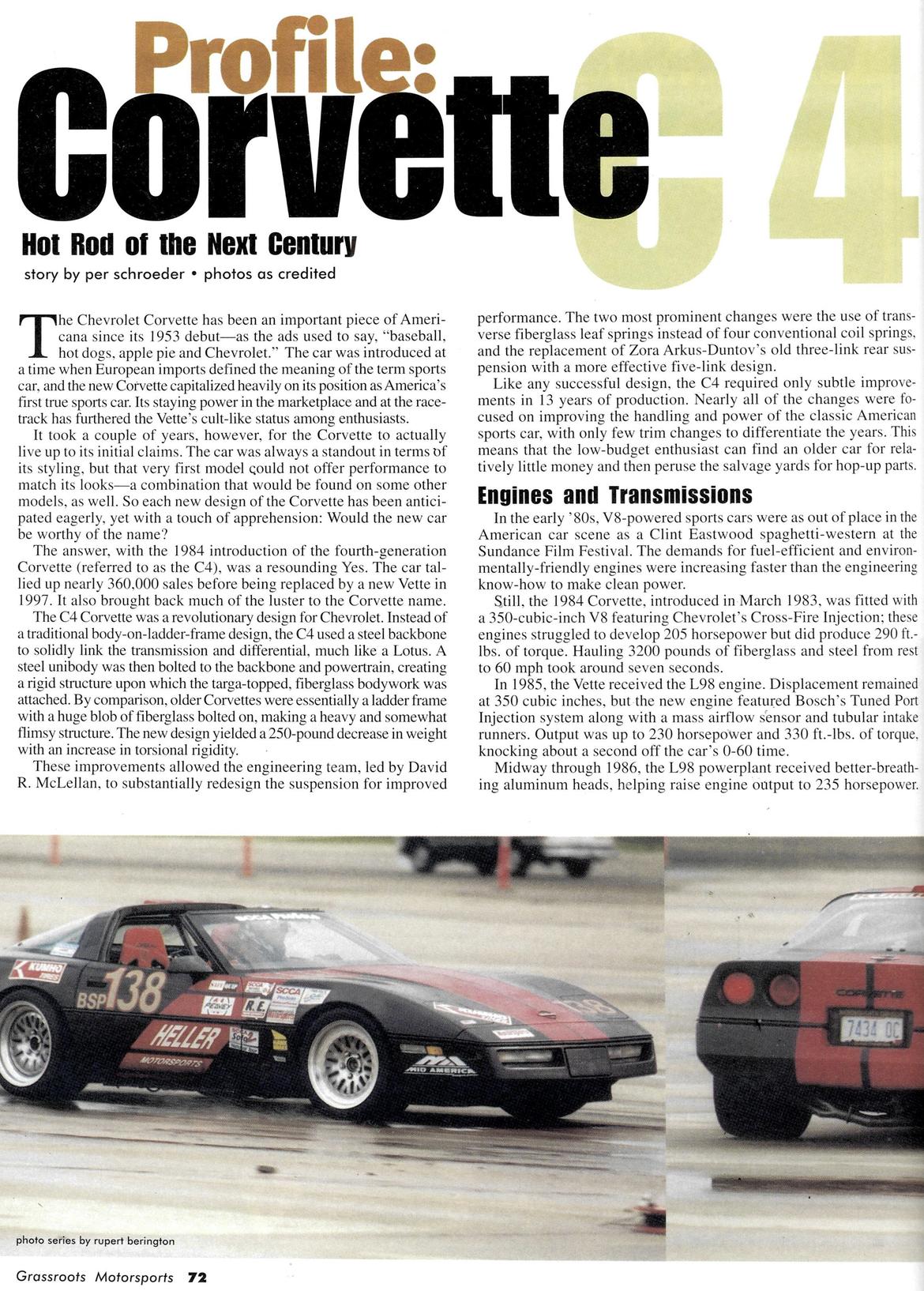
In 1986, the C4 was moved to B Stock and became an autocross powerhouse. So strong was the Corvette's dominance, that the SCCA created a new class, Super Stock.
The dominance of the Corvette has waned somewhat with the introduction of the Mazda RX-7 twin turbo into the class, but even so, a Corvette took the top spot in Topeka last year in Super Stock Ladies with Lori Robertson behind the wheel. The car remains a staple on the local autocross scene.
Street Prepared and Prepared drivers have also won a few championships in the fourth-generation car, with the last one claimed in 1998 by Linay Whito in her bright-yellow B Street Prepared car.
Autocrossers weren't the only fans of the Corvette. Road racers also found success with the C4, winning numerous SCCA and IMSA professional national titles.
In 1988, a factory-built race car was only a phone call away, as Chevrolet supplied the cars for SCCA Pro Racing's Corvette Challenge. Fifty-six cars were built for 1988, with 50 of them featuring roll cages courtesy of Protofab. Sixty more cars were built for the 1989 season, which would prove to be the last before the Corvette Challenge morphed into today's Speedvision World Challenge series.
Chevrolet dealers supplied 23 R9G-spec Corvettes for the 1990 World Challenge series. These cars featured stiffer springs and optional race-spec engines.
Many of the suspension improvements that found their way onto production cars were a direct result of the Corvette's experience on the track. Old adages such as "racing impcoves the breed" and "win on Sunday, sell on Monday" were never more true. Road racers are still finding success with the C4, which is raced competitively against its successor in SCCA's World Challenge series.
These cars have proven themselves to be fairly bullet-proof, but there have been some problem areas that are directly related to autocrossing and other racing uses. Roger Johnson, a multi-time Solo II national champion in Corvettes, has some suggestions on areas that need special attention:
Hubs and bearings take a pounding, and when shot the whole hub needs to be replaced ($425 dealer list price each), not just the wheel bearings themselves.
A-arm bushings also wear quickly, and the whole arm needs to be replaced when servicing these parts.
Strangely enough for a car with such a healthy power curve, gas pedals will break approximately once a season. You should carry a spare.
Alternators do not last long on L98 motors. Again, carry a spare.
The limited-slip differential used on automatic cars, a Dana 36, is more robust than those used in typical F-body applications, but it is not as strong as the unit used in manual transmission cars, the Dana 44.
The power steering system on the LT1 engine is susceptible to problems. Flush and bleed the power steering system every 15 events, being very careful not to allow any air bubbles into the lines.
A third of a million C4 Corvettes have been produced, and there are hundreds of enthusiast clubs across the nation, so it's no wonder that there's a plethora of aftermarket support and parts available. In the words of Dick Guldstrand, long-time Corvette enthusiast and owner of Guldstrand Engineering, "the C4 is the hot rod of the next century."
Before you start shopping, however, remember that even those late-night infomercials featuring Randy Johnson hawking exercise widgets will caution that you should consult your physician before you start any exercise program. Besides covering their butts, these companies are teaching an important lesson: Know what you can do before you do it. Car modification is similar: If you race, you should consult your rulebook before you break out the credit card and head for the phone.
The small-block Chevy powerplant was introduced in 1955, and in the 45 years that have followed, just about every trick known to man has been applied to this venerable engine. Like any internal combustion engine, tweaks that allow more air and fuel in and more exhaust out will help you get more power.
For starters, replacing the stock air filter with an aftermarket drop-in part will free up some power. You can also buy a modified airbox that flows better than the stock piece.
The wire screen on the mass airflow sensor is another restriction in the intake tract that can be removed for more horsepower. Oversized mass airflow sensors, throttle bodies and intake manifolds are also available from just about any Corvette aftermarket tuning firm.
Fuel system components, such as adjustable fuel pressure regulators, high-volume fuel pumps and high-flow fuel injectors are also available, and are even recommended once your modifications progress past the typical exhaust and intake scenario. The stock fuel system components will tend to run out of juice once you hit the happy side of 300 horsepower.
Aftermarket computer chips will increase power as well, with the benefit of improved drivability and part-throttle response. There's even a software package, Diacom, that is available to download data from the GM computer system for analysis on a laptop.
On the exhaust side of things, a good cat-back exhaust system frees up a bit of horsepower. Typical quoted gains are between 20 and 30 horsepower; however, some independent dyno testing of straight pipes from the cat-back has shown only five additional horsepower produced on the L98 at 4800 rpm.
While gains are debatable, exhaust modifications will definitely unleash the great American soundtrack of a well-tuned V8. Systems that are often recommended are those produced by Borla or Flowmaster: Borla has a straight-through muffler design and T-304 stainless steel construction, while Flowmaster offers a more affordable exhaust system that uses their chambered mufflers and aluminized construction.
Short-tube exhaust manifolds are available that retain the stock downpipes and cats, and these are a good improvement for owners looking to keep their cars "green." Long-tube headers can be had in both 4-1 and 4-2-1 configurations, although. most builders tend to prefer the 4-1 design because of its higher peak power levels. However, some companies, such as Belanger Headers, have been doing work with the 4-2-1 for both street and track with good results.
"I think the cheapest, ultimate BSP C4 starts with a '96 LT4 car, as you have to do way less motor work-just headers, intake and valve job," says Corvette racer and autocrosser Scotty White. "The motor is already so good that not much else is needed."
From there, the small-block Chevy can be built up with ported heads, better intake manifolds, hotter cams and so on. The sky is the limit with these engines, but what's amazing is the amount of power tuning that can be done without going into the engine-and how effective it is at a reasonable price.
The first step in any racing preparation is to fit a set of race-compound tires. Kumho, BFGoodrich and Hoo.sier all have seen recent success on the C4, with the Kumho gaining popularity due to its low price and good performance. The C4 is very easy on race compound tires; with proper care, you can make a set last for over 100 autocross runs.
The stock wheels–16x9-inch fronts and I 6x9.5-inch rears on earlier cars or 17x9.5s on later models–can be replaced with larger hoops, up to 11 inches wide in the front and 11.5 inches out back. With these larger rims, you can run 275s in the front and 315s in the back, which can help put the power to the ground.
Konis have been the shock of choice for many years, and both single- and double-adjustable units are available. You can also have them re-valved to suit your driving style. Other shock options include Penske, JRZ, Ohl ins and Fox. Owners of FX3-equipped cars (an option package which uses cockpit-adjustable shock damping) can use upgraded controllers that increase the range of damping changes.
The fiberglass leaf springs can be replaced with coil-overs, making the suspension completely independent. Coil-over systems will have the advantage of easy spring replacement and availability as well as ride height adjustment and corner weighting. The transverse leaf springs can also be found with ends that can be adjusted to change ride height.
Anti-roll bars are available from quite a few different firms, and some are adjustable. The ability to adjust the bar to suit driving style or tracks is very helpful and is something to seek out. Guy Ankeny of Ankeny Racing Enterprises is developing blade-style, adjustable anti-roll bars for nearly infinite tweakability.
Polyurethane and Delrin bushings are available for the Corvette, and will solve the problem of quickly disintegrating control arm bushings. Scotty White does not recommend the Delrin rear trailing arm bushings, however, as these tend to bind.
Some companies offer heim-jointed rear suspension arm that completely replace the rubber jointed factory links. These links will improve handling, but watch out for their illegality in Street Prepared autocross action, as bushings can't be replaced with all-metal joints.
Alignment for the front should be around one degree of negative camber (all shims removed) with four to six degrees of caster. There are varying opinions on toe settings for the front, as some competitors run 1/8-inch toe in, while others use as much as 1/4-inch toe out. The rear should work best at 1.25 degrees negative camber. Like the front, rear toe is also debated, ranging from 3/16-inch toe in to zero toe.
As can be expected with a reasonably heavy car powered by a large V8 engine, the brakes are an area of concern, and a simple pad change will help immensely. Autocrossers would do well to check out Carbotech Mean Green or Porterfield R-4 compound pads, while road racers should check out Hawk Blues or the Performance Friction 93 compound. These will offer both improved fade resistance and increased stopping force.
Caliper modifications will also help braking performance. An easy upgrade is to replace the somewhat flimsy early calipers with those from the later Grand Sport special edition model.
If that's not enough for you, you can replace rotors with ones that have separate aluminum hats. The advantage here is that the aluminum will rapidly-dissipate heat, increasing fade resistance.
One very cheap brake modification that helps is to change the brake bias spring in the front of the master cylinder. This will increase the amount of brake pressure going to the rear wheels. Doug Rippie offers a kit that includes everything you need to do this for a very reasonable $13.
The 1984-'96 Corvette offers an amazing blend of power, handling, and–in true grassroots style–affordable fun. Used early C4 Vettes can be found for as little as $6000, and the latest iteration, the 330-horsepower 1996 LT4, can be had for not much more than the price of a new Honda Civic. It may not have the Civic's cup-holders, fuel efficient four-cylinder engine, or Yo-Boy following, but it'll do for many enthusiasts.

I wish everybody would shut up about C4's. They'll drive the price up before I have a chance to buy one...

In reply to stroker :
If it helps, this article was written back in 2000, so maybe C4s have gotten worse, and perhaps nobody wants them anymore... 

Even with the recent breakdown, I believe you know my feelings on the subject...


Almost every single day, my friends and I send each other a sub-$5k (and usually sub-$3k) C4 Corvette to egg each other on to be the first of our friend group to buy one. They are unbelievably cheap right now. Over the weekend, we missed out on a 1994 with just 80K original miles for $1200. Guy couldn't get it started off the gas tank and didn't want to mess with it. None of us could figure out a trailer/shuffling our stuff around/convince our spouse before it sold. But again, there's one every day, so it's not a huge loss.
We've toyed around with an idea we call the Cheap Corvette Challenge, where we all buy cheap C4's (or late C3's) and do a vacation cruise with them, and maybe hit up a cruise night or two dressed in the "Corvette Uniform" to mess with people and parody weirdo Corvette guys. We were originally supposed to do this when we hit around 40, but I think it's been pushed to 50 now. One of these days....

Tony Sestito said:Almost every single day, my friends and I send each other a sub-$5k (and usually sub-$3k) C4 Corvette to egg each other on to be the first of our friend group to buy one. They are unbelievably cheap right now. Over the weekend, we missed out on a 1994 with just 80K original miles for $1200. Guy couldn't get it started off the gas tank and didn't want to mess with it. None of us could figure out a trailer/shuffling our stuff around/convince our spouse before it sold. But again, there's one every day, so it's not a huge loss.
We've toyed around with an idea we call the Cheap Corvette Challenge, where we all buy cheap C4's (or late C3's) and do a vacation cruise with them, and maybe hit up a cruise night or two dressed in the "Corvette Uniform" to mess with people and parody weirdo Corvette guys. We were originally supposed to do this when we hit around 40, but I think it's been pushed to 50 now. One of these days....
I am IN!
In reply to Tony Sestito :
What is this "uniform" you speak of??

Tony Sestito said:Almost every single day, my friends and I send each other a sub-$5k (and usually sub-$3k) C4 Corvette to egg each other on to be the first of our friend group to buy one. They are unbelievably cheap right now. Over the weekend, we missed out on a 1994 with just 80K original miles for $1200. Guy couldn't get it started off the gas tank and didn't want to mess with it. None of us could figure out a trailer/shuffling our stuff around/convince our spouse before it sold. But again, there's one every day, so it's not a huge loss.
We've toyed around with an idea we call the Cheap Corvette Challenge, where we all buy cheap C4's (or late C3's) and do a vacation cruise with them, and maybe hit up a cruise night or two dressed in the "Corvette Uniform" to mess with people and parody weirdo Corvette guys. We were originally supposed to do this when we hit around 40, but I think it's been pushed to 50 now. One of these days....
Whoa, really? That's giving me bad ideas.
Can I assume people have figured out LS swaps, big brakes, and how to cure any handling woes?

They handle and stop pretty good out of the box. 1988+ cars are better. The J55 brakes or C5 calipers are an easy upgrade. They're just small block Chevys with a fancy wrapper so parts are easy and LS swaps are out there.

I still think they are the best looking Corvette. (dodges shoe)
I don't know if it's just that they were the Corvette when I was growing up or what, but they just seem to have a presence and exotic style that the ones that came after never had. The rear tires always looked so wide to me too, like wider than a C5. When I think of Corvette, it's still the car that comes to mind.
I haven't heard the driving experience is great, so I've never really longed for one.

Having raced, AXed and track dayed C-4's for about 25 years and having read the article, I did notice an omission.
The LT1 and LT4 were notorious for the infamous "Opti=spark" (OS) distributor. Failures were common and the part was a challenge to replace. Thus some aftermarket parts came along to help. I'm lucky I have small hands because the wiring on these was quite challenging.
The "Opti-spark" was located just below the water pump and any leakage migrated into the OS an caused problems.
If I remember right this was a time when GM had a cost cutting parts person that came from VW. He soon departed. lol
Displaying 1-10 of 24 commentsView all comments on the GRM forums
You'll need to log in to post.